
Aug 23, 2026Technical Insights
5050 Packaged VCSEL Lasers: Specifications and Application Guide
Learn how to evaluate 5050 VCSEL packages by wavelength, drive current, optical output, beam angle, thermal path, SMT process, and use case.
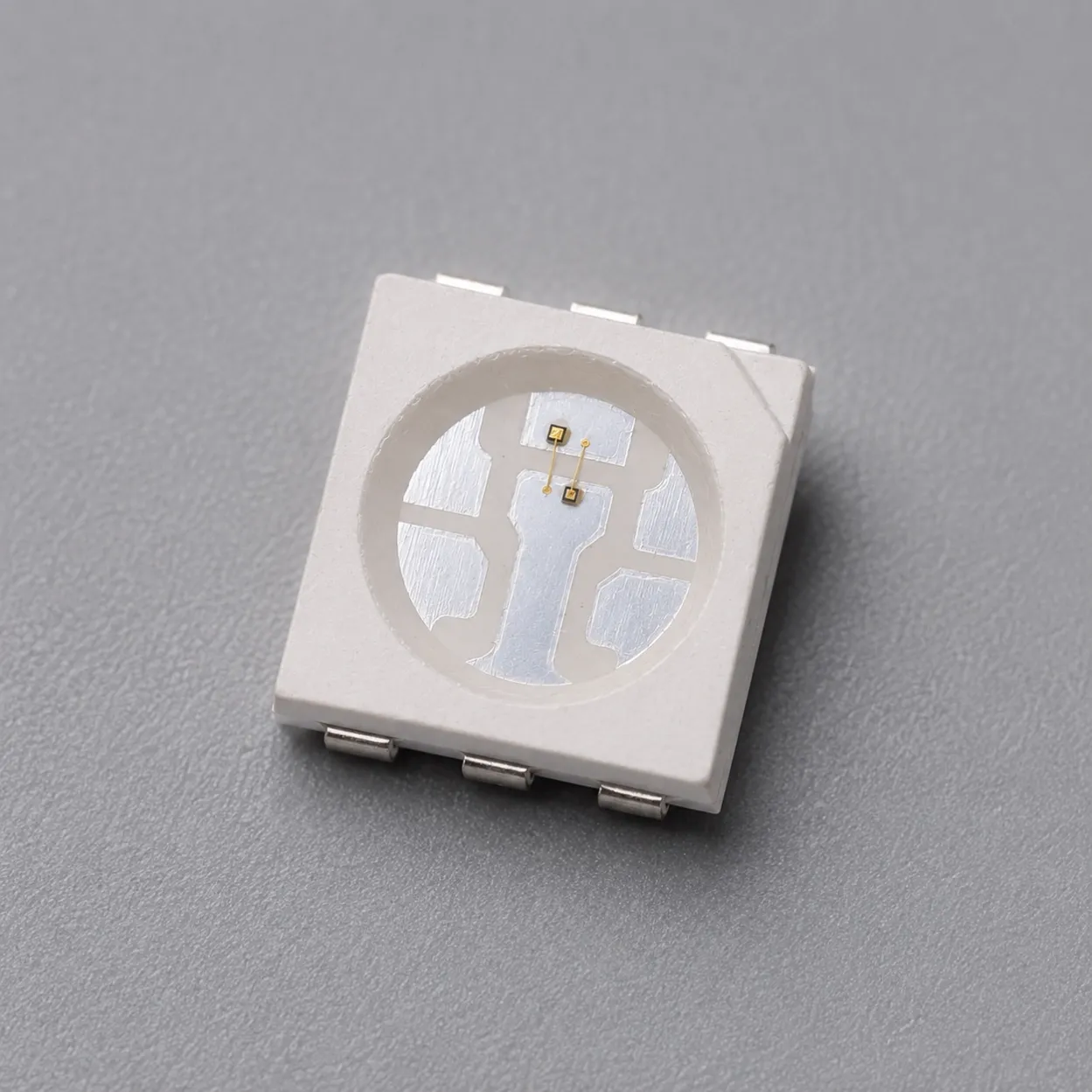
A 5050 packaged VCSEL laser is a vertical-cavity surface-emitting laser built in a 5050 SMD package format.
This type of device typically uses a package measuring approximately 5.0 × 5.0 mm. It supports automated SMT placement and can be installed on conventional PCB lighting boards and optical modules.
With a concentrated beam, narrow optical spectrum, fast modulation response, and the ability to integrate multiple wavelengths, the 5050 VCSEL package is used in infrared sensing, security illumination, 3D sensing, time-of-flight ranging, medical beauty equipment, and personal care devices.
It is important to understand that 5050 mainly describes the package outline. It does not mean that every product has the same wavelength, voltage, current, optical power, beam divergence, carrier material, or number of VCSEL dies.
All numerical values in this guide should be treated as representative product specifications. Final selection should always be based on the specifications of the actual product model.
What Is a 5050 Packaged VCSEL?
VCSEL stands for Vertical-Cavity Surface-Emitting Laser.
Unlike an edge-emitting laser, which emits light through the side of the chip, a VCSEL emits laser light vertically from the chip surface.
A 5050 package places the VCSEL chip inside an SMD carrier measuring approximately 5.0 × 5.0 mm. This allows the device to be mounted on PCB lighting boards or integrated into compact optical modules.
Representative package dimensions include:
Item | Representative Specification |
|---|---|
Length | Approximately 5.0 mm |
Width | Approximately 5.0 mm |
Height | Approximately 1.6 mm |
Mounting method | SMD |
Assembly process | Compatible with automated SMT placement |
The VCSEL chip and electrode structure can usually be seen in the center of the package.
Different products may use different numbers of chips, wavelengths, carrier materials, and electrode layouts. The exact specification cannot be determined from appearance alone.
Common Carrier Materials for 5050 VCSEL Packages
A 5050 packaged VCSEL can commonly use a PCT carrier or an aluminum nitride ceramic carrier.
PCT Carrier
PCT is a common carrier material used in 5050 optoelectronic packages.
A PCT carrier supports a standard SMD package structure. It can be used for a single-wavelength VCSEL or a multi-wavelength VCSEL combination.
A 5050 VCSEL using a PCT carrier can be installed on conventional PCB lighting boards and optical modules, making it suitable for automated placement and volume assembly.
Aluminum Nitride Ceramic Carrier
A 5050 VCSEL package can also use an aluminum nitride ceramic carrier.
An aluminum nitride ceramic carrier can be used in 5050 VCSEL products with different chip quantities, wavelength combinations, and power requirements.
The choice between a PCT carrier and an aluminum nitride ceramic carrier should be based on the product design and project requirements.
Single-Wavelength 5050 VCSEL
A single-wavelength 5050 VCSEL integrates one VCSEL wavelength inside one 5050 package.
Common single-wavelength options include:
- 850 nm
- 940 nm
- 650 nm
- 660 nm
- 1064 nm
A single-wavelength package is suitable for equipment that requires only one red or infrared wavelength.
For example, an 850 nm VCSEL can be used for security night-vision illumination. A 940 nm VCSEL can be used for 3D sensing and facial recognition. A 650 nm or 660 nm VCSEL can be used in medical beauty and personal care devices.
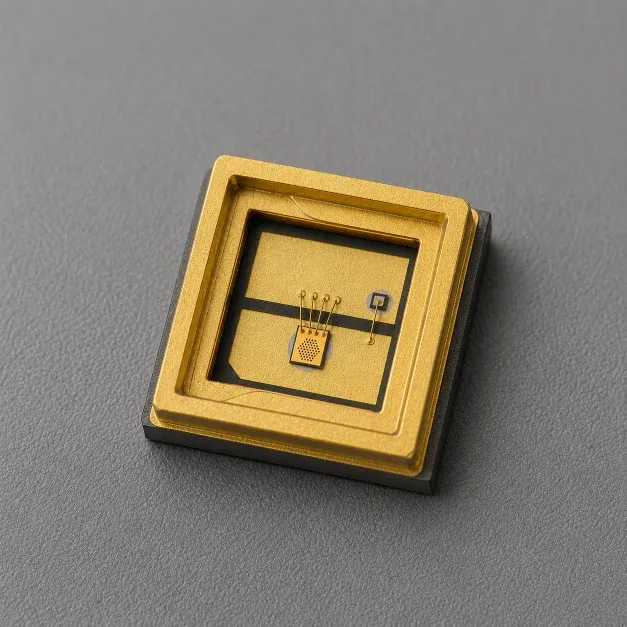
Why Is the 5050 Package Suitable for Multiple Wavelengths?
In addition to a single VCSEL wavelength, the 5050 package is suitable for multi-wavelength combinations.
Depending on the product requirement, one 5050 package can commonly integrate:
- Two wavelengths
- Three wavelengths
- Up to four wavelengths
This makes the 5050 package particularly suitable for equipment that requires mixed-wavelength output.
A multi-wavelength design can combine different red or near-infrared wavelengths inside one package. It reduces the space required for several separate light sources and simplifies their arrangement on the same PCB lighting board.
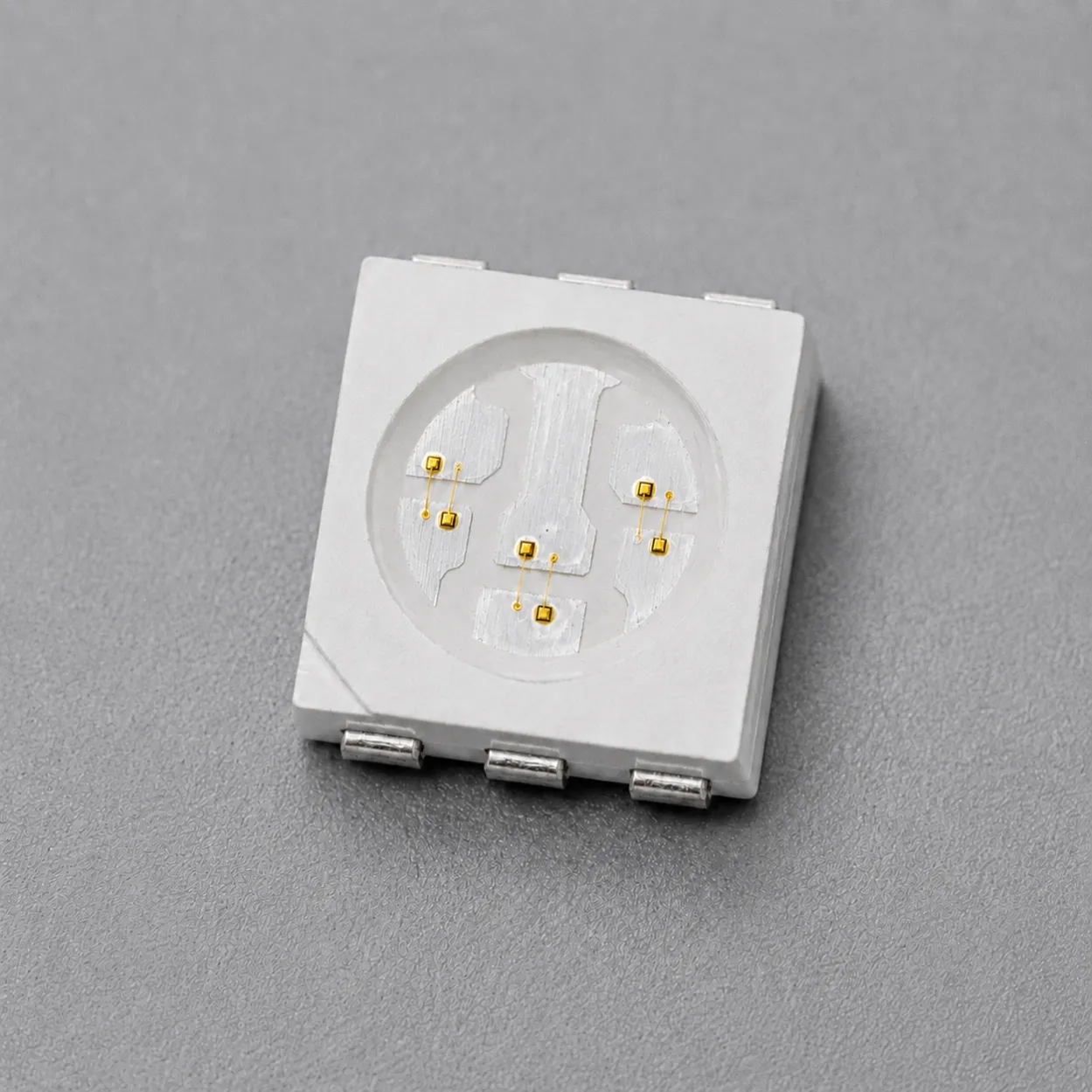
Three-Wavelength 5050 VCSEL with PCT Carrier
A three-wavelength 5050 VCSEL can integrate three different wavelengths inside one PCT carrier.
This design is suitable for medical beauty equipment, personal care devices, and custom optical modules that require three light-source wavelengths.
The exact wavelength combination should be selected according to the product requirement.
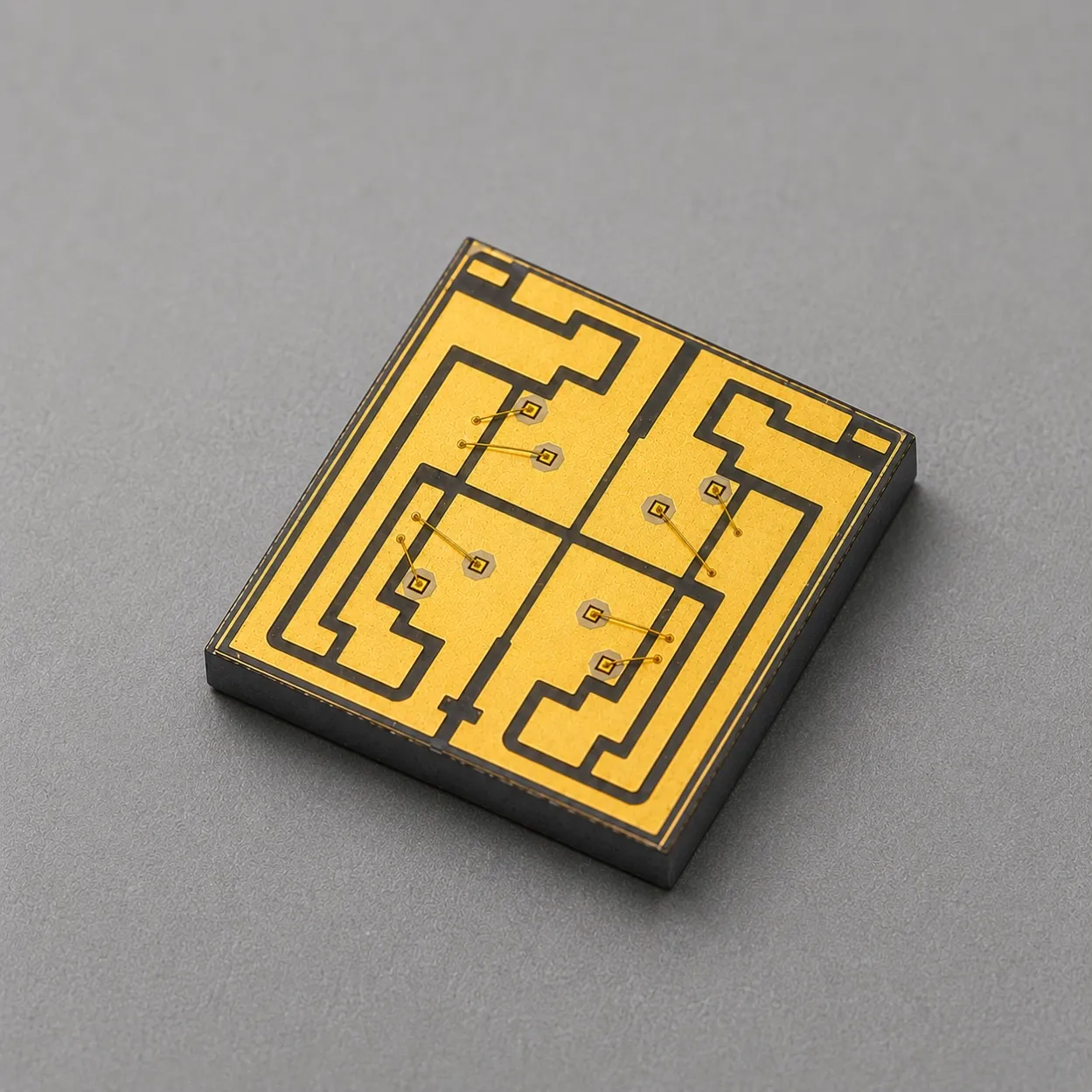
Four-Wavelength 5050 VCSEL with Aluminum Nitride Ceramic Carrier
A 5050 package can integrate up to four wavelengths.
A four-wavelength design can use an aluminum nitride ceramic carrier to combine four different wavelengths in one 5050 package.
This package format is suitable for products that require mixed output from several red and near-infrared wavelengths.
How Is a 5050 VCSEL Different from a Conventional 5050 LED?
A VCSEL and an LED can both use a 5050 SMD outline, but their light-generation principles are different.
A VCSEL is a laser source that produces light through stimulated emission. A conventional LED produces light mainly through spontaneous emission.
Comparison | 5050 Packaged VCSEL | Conventional 5050 LED |
|---|---|---|
Light-generation principle | Stimulated emission | Spontaneous emission |
Beam characteristics | More concentrated beam | Usually wider emission |
Spectrum | Narrower spectrum | Usually broader spectrum |
Modulation response | Fast response | Depends on the LED product |
Common applications | Sensing, ranging, infrared illumination, 3D sensing | Lighting, indication, general illumination |
A representative 5050 VCSEL beam divergence is approximately 15–22°.
A smaller divergence angle allows the optical output to remain more concentrated. Under similar power and operating conditions, this concentrated beam helps deliver more optical energy to the target area.
The actual transmission distance still depends on the specific VCSEL product and the complete system design.
Core Technical Features of a 5050 VCSEL
Concentrated Beam
Representative 5050 VCSEL products may have a beam divergence of approximately 15–22°.
Compared with a conventional LED that has a wider emission angle, a VCSEL produces a more concentrated beam. This makes it suitable for directional illumination, short-range sensing, and distance-measurement applications.
Narrow Optical Spectrum
A representative VCSEL product may have a spectral width of approximately 4 nm.
A narrow spectrum can work with a corresponding optical filter and receiver, helping reduce the effect of unwanted ambient light in a sensing system.
Fast Modulation Response
A VCSEL supports fast modulation and can be used with high-frequency drive signals.
This characteristic makes it suitable for:
- Time-of-flight ranging
- 3D sensing
- Facial recognition
- Dynamic distance detection
- Industrial sensing
Multiple Wavelengths in One Package
A 5050 package can integrate a single wavelength, two wavelengths, three wavelengths, or up to four wavelengths.
For devices that need a combination of red and near-infrared wavelengths, a multi-wavelength 5050 VCSEL provides a more compact light-source solution.
Representative 5050 VCSEL Specifications
The values in the following table are representative product specifications. They should not be understood as universal specifications for every 5050 VCSEL.
Parameter | Representative Product Specification |
|---|---|
Package dimensions | 5.0 × 5.0 × 1.6 mm |
Common wavelengths | 850 nm and 940 nm |
Other wavelength options | 650 nm, 660 nm, and 1064 nm |
Wavelength tolerance | Approximately ±10 nm |
Forward voltage | Approximately 1.7–2.3 V |
Low-power operating current | Approximately 6–20 mA |
High-power operating current | Approximately 100–500 mA |
Beam divergence | Approximately 15–22° |
Low-power optical output | Approximately 5–9 mW |
High-power optical output | Approximately 0.2–1 W |
Spectral width | Approximately 4 nm |
Wavelength quantity | Single, dual, triple, or up to four wavelengths |
Different wavelengths, chip quantities, and package designs may have different electrical and optical specifications.
When comparing optical power, it is also necessary to confirm whether the value refers to one VCSEL chip, the combined output of several chips, or a representative output under a particular operating condition.
Common 5050 VCSEL Wavelengths
850 nm
An 850 nm VCSEL is commonly used in security monitoring and night-vision illumination.
It can support infrared imaging and illumination in dark environments. Because the VCSEL beam is relatively concentrated, it can direct infrared light toward the intended target area.
Representative applications include:
- Security cameras
- Night-vision monitoring
- Infrared illumination devices
- Industrial infrared inspection
940 nm
A 940 nm VCSEL is commonly used in infrared devices that require lower visible perception.
It is one of the common wavelengths used in 3D sensing, facial recognition, facial access-control equipment, payment terminals, and time-of-flight ranging.
Representative applications include:
- 3D sensing
- Facial recognition
- Facial access control
- Payment terminals
- Time-of-flight ranging
650 nm and 660 nm
650 nm and 660 nm are red-light wavelengths.
These wavelengths can be used in medical beauty equipment, personal care devices, hair-growth devices, and related red-light products.
In a multi-wavelength 5050 package, 650 nm and 660 nm can also be combined with other wavelengths.
1064 nm
A 5050 package can also use a 1064 nm VCSEL according to project requirements.
The wavelength should be selected according to the target equipment and intended application.
Security Monitoring and Night-Vision Illumination
A 5050 VCSEL can be used as an infrared light source for security monitoring and night-vision illumination.
850 nm is a common wavelength for surveillance night vision. Its concentrated beam can illuminate the target area in front of a camera.
Representative applications include:
- Indoor surveillance cameras
- Outdoor night-vision cameras
- Entrance monitoring devices
- Infrared illumination modules
The appropriate optical power and divergence should be selected according to the required illumination distance, coverage area, and camera requirements.
Explore
3D Sensing and Facial Recognition
A 940 nm VCSEL can be used in 3D sensing, facial recognition, and related infrared sensing equipment.
Because a VCSEL has a fast modulation response, it is suitable for structured-light and time-of-flight applications.
Representative applications include:
- Smartphone facial recognition
- Facial access-control systems
- Payment terminals
- 3D structured light
- Time-of-flight distance measurement
The 5050 SMD package can be mounted on a PCB and integrated with the control and receiving sections of the complete module.
Medical Beauty and Personal Care Devices
650 nm and 660 nm red VCSELs can be used in hair-growth devices, therapy-related equipment, photonic facial masks, and personal care devices.
Infrared wavelengths can also be used in infrared therapy-related and skin-detection equipment.
The 5050 package is suitable for regular arrangement on a PCB lighting board and is also suitable for mixed-wavelength designs.
One 5050 package can integrate two wavelengths, three wavelengths, or up to four wavelengths. This makes it suitable for products that combine several red and near-infrared wavelengths.
Representative applications include:
- Hair-growth devices
- Photonic facial masks
- Therapy-related equipment
- Personal care devices
- Skin-detection equipment
- Multi-wavelength optical modules
Industrial Sensing and Time-of-Flight Ranging
The fast modulation capability of a VCSEL makes it suitable for industrial sensing and time-of-flight ranging.
Representative applications include:
- Robot-vacuum obstacle detection
- Industrial distance measurement
- Automated equipment sensing
- Short-range detection
- Machine-vision illumination
Depending on the equipment requirement, an 850 nm or 940 nm VCSEL can be selected. A low-power or high-power 5050 VCSEL can also be chosen according to the required output.
High-Power 5050 VCSEL Applications
Representative high-power 5050 VCSEL products may provide approximately 0.2–1 W of optical output and operate at approximately 100–500 mA.
These products can be used in:
- High-power infrared illumination
- Industrial inspection
- Longer-range sensing
- Machine vision
- Infrared optical modules
- Custom VCSEL light sources
The actual optical power, current, wavelength, and carrier material should be confirmed according to the selected product model and project requirements.
How to Select a 5050 Packaged VCSEL
The following factors should be confirmed when selecting a 5050 VCSEL.
Wavelength
Confirm whether the equipment requires 850 nm, 940 nm, 650 nm, 660 nm, 1064 nm, or another wavelength.
Number of Wavelengths
Confirm whether the project requires:
- One wavelength
- Two wavelengths
- Three wavelengths
- Four wavelengths
For mixed-wavelength output, a 5050 package can reduce the PCB space required by several separately packaged light sources.
Optical Power
A representative low-power range is approximately 5–9 mW.
A representative high-power range is approximately 0.2–1 W.
The project should also confirm whether the value refers to one VCSEL chip or the total output from several chips inside the package.
Operating Current
A representative low-power operating-current range is approximately 6–20 mA.
A representative high-power operating-current range is approximately 100–500 mA.
The actual drive current should follow the specification of the selected product.
Beam Divergence
A representative beam-divergence range is approximately 15–22°.
The actual angle may vary between products, so it should be selected according to the required illumination area and operating distance.
Carrier Material
Select a PCT carrier or an aluminum nitride ceramic carrier according to the product design.
What Information Should Be Sent to a Supplier?
To match the project with a suitable 5050 VCSEL product, provide the following information:
- Target wavelength
- Single-wavelength or multi-wavelength requirement
- Two, three, or four wavelengths
- Target optical power
- Operating current
- Beam divergence
- PCT or aluminum nitride ceramic carrier
- Target equipment
- Working distance
- Sample quantity
- Estimated purchasing quantity
For a special wavelength, multi-wavelength combination, or custom package, use Submit Custom Development & ODM.
Frequently Asked Questions
What Are the Representative Dimensions of a 5050 VCSEL?
Representative dimensions are approximately 5.0 × 5.0 × 1.6 mm. The actual dimensions should be confirmed for the selected model.
How Many Wavelengths Can a 5050 VCSEL Package Integrate?
A 5050 package can use one wavelength or integrate two wavelengths, three wavelengths, or up to four wavelengths.
What Are the Common Wavelengths?
Common wavelengths include 850 nm and 940 nm. Other options include 650 nm, 660 nm, and 1064 nm.
Can Both PCT and Aluminum Nitride Ceramic Carriers Be Used?
Yes. The carrier material should be selected according to the product design and project requirements.
Can a 5050 VCSEL Directly Replace a Conventional 5050 LED?
It should not be replaced based on package appearance alone. A VCSEL and an LED have different emission principles, beam characteristics, spectra, drive requirements, and applications.
Can a 5050 VCSEL Be Used for Time-of-Flight Ranging?
Yes. The fast modulation response of a VCSEL makes it suitable for time-of-flight ranging and dynamic sensing.
What Is the Representative Optical Power?
Representative low-power products may provide approximately 5–9 mW. Representative high-power products may provide approximately 0.2–1 W. The actual specification depends on the selected model.
Application Value of the 5050 VCSEL Package
A 5050 package combines a VCSEL laser source with a standard SMD format, making it convenient for installation on PCB lighting boards and integration into optical modules.
It can package a single 850 nm, 940 nm, 650 nm, 660 nm, or 1064 nm VCSEL. It can also integrate two wavelengths, three wavelengths, or up to four wavelengths.
PCT carriers and aluminum nitride ceramic carriers provide options for different 5050 package designs.
In security illumination, 3D sensing, facial recognition, time-of-flight ranging, industrial sensing, medical beauty equipment, and personal care devices, a 5050 VCSEL can be selected according to wavelength, optical power, divergence, and the number of integrated wavelengths.
The specifications in this guide should be treated as representative product parameters. Final selection should always be confirmed against the actual VCSEL model.