
Aug 23, 2026Technical Insights
What Is a VCSEL and Why Its Structure Matters
What is a VCSEL? A surface-emitting semiconductor laser whose structure enables wafer-level testing, binning, arrays, and a symmetric beam.
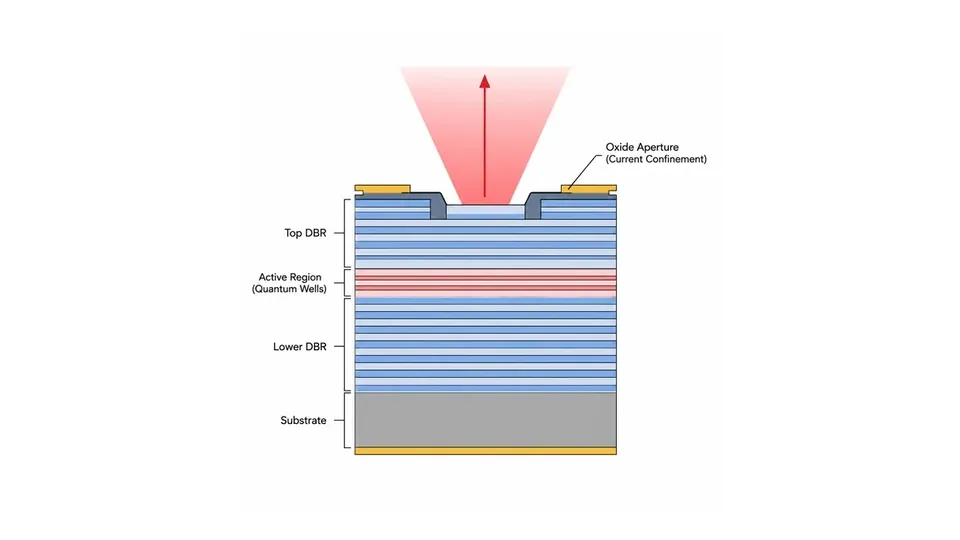
A VCSEL, or vertical-cavity surface-emitting laser, is a semiconductor laser that emits perpendicular to the wafer surface rather than through a cleaved edge. Its surface-emitting architecture lets a processed device be characterized on the wafer before dicing, which supports earlier screening and production binning before packaging.
1ONEVCSEL, the VCSEL product line of 1ONELASER, supplies single emitters and arrays in selected configurations including bare die, SMD packages, and COB assemblies, across 650–1064 nm, for OEM device developers. Whether a VCSEL is the right source depends on the wavelength, spectrum, beam, optical power, drive mode, and thermal requirements of the system, not on the laser category by itself.
How a VCSEL emits light
A VCSEL is built as a vertical stack. An active region containing quantum wells sits between two mirrors called distributed Bragg reflectors, or DBRs, each made of many thin semiconductor layers. In a common oxide-confined VCSEL design, current is confined through a small aperture so it flows through a defined part of the active region. The light emerges from that aperture region rather than from the entire chip surface, and the optical field builds up within the cavity and exits through the partially transmitting top DBR.
The optical cavity is much shorter than the cavity in a typical edge-emitting laser. A short cavity increases the longitudinal-mode spacing, so fewer cavity modes fall within the material gain bandwidth. Together with the wavelength-selective reflectivity of the DBRs, this limits the longitudinal modes available for lasing and supports a comparatively narrow optical spectrum. The actual peak wavelength still shifts with junction temperature and drive current.
The semiconductor layer stack, including the DBRs and active region, is grown epitaxially before wafer-level device processing begins. Because a device can be characterized before it is separated from the wafer, relevant electrical and optical variations, along with off-spec devices, can be identified before packaging adds further cost.
Why the vertical structure changes what you can build
Emitting from the surface instead of the edge has several practical consequences for optical design and manufacturing.
- The output is more symmetric. Many edge-emitting lasers produce a strongly elliptical and astigmatic beam that requires additional correction. A VCSEL typically produces a more symmetric output beam that is easier to couple or shape, which can reduce the beam-shaping optics a design needs. Actual divergence and far-field profile still depend on aperture size, transverse mode, array layout, and drive current. Multimode devices may exhibit ring-shaped or multi-lobed far-field distributions rather than a single Gaussian-like profile.
- The chip can be measured on the wafer. A processed VCSEL can be characterized electrically and optically before the wafer is diced, so electrically or optically off-spec dies can be identified before additional processing and packaging costs are incurred. For an edge-emitting laser, final optical output testing generally follows cleaving, once the output facet exists. Early testing then supports removing off-spec devices and binning the rest against defined production limits, which is central to controlling VCSEL variation in production.
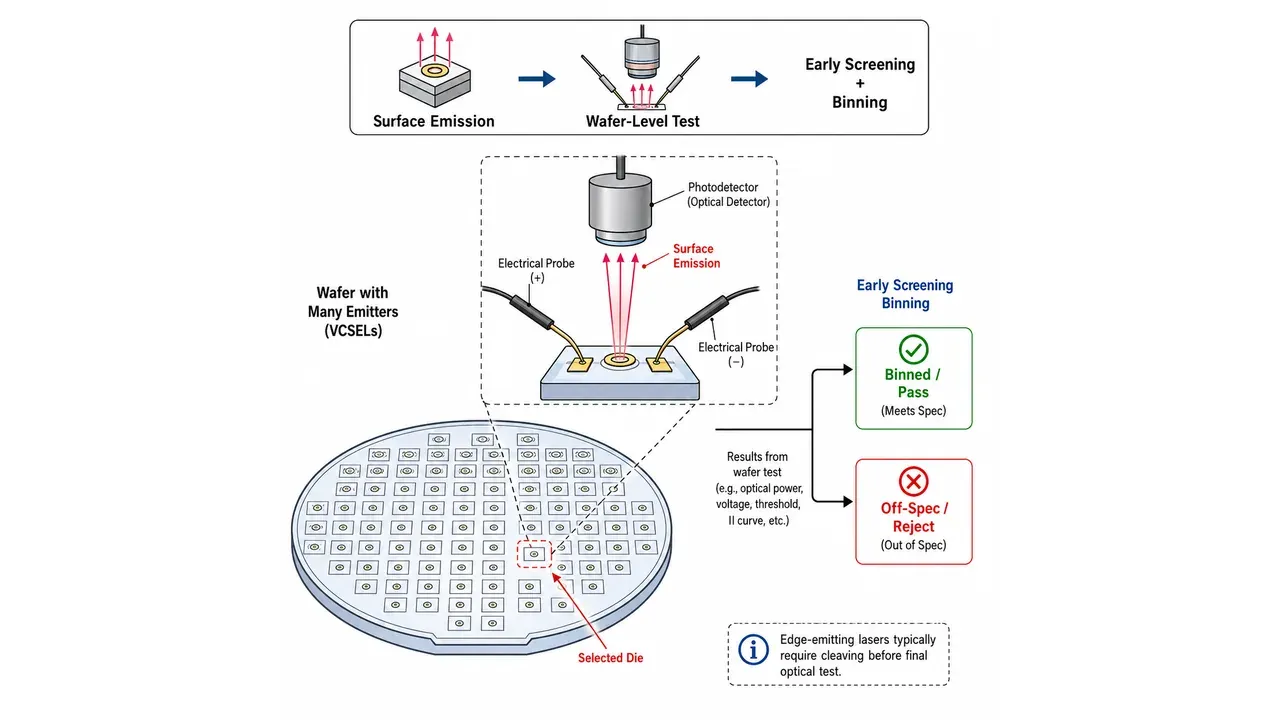
- Emitters combine into arrays. Because individual emitters are compact and aligned along the surface-normal direction, hundreds or thousands can be integrated on one chip. Higher total output can be obtained by combining many emitters rather than increasing the current density of a single aperture alone. This does not scale without limit: thermal resistance, current distribution, and emitter uniformity increasingly limit usable output as array size and emitter count increase.
VCSELs are also less prone to facet-related catastrophic optical damage than edge-emitting lasers, because the light leaves over a surface aperture rather than a concentrated cleaved facet. The architecture reduces an important facet-related limitation, but device reliability still depends on electrical stress, junction temperature, ESD protection, and package design.
Single emitters, arrays, and how much power you get
Optical output power has to be read differently for single emitters and for multi-emitter arrays, and confusing the two leads to the wrong part.
Many conventional single-emitter VCSELs deliver optical power in the milliwatt range, though the exact output depends on wavelength, aperture size, transverse-mode requirements, and operating conditions. Specialized device designs may exceed this range, depending on aperture size and modal requirements. Even so, a single emitter generally provides less optical power than most high-power illumination applications require.
Arrays change the scale. Depending on array size, cooling, and drive mode, a VCSEL array can reach watt-level continuous-wave output or substantially higher peak power under pulsed or quasi-continuous-wave (QCW) drive, provided peak current, pulse width, duty cycle, and junction temperature stay within the device limits. The 1ONEVCSEL portfolio spans milliwatt-class single emitters and higher-power multi-emitter arrays; the rated optical output must be read together with the specified CW, QCW, or pulsed operating conditions. The specification that matters is not the headline power on its own, but whether it is quoted per emitter or for the full array, and under what drive current, duty cycle, junction temperature, and cooling or mounting condition. Peak optical power measured under short-pulse conditions must not be interpreted as continuous-wave output capability.
Where device makers use VCSELs
VCSELs first reached high volume in short-reach optical links, and then in the 3D sensing and proximity modules inside smartphones. Other established uses include optical interconnects and structured-light illumination. The same properties also matter in applications where spectral control, beam symmetry, and part-to-part repeatability are more important than maximum modulation bandwidth.
Device developers now build VCSELs into red and near-infrared illumination modules for skin and scalp applications, into wearable photoplethysmography (PPG) modules used for heart rate and pulse oximetry measurements, and into compact atomic clocks and magnetometers, where the emission frequency has to be tuned and stabilized relative to a specific atomic transition. Atomic sensing applications may also require a defined polarization state, because some VCSELs exhibit polarization switching as current or temperature changes.
What engineers compare when choosing a VCSEL
Once a VCSEL is on the table, the choice usually comes down to a set of parameters: wavelength and spectral width; optical output and operating mode; threshold current, operating voltage, and slope efficiency; divergence and beam profile; aperture size or emitter count; temperature drift; polarization; package format and pin configuration; and thermal resistance. Separate guides in this series cover datasheet interpretation, linewidth and SMSR requirements for single-mode applications, and power selection by application.
High-power designs add one constraint that is easy to underestimate: thermal management. Optical output, efficiency, wavelength, threshold current, and emitter uniformity all change with junction temperature, so datasheet values should be compared only under clearly defined thermal, mounting, and heat-sink conditions.
Is a VCSEL always the right source?
No. A VCSEL fits well when a design needs a narrow and controllable spectrum, a comparatively symmetric beam, and devices that can be screened and binned to defined production limits. It is not the default answer for every device.
If a device only needs broad, uncollimated light and does not care about exact wavelength, an LED may be simpler and cheaper. If it needs high optical power from a single emitting aperture, an edge-emitting laser or another structure may fit better. Precision timing and sensing often turn on whether the source is single-mode or multimode and on how the wavelength holds with temperature. Like any laser diode, a VCSEL also needs proper ESD handling, current control, and thermal protection during assembly and operation.
VCSEL structure defines a useful set of capabilities. It does not, on its own, decide that a VCSEL is right for you: that still depends on the full optical, electrical, thermal, and packaging requirements of the system.
About 1ONEVCSEL
1ONEVCSEL is the VCSEL product line of 1ONELASER. It supplies VCSEL components rather than finished end devices. The 1ONEVCSEL product range covers single emitters and arrays in selected configurations including bare die, SMD packages, and COB assemblies, and custom package and pin configurations are available for OEM projects.
Design teams usually settle the questions above by evaluating a small batch before committing to tooling. Engineering samples and small evaluation batches are available so a team can verify wavelength, optical output power, electrical behavior, and package and assembly compatibility at that stage. Quality-system certificates and product-specific material-compliance documentation are available subject to the manufacturing site and part number, and the device manufacturer remains responsible for deciding which component records and end-product certifications apply in the target market.
To point a team at suitable evaluation parts, the useful starting information is the target wavelength, CW, QCW, or pulsed operation, required optical output power, required beam profile, divergence, and coupling geometry, package format, operating temperature range, development stage, prototype quantity, and expected annual volume. These parameters are usually sufficient to identify a short list of suitable evaluation parts.
Frequently asked questions
What does VCSEL stand for?
VCSEL stands for vertical-cavity surface-emitting laser. The name refers to an optical cavity oriented perpendicular to the wafer plane, with light emitted through the chip surface rather than a cleaved edge.
Is a VCSEL a laser diode?
Yes. A VCSEL is a type of semiconductor laser diode. What sets it apart is that the optical cavity is perpendicular to the wafer surface and the beam exits through the top or bottom surface of the chip, depending on the device design, rather than from a cleaved edge.
How is a VCSEL different from an edge-emitting laser?
A VCSEL differs from an edge-emitting laser mainly in cavity orientation and emission direction: an edge-emitting laser sends its beam sideways out of a cleaved facet, while a VCSEL emits perpendicular to the wafer surface. This affects beam shape, wafer-level testability, array integration, and the way production devices are screened and binned.
How is a VCSEL different from an LED?
A VCSEL is a laser and an LED is not: a VCSEL operates above a lasing threshold through stimulated emission, while an LED produces light by spontaneous emission. As a result a VCSEL is typically narrower in spectrum, more directional, and faster to modulate. The choice depends on whether the system requires narrow spectral output, directional emission, and high modulation speed, or whether broad-area incoherent illumination is sufficient.
What wavelengths do VCSELs come in?
Commercial VCSELs are available at selected visible and near-infrared wavelengths determined by the semiconductor material system and cavity design. The 1ONEVCSEL range covers 650–1064 nm. The appropriate wavelength depends on the target absorber, detector response, optical path, safety limits, and application requirements. A separate guide explains which wavelength an application needs based on these constraints.
Are VCSELs single-mode or multimode?
VCSELs can be designed for either single-mode or multimode operation. Aperture size, cavity design, current distribution, and operating point influence which transverse modes the device supports. The choice affects available optical power, beam profile, spectral behavior, and coupling performance.
How much power can a VCSEL produce?
Output runs from milliwatts for many single emitters to watt-level and higher total output from arrays. The meaningful value is not power alone: confirm whether it applies per emitter or to the full array, and whether it is rated under CW, QCW, or pulsed operation, together with pulse width, duty cycle, drive current, temperature, and cooling conditions.
Can a VCSEL be tested before it is packaged?
Yes, and it is one of the defining traits of the technology. Because a processed VCSEL emits perpendicular to the wafer plane, individual emitters or array regions can be characterized electrically and optically at wafer level, depending on the test structure. This supports earlier rejection of off-spec devices and tighter production binning before packaging.