
660nm+850nm+940nm+1064nm
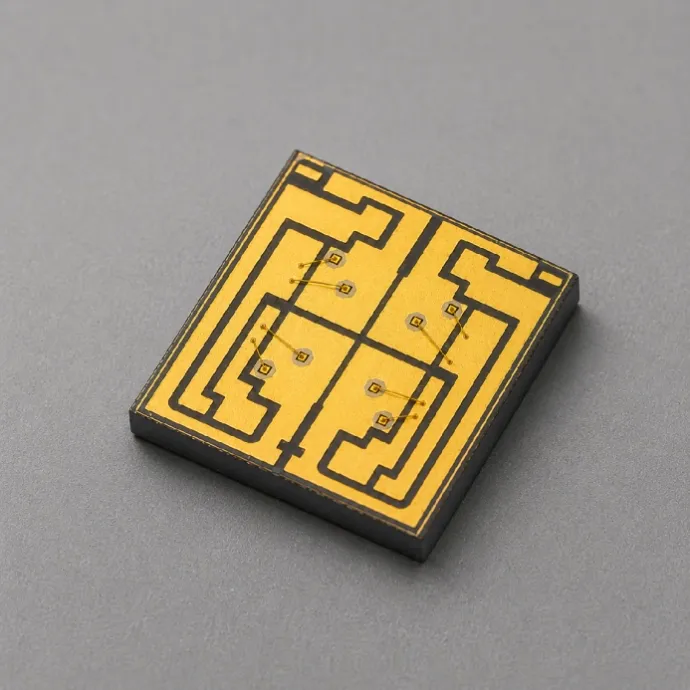
660nm / 850nm / 940nm / 1064nm Four-Wavelength VCSEL Ceramic SMD 5050
660nm / 850nm / 940nm / 1064nm four-wavelength VCSEL SMD in a 5050T ceramic package for custom multi-channel optical-source integration and evaluation.
Specifications
- Product Type
- Four-Wavelength VCSEL SMD
- Wavelength Channels
- 660nm, 850nm, 940nm and 1064nm
- Optical Output Power
- 660nm: 8–15mW at 10mA; 850nm: 1.6–6mW at 7mA; 940nm: 5–6mW at 7mA; 1064nm: 9–20mW at 10mA
- Emitter Configuration
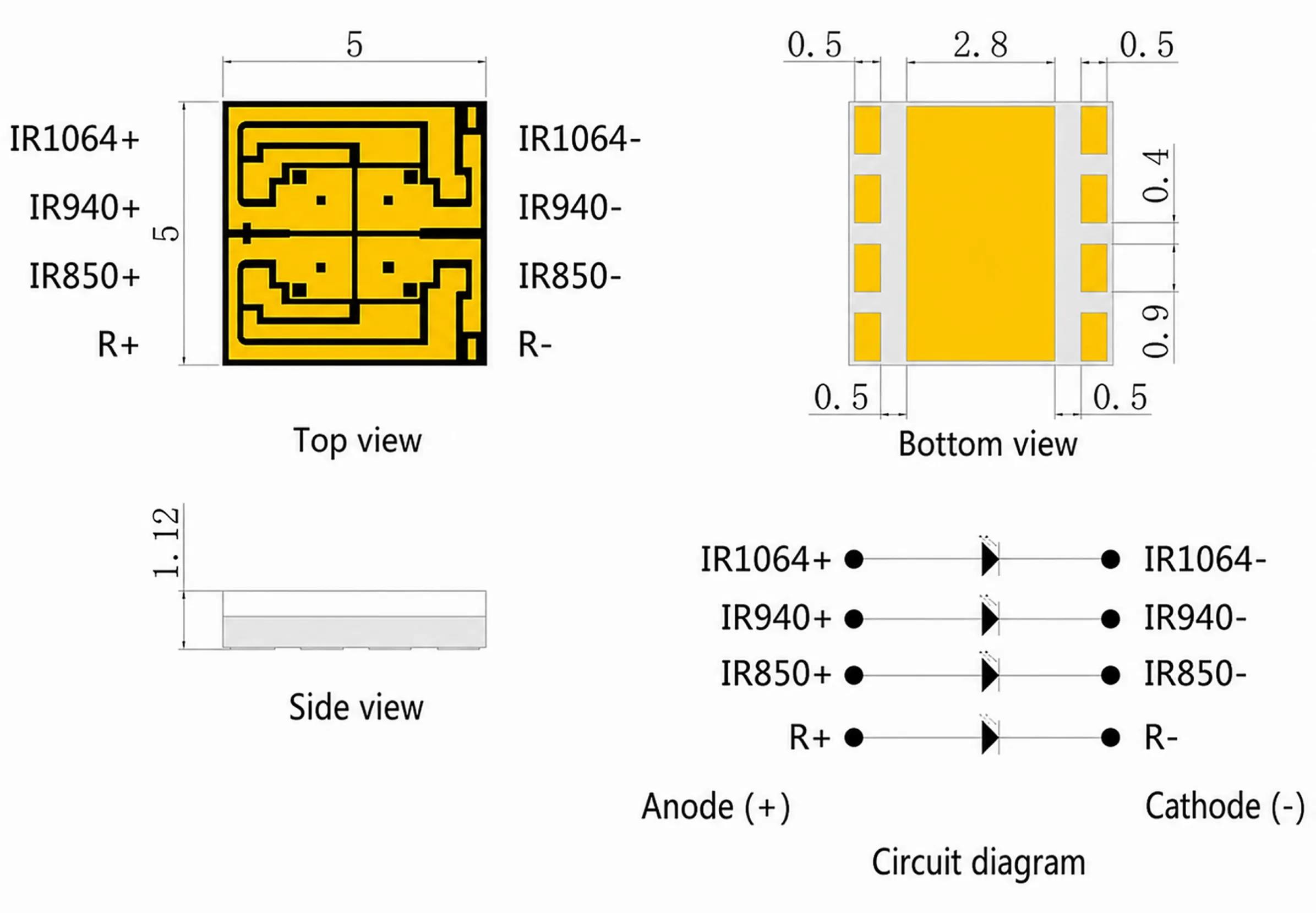
- Four independently wired VCSEL channels with separate anode/cathode pairs
- Operating Mode
- Continuous-current characteristics; a 0.1ms, 1/10-duty peak-current condition is also specified
- Optical Emission Profile
- 20° beam divergence specified in the source
- SMD Package Options
- 5050T ceramic SMD package
1. 660nm / 850nm / 940nm / 1064nm Four-Wavelength VCSEL SMD for Custom Multi-Channel Optical-Source Integration
The 660nm / 850nm / 940nm / 1064nm Four-Wavelength VCSEL SMD 5050T Ceramic combines four source-specified VCSEL channels in a surface-mount package with a 5050T ceramic construction. It is intended for OEM and engineering teams evaluating a multi-channel optical source where each wavelength must be addressed, measured, and integrated within a defined PCB and optical architecture.
The released source specifies separate anode/cathode pairs for the four channels and a 20° beam divergence. The optical output values are channel-specific ranges measured at different currents, so they must not be added together or rewritten as one unsupported total-output value. The ceramic package is the source-confirmed product distinction; no additional thermal, lifetime, reliability, or optical-performance advantage is inferred here.
Lead Time: In-stock products are dispatched within 3 business days; custom-packaged products have a lead time of 15–20 days.
MOQ: The minimum order quantity is 1 reel; selected special models support small-batch orders.
2. Multi-Wavelength Optical Configuration and Channel Selection
The four channels cover visible red and near-infrared wavelengths for a custom optical-source architecture. The source specifies 660nm output of 8–15mW at 10mA, 850nm output of 1.6–6mW at 7mA, 940nm output of 5–6mW at 7mA, and 1064nm output of 9–20mW at 10mA.
These values are reported as source ranges rather than a single typical value. Channel selection should consider the customer's required wavelength, current, optical coupling, beam distribution, measurement method, thermal path, and enclosure geometry. The source's multi-value current table is not used to invent a per-channel maximum-current mapping; final driver limits must follow the released technical documentation and project validation.
3. 5050T Ceramic Package, Electrical Interface and PCB Integration
The 5050T ceramic package provides the released mechanical and material configuration for this four-channel SMD. The source drawing identifies independent anode/cathode pairs, allowing the customer system to address the 660nm, 850nm, 940nm and 1064nm channels as separate electrical paths. Review the released drawing for pin marking, pad layout, package orientation, forward-voltage checks, soldering conditions, storage, and electrostatic handling.
During evaluation, keep every optical measurement tied to its channel and test current. Confirm PCB clearance, reflow process, optical-axis alignment, beam overlap or separation, thermal management, enclosure geometry, lens or diffuser interfaces, and control-system sequencing before production integration. Do not assume that the ceramic package is directly interchangeable with the 5050 PCT or 3227 configurations without mechanical, electrical, thermal, and optical verification.
4. Multi-Channel Optical-System Development and Custom Integration
This four-wavelength SMD is intended for custom component-level optical-source development where a single ceramic package must accommodate multiple independently driven channels. Engineering work may include driver architecture, channel sequencing, optical coupling, beam distribution, thermal design, enclosure geometry, and measurement repeatability.
The released 660nm / 850nm / 940nm / 1064nm 5050T ceramic configuration is the standard specification described by this page. If a project needs another wavelength combination, output condition, package material, electrical interface, channel layout, or integrated optical element, those requirements must be reviewed as a project-specific custom configuration. The component does not establish medical efficacy, clinical performance, finished-device safety, certification, or competitor equivalence.
Related Articles
5. Evaluation, Documentation and Custom Development Support
For component-level evaluation, review the released datasheet together with the customer's driver, PCB, optical coupling, thermal, and assembly requirements. An Evaluation Kit with 10 pcs / KIT is available for checking four-channel addressing, per-channel output, drive conditions, ceramic-package fit, optical alignment, and early assembly repeatability.
Samples & Pilot Production: Evaluation kits, low-volume pilot production, and pre-production validation are supported.
Before production integration, confirm the applicable electrical limits, continuous and peak-current conditions, soldering profile, ESD handling, optical measurement method, and customer-system exposure conditions against the current technical documentation. Documentation applies to this component configuration and does not certify the customer's finished device.
For component-level project evaluation, an Initial Product Report covering the Laser Diode Series and VCSEL Laser Diode Chip Series has been filed with the U.S. FDA CDRH. This filing supports technical documentation and product evaluation.
For applicable products, CE, EMC, EN 60825, LVD, RoHS, REACH and halogen-free certification and compliance documents are available. Documentation depends on the corresponding product model and does not represent certification of the customer's finished device.
6. Frequently Asked Questions
FAQ 1. What is the source-confirmed distinction of the 5050T version?
The released distinction is the 5050T ceramic SMD package. The source does not establish a general thermal, lifetime, reliability, or optical-performance advantage over the other package configurations, so those properties must be evaluated for the customer's complete assembly.
FAQ 2. Can the four wavelength channels be driven independently?
Yes. The source electrical drawing identifies separate anode/cathode pairs for the four channels. The customer's driver must still verify pin marking, current control, forward voltage, thermal behavior, sequencing, optical alignment, and system-level exposure control.
FAQ 3. How should this page be compared with the 5050 PCT and 3227 pages?
This page owns the 5050T ceramic package-specific selection intent. The 5050 PCT and 3227 pages describe their own source-confirmed package structures and output/test conditions. Selection should be based on verified electrical, mechanical, thermal, optical, and assembly requirements rather than an unsupported assumption of direct interchangeability.