
Aug 25, 2026Technical Insights
What VCSEL Does a Chip-Scale Atomic Clock Need?
Learn what a chip-scale atomic clock VCSEL needs: single-mode output, narrow linewidth, D1 wavelength tuning, polarization, and RF modulation.
A chip-scale atomic clock needs a VCSEL that does more than sit near the right wavelength. The part has to provide single-transverse-mode output with a stable, well-defined polarization, hold a narrow linewidth, center on the alkali D1 line to within a fraction of a nanometer, and tune onto that line with current and temperature. It must also hold enough frequency-modulation response at the RF frequency the interrogation scheme uses. 1ONEVCSEL supplies single-mode 795 nm and 894.6 nm VCSELs for rubidium and cesium systems. A wavelength match alone does not qualify a part.
Start from what the clock is measuring, not the wavelength
A vapor-cell clock does not care about the laser for its own sake. It locks an electronic oscillator to a fixed atomic frequency, the ground-state hyperfine splitting of an alkali atom. In a coherent population trapping design, a common approach in chip-scale clocks, the laser is modulated so that optical sidebands address the clock transition. When the sideband structure matches the hyperfine splitting, a sharp transmission feature appears, and the clock locks to it. Everything the light source has to do follows from keeping that feature narrow, deep, and stable. The mechanism, along with the full set of source requirements for these devices, is surveyed in Kitching’s review of chip-scale atomic devices.
Read the usual VCSEL specifications that way and they stop looking like a wish list. Each one protects the atomic signal, and the priorities sort themselves. The ones that decide most designs are below.
The requirements a nominal wavelength match hides
Single transverse mode and stable polarization. The atoms respond to a clean optical field. Higher-order transverse modes or unstable polarization put optical power into fields that can couple differently to the atomic transitions, which can lower CPT contrast, alter light shifts, and move the optimum operating point. A high single-mode suppression ratio and a defined polarization extinction ratio are what keep the emission usable.
Narrow linewidth. A broad laser line washes out the CPT feature and degrades short-term stability. Conventional clock-oriented single-mode VCSELs at these wavelengths often have linewidths in the tens-of-megahertz range, and the field is pushing lower. A 2026 demonstration of a 1 MHz linewidth VCSEL at the cesium D1 line shows where narrow-linewidth work is heading for high-stability clocks. Linewidth is quoted several ways, so match the definition, whether instantaneous, intrinsic, or integrated, to how your lock uses it.
Wavelength centering and tuning. The emission has to land on the D1 line and stay there. Temperature moves it, around 0.06 nm per kelvin for the devices considered here, and drive current moves it as well. Current tuning is strong in a VCSEL because the drive changes both carrier density and junction temperature, so a small current change pulls the wavelength onto the line. That sensitivity is useful for tuning, but it also means current and temperature fluctuations can shift the optical frequency and, through detuning and light shifts, degrade clock stability.
RF modulation capability. The part has to hold enough frequency-modulation response at the RF frequency the chosen CPT scheme uses. The value depends on the atom and the interrogation scheme, which is the next section.
Low relative intensity noise and low electrical power consumption. Intensity noise limits how tightly the lock holds, while the VCSEL’s electrical consumption matters because a chip-scale clock has a tight power budget for the whole physics package.
Why rubidium and cesium call for different modulation frequencies
The RF frequency that drives the modulation is set by the atom and the interrogation scheme, and the two common alkali choices do not share it.
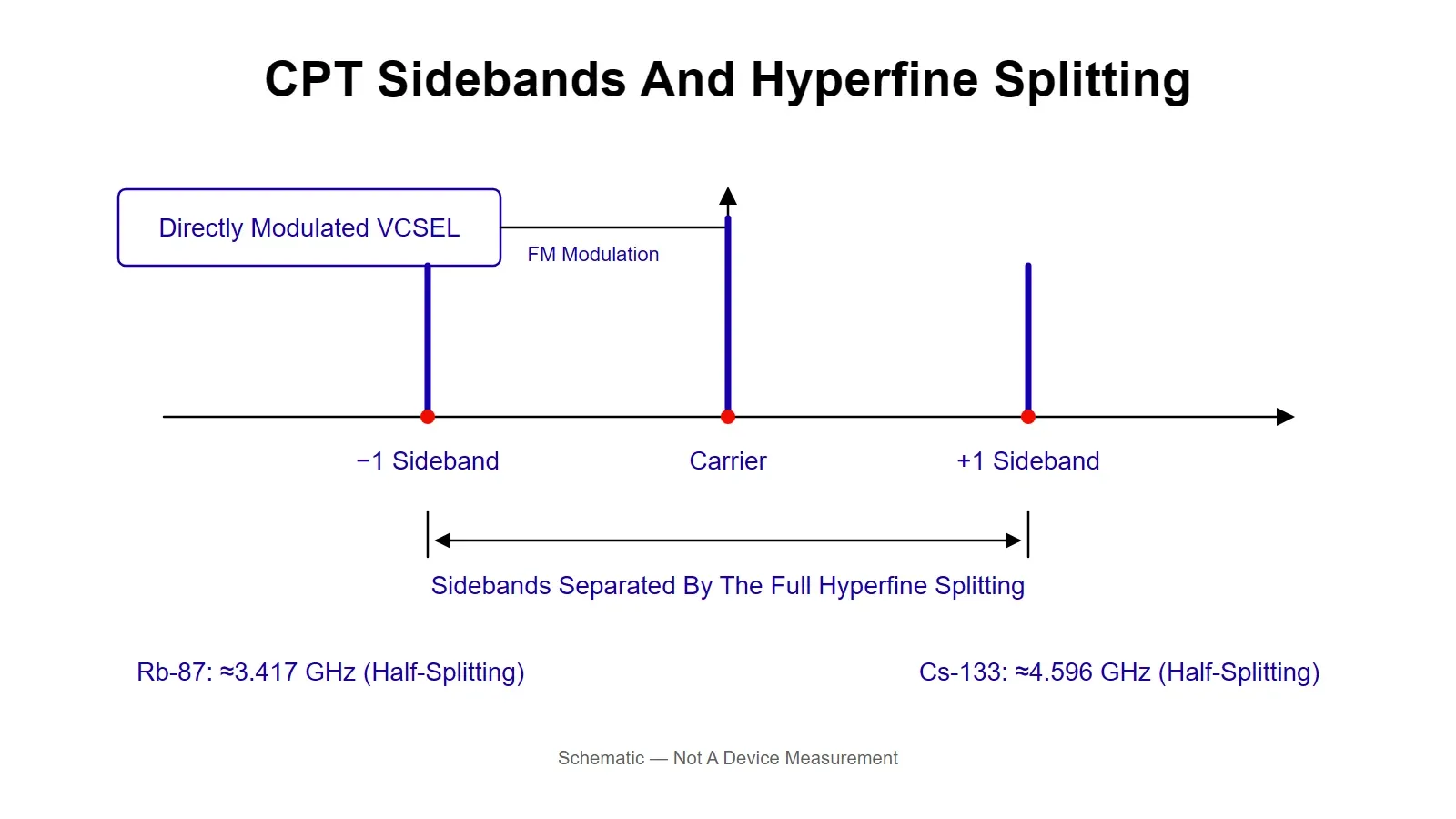
Rubidium-87 has a ground-state hyperfine splitting near 6.835 GHz. Cesium-133 sits at 9.192631770 GHz, the value that defines the SI second. In many directly modulated CPT architectures, the VCSEL is driven near half the ground-state hyperfine splitting, so the two first-order sidebands are separated by the full clock-transition frequency. Other CPT architectures may use modulation near the full hyperfine splitting or different sideband orders, so the required RF response has to be matched to the interrogation scheme, not inferred from the atom alone.
For a design using first-order sidebands placed symmetrically around the carrier, the modulation frequency is approximately 3.417 GHz for rubidium-87 and 4.596 GHz for cesium-133. Datasheets reflect this. A rubidium D1 part specifies an FM modulation bandwidth of at least 3.4 GHz, and a cesium D1 part specifies at least 4.6 GHz. The point behind the number is that the VCSEL must keep sufficient frequency-modulation response at whatever RF frequency the scheme requires. A part that cannot reach it will not produce the sidebands the scheme needs, and no other specification compensates.
Different atoms, different wavelengths
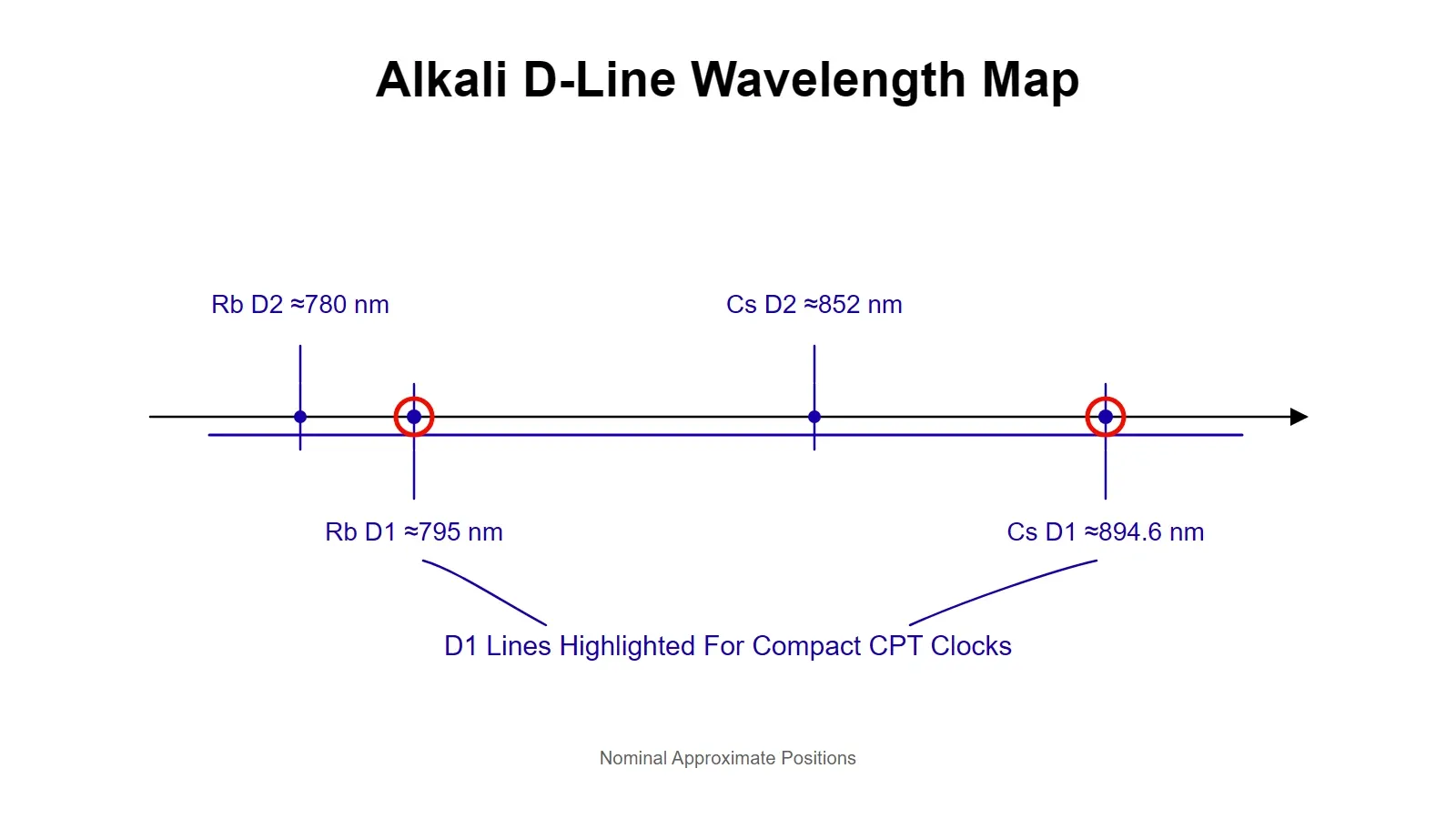
The wavelength follows the atom and the transition. Rubidium runs on its D1 line near 795 nm. Cesium runs on its D1 line near 894.6 nm. Both atoms also carry a D2 line, near 780 nm for rubidium and 852 nm for cesium, and VCSELs exist there too.
Compact CPT clocks commonly favor the D1 line. Many implementations choose the D1 transition because its level structure can give higher CPT contrast under commonly used polarization and buffer-gas conditions, which is why many compact CPT clock designs use 795 nm for rubidium and 894.6 nm for cesium rather than the corresponding D2 transitions. A rubidium clock and a cesium clock are therefore not interchangeable at the light source, and their parameter tables differ.
This overview stops at the framework. The full parameter set for each system, and the match to a specific part you may be replacing, belongs in the wavelength-specific pages. The 795 nm rubidium clock VCSEL and the 894.6 nm cesium clock VCSEL each carry their own conditions and test points.
Second-sourcing atomic-wavelength VCSELs
The commercial supplier base for atomic-wavelength VCSELs is relatively concentrated. The landscape also consolidated when Osram acquired VCSEL specialist Vixar in 2018. For a clock program that expects to ship for years, one qualified source is a schedule risk as much as a technical one, since lead times, allocation, and end-of-life decisions then sit outside your control.
Qualifying a second source is ordinary engineering hygiene, not a purchasing preference. The work is real, because two parts that share a nominal wavelength can still differ in linewidth, tuning behavior, and modulation response, and each of those has to be checked against your physics package. A second source is worth qualifying when the part matches on the requirements above, not when it merely matches on wavelength. For a specific part, a comparison of second-source atomic-wavelength VCSELs against the incumbent goes parameter by parameter, which is where a given replacement is decided.
About 1ONEVCSEL
1ONEVCSEL is the VCSEL product line of 1ONELASER. It supplies VCSEL components rather than finished clocks: single-mode emitters at atomic reference wavelengths, screened and binned to a project’s wavelength and power requirements, in selected bare-die and packaged configurations, with datasheets and test data to support evaluation. The clock builder remains responsible for the finished instrument, and the VCSEL is delivered as a specified, measured part.
A few supply decisions matter on a clock program. Bare die suits tight physics packages, while a TO-46 package suits earlier evaluation and looser layouts. Selecting the wavelength bin that centers the emission at your cell’s operating temperature keeps it where the cell runs, rather than at a generic test point. For the OPM and magnetometer variants, the packaging must not perturb the field being measured, which is worth confirming for any candidate part. The atomic clock and OPM VCSELs are grouped for evaluation, and an evaluation kit lets you check linewidth, tuning, and modulation on your own bench. Where the standard forms do not fit, custom development and ODM covers packaging and integration options, subject to project requirements. Validate the final match under your own optical, thermal, and electrical conditions.
Frequently asked questions
What wavelength does a rubidium clock use versus a cesium clock?
A rubidium-87 clock runs on the rubidium D1 line near 795 nm, and a cesium clock runs on the cesium D1 line near 894.6 nm. Compact CPT designs commonly favor the D1 lines over the D2 lines at 780 nm and 852 nm, because the D1 transition can give higher CPT contrast under typical operating conditions.
Why does the VCSEL need to be single-mode and single-polarization?
The clock transition responds best to a clean optical field. Higher-order transverse modes or unstable polarization put power into fields that couple differently to the atomic transitions, which can lower CPT contrast and change the optimum operating point. A high single-mode suppression ratio and a defined polarization extinction ratio keep the emission usable.
What modulation frequency does a CSAC VCSEL need?
It depends on the atom and the CPT interrogation scheme. For a common scheme using first-order sidebands around the carrier, the drive is near 3.417 GHz for rubidium-87 and near 4.596 GHz for cesium-133, so the two sidebands sit a full hyperfine splitting apart. Other schemes use different frequencies or sideband orders, so match the required RF response to the scheme rather than to the atom alone.
How is the VCSEL tuned onto the atomic line?
With temperature and drive current. Temperature tuning is around 0.06 nm per kelvin for representative devices, and current tuning is strong because the drive changes both carrier density and junction temperature. Both are held stable in operation, because current and temperature fluctuations can shift the optical frequency and, through detuning and light shifts, degrade clock stability.
Should a clock use bare die or a packaged VCSEL?
Bare die is common for compact physics packages, while a TO-46 package suits earlier evaluation and looser mechanical layouts. For OPM and magnetometer builds, non-magnetic packaging avoids perturbing the field being measured. The right form depends on your integration stage and package constraints.