
Aug 29, 2026Technical Insights
FDA CDRH Reporting for PBM and LLLT VCSEL Devices
FDA CDRH reporting for VCSEL components in PBM and LLLT devices: accession numbers, exemptions, OEM responsibilities, and filing boundaries.
Photobiomodulation, commonly abbreviated as PBM, is also referred to in many regulatory and commercial contexts as low-level light therapy, or LLLT. PBM devices use low-energy visible or near-infrared light to produce a non-thermal biological response.
Medical beauty, hair-growth, skin-care, pain-relief, and personal-care devices may use VCSEL bare dies or packaged VCSEL components as compact optical sources. However, a VCSEL component and a finished PBM or LLLT device are not the same regulatory product.
The applicable FDA pathway depends on the actual product configuration, accessible laser emission, intended use, laser classification, operating conditions, component status, medical claims, and whether a specific reporting exemption applies.
This article explains:
- FDA CDRH Laser Product Reports
- acknowledgement letters
- FDA accession numbers
- low-power reporting exemptions
- the difference between Product Reports and 510(k) clearance
- the regulatory boundary between a VCSEL component and a finished PBM device
- the responsibilities that remain with the OEM
This article provides general technical and regulatory information only. It is not legal advice and does not replace a product-specific assessment by a qualified regulatory professional.
Why FDA CDRH Reporting Matters for PBM and LLLT OEM Projects
PBM and LLLT products may use red or near-infrared light at relatively low optical output. Low output, however, does not automatically remove FDA CDRH obligations.
An OEM project may involve:
- a VCSEL bare die
- an SMD-packaged VCSEL
- another component-level package
- a driver and optical assembly
- a complete laser module
- a finished PBM medical or personal-care device
Each form can create a different regulatory situation.
The complete product may include:
- the VCSEL source
- a driver circuit
- optical windows or diffusers
- protective housing
- treatment-distance controls
- firmware
- emission timing
- user controls
- labels
- medical or wellness claims
These system-level elements influence accessible emission, laser classification, testing, labeling, reporting, and medical-device responsibilities.
A supplier’s component documentation supports OEM evaluation. It does not establish the regulatory status of the finished device.
For broader application context, see our Medical Beauty & Personal Care VCSEL Solutions and our guide to VCSEL solutions for hair-growth, facial-mask, and therapy devices.
What Is Photobiomodulation and LLLT?
FDA describes photobiomodulation devices as also being known as low-level light therapy devices.
PBM is generally associated with the application of low-energy visible or near-infrared light intended to produce non-thermal biological effects. Depending on the product, the light source may be a laser, an LED, or another suitable optical source.
For a VCSEL supplier, PBM and LLLT describe the intended finished-device application. They do not automatically define:
- the regulatory status of the VCSEL component
- the final laser class
- whether a Product Report is required
- whether an exemption applies
- whether the finished medical device requires a 510(k)
The OEM must evaluate the complete product rather than relying only on the component’s nominal optical power.
What Is an FDA CDRH Laser Product Report?
A Laser Product Report is a radiation-safety submission describing a laser product or product family and how the manufacturer addresses applicable FDA requirements.
Depending on the product, the report may include:
- manufacturer identification
- product-family identification
- models and configurations
- wavelength
- optical output
- continuous-wave or pulsed operation
- laser classification
- protective housing
- interlocks
- emission indicators
- warning labels
- user information
- test methods
- quality-control procedures
- production testing
The submitted information should correspond to the product actually manufactured and distributed.
A Product Report is not a marketing certificate. It does not replace production controls, traceability, design-change management, finished-product testing, or medical-device requirements.
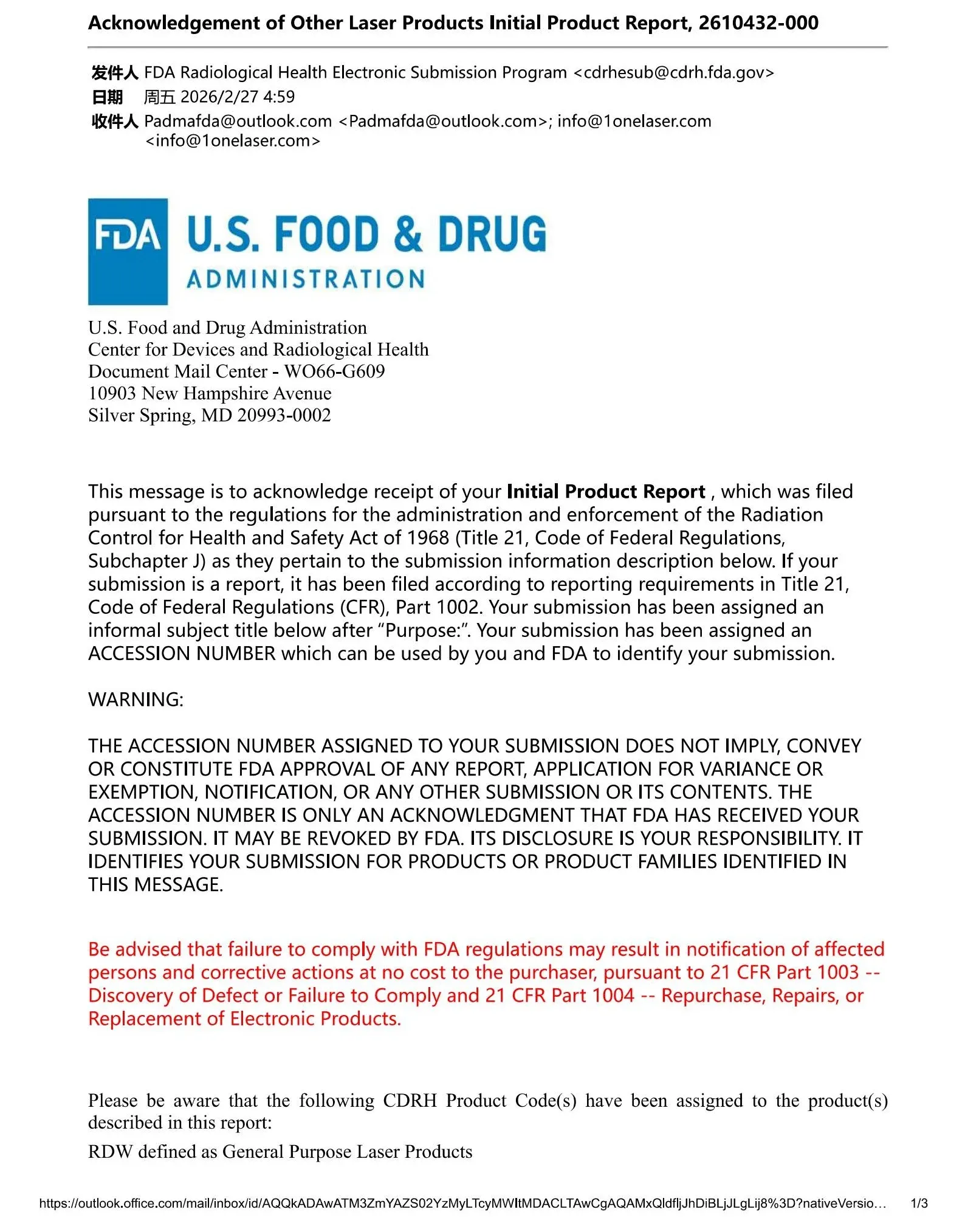
BestLaser Opto Component Device Limited has submitted an FDA CDRH Initial Product Report filing covering specified Laser Diode Series products, including applicable VCSEL Laser Diode Chip Series configurations.
The report applies only to the product families and configurations described in the submitted documentation. It should not be interpreted as covering every 1ONELASER wavelength, power level, package, array, module, or finished device.
What Does a CDRH Acknowledgement Letter Mean?
After FDA receives a radiation-emitting product report, the agency may issue an acknowledgement letter and assign an accession number.
FDA’s Product Report guidance explains that an acknowledgement letter and accession number should not be interpreted as a technical review or approval of the report. FDA acknowledgement does not mean that the product has been approved or that the report has been determined to be adequate.
An accurate statement is:
A Laser Product Report has been submitted to FDA CDRH, and an accession number has been assigned.
It should not be rewritten as:
- FDA-approved VCSEL
- FDA-certified VCSEL component
- FDA-approved laser diode
- FDA-endorsed laser supplier
- FDA-approved Product Report
- FDA-approved accession number
An acknowledgement letter is a reporting milestone. It is not FDA approval, medical-device clearance, certification, or endorsement.
What Is an FDA Accession Number?
An accession number is a reference identifier assigned to a radiation-safety report in the FDA CDRH reporting system.
It may be used for:
- correspondence with FDA
- Supplemental Reports
- Annual Reports
- ownership or manufacturer updates
- import documentation
- product-family record management
An accession number does not automatically prove that:
- every model is covered
- every wavelength or output level is included
- the finished device is compliant
- the finished device is FDA cleared
- medical claims are authorized
- future design changes are covered
- FDA has completed a comprehensive technical review
OEM teams should confirm the exact manufacturer, product family, model, configuration, and report scope associated with the accession number.
Filed, Acknowledged, Cleared, and Approved Are Different
Term | Practical meaning | It does not mean |
|---|---|---|
Report submitted | Documentation has been sent to FDA CDRH | The product has not automatically been approved or cleared |
Acknowledgement letter | FDA confirms report receipt and processing into its reporting system | FDA has not necessarily completed a technical review |
Accession number | Reference identifier assigned to the report | It is not a product-approval number |
Manufacturer certification | The manufacturer certifies compliance based on its testing and quality controls | It is not an FDA-issued product certificate |
FDA clearance | A result under an applicable medical-device pathway, such as 510(k) | It is separate from Product Report acknowledgement |
FDA approval | A formal approval under a pathway for which approval applies | It cannot be claimed based only on an accession number |
FDA endorsement | Recommendation or promotion by FDA | Product reporting does not create endorsement |
Accurate use of these terms reduces regulatory, contractual, and marketing risk.
Is a Laser Product Report the Same as 510(k) Clearance?
No.
FDA CDRH radiation-safety reporting and medical-device premarket review are separate regulatory frameworks.
A Laser Product Report generally addresses matters such as:
- laser radiation safety
- classification
- protective features
- warning labels
- test methods
- production controls
- manufacturer certification
- recordkeeping
A 510(k), when required, addresses whether a medical device is substantially equivalent to an appropriate legally marketed predicate device.
For finished PBM or LLLT devices within the applicable FDA reporting scope, the OEM evaluation must cover:
- laser radiation-safety reporting
- medical-device classification
- establishment registration
- device listing
- quality-system requirements
- labeling
- 510(k) or another applicable premarket pathway
- performance or clinical evidence
- post-market responsibilities
A component-level Product Report or accession number does not mean that the OEM’s finished device has received 510(k) clearance.
Does Low-Output VCSEL Mean Class I?
Not necessarily.
The following terms are not interchangeable:
- low output
- low power
- low energy
- PBM
- LLLT
- Class I
- FDA reporting exemption
PBM and LLLT describe an application or treatment approach.
Class I describes a laser-safety classification based on accessible emission under defined conditions.
A VCSEL may have relatively low nominal optical output, but the finished product’s classification can still depend on:
- wavelength
- continuous-wave or pulsed operation
- pulse width
- repetition rate
- emitter count
- optical system
- treatment distance
- protective housing
- accessible emission
- service conditions
- fault conditions
The final classification must be determined at finished-product level using the applicable standards and regulatory framework.
Do Low-Power Laser Products Have Reporting Exemptions?
FDA Laser Notice 54 provides a limited exemption from certain reporting and recordkeeping requirements for specified low-power laser products that satisfy its conditions.
It does not create a blanket exemption for every low-output VCSEL, PBM source, Class I device, or embedded laser.
Eligibility may depend on:
- the final laser class
- accessible emission
- operating, maintenance, and service conditions
- product certification
- manufacturer testing
- reporting history
- product type
- whether all conditions of the notice are satisfied
The existence of Laser Notice 54 should not be interpreted as meaning:
Low-output VCSEL = automatically exempt.
The responsible manufacturer must document why an exemption applies to the specific product.
Does a Component-Level VCSEL Automatically Qualify for an Exemption?
No automatic conclusion should be made.
A component may present a different regulatory situation from a complete laser product, but component status alone does not answer every reporting question.
The assessment must consider:
- whether the VCSEL can operate independently
- whether accessible laser radiation can be produced
- whether it is intended exclusively for incorporation
- whether it includes a driver
- whether it includes protective housing
- whether it includes optics
- how it is labeled
- who receives it
- whether distribution records are maintained
- whether a specific component or low-power exemption applies
FDA evaluates a bare die supplied to a qualified OEM and a packaged module with independent operating capability according to their distinct functions and operating characteristics.
High-power VCSEL arrays, industrial modules, and complete treatment systems should be assessed separately and should not be assumed to fall within the same Product Report or low-power reporting pathway.
Which VCSEL Products Are Relevant to PBM and LLLT Development?
PBM and LLLT devices commonly evaluate visible-red and near-infrared light sources. The suitable component depends on the intended application, optical dose, beam design, thermal architecture, package, working distance, and final system requirements.
Representative 1ONELASER product directions include:
- 650nm VCSEL SMD Series for selected visible-red OEM concepts
- 660nm VCSEL SMD Series for visible-red PBM and personal-care evaluation
- 780nm VCSEL SMD Series for selected near-infrared device development
These links describe representative product families. They do not by themselves establish:
- Product Report coverage
- laser classification
- exemption eligibility
- clinical performance
- finished-device regulatory status
Product-specific CDRH-related documentation availability must be confirmed during project evaluation.
Why Component Documentation Still Matters
Component documentation cannot replace finished-device compliance, but it helps OEM teams create a controlled and traceable product-development process.
Depending on the selected product, relevant documents may include:
- datasheets
- center wavelength and tolerance
- optical output
- continuous-wave or pulsed operating information
- maximum ratings
- beam characteristics
- die or aperture dimensions
- package drawings
- pin configuration
- recommended driving conditions
- thermal requirements
- production-lot identification
- material declarations
- test information
- available CDRH-related supporting documents
- product-change notifications
You can review currently available Certificates and compliance documents. Document availability varies by product family, configuration, development stage, and customer requirement.
Component information supports system design and regulatory planning. It does not determine the finished product’s final classification or market authorization.
What Responsibilities Remain With the Finished-Device OEM?
The finished-device manufacturer normally controls the final design and remains responsible for evaluating the complete system.
This may include:
- maximum accessible emission
- final laser classification
- normal operating conditions
- maintenance and service modes
- fault conditions
- protective housing
- interlocks
- emission indicators
- warning labels
- user instructions
- treatment distance
- optical accessories
- beam delivery
- driver behavior
- firmware-controlled emission
- optical-dose validation
- risk management
- production testing
- quality control
- medical claims
- import documentation
- applicable medical-device requirements
A VCSEL supplier cannot determine the final product’s complete regulatory status without full information about the system, intended use, claims, controls, and user access.
OEM teams should involve optical, electrical, mechanical, firmware, quality, laser-safety, and regulatory personnel early in product development.
Which Product Changes May Require Additional Review?
A change to a reported laser product or finished PBM device should be assessed before implementation.
Relevant changes may include:
- wavelength
- optical output
- pulse width
- repetition rate
- continuous-wave or pulsed operation
- emitter count
- package
- beam divergence
- diffuser or lens
- treatment distance
- driver
- firmware
- protective housing
- interlocks
- labels
- product model
- intended use
- integration into a new finished device
Not every change automatically requires a new Product Report.
Depending on the significance and reporting framework, a change may be handled through:
- a Supplemental Report
- an Annual Report
- an internal design-change record
- updated testing
- another regulatory action
The responsible manufacturer should document the assessment and the basis for the selected pathway.
What Are Annual Reporting Responsibilities?
An accession number does not end reporting and recordkeeping responsibilities.
Depending on the product and applicable requirements, manufacturers may need to maintain:
- production information
- quality-control procedures
- product-test information
- distribution information
- product changes
- model updates
- other reportable records
OEMs and suppliers should clearly determine which party is responsible for:
- Product Reports
- Supplemental Reports
- Annual Reports
- production records
- distribution records
- regulatory correspondence
What Happens When Laser Products Are Imported Into the United States?
Applicable radiation-emitting electronic products may be reviewed during importation.
FDA may verify:
- manufacturer identity
- model designation
- report accession number
- Annual Report information
- import declarations
- whether the manufacturer or product appears on an import alert
Differences between the following information can delay import review:
- manufacturer name
- model number
- Product Report
- accession number
- product label
- commercial invoice
- importer records
- customs declaration
The relevant parties should maintain consistent product and manufacturer information across the supply chain.
Common Misunderstandings About PBM, LLLT, and FDA CDRH
PBM and LLLT automatically mean Class I.
They do not. PBM and LLLT describe an application approach, while Class I is a safety classification based on accessible emission.
A low-output VCSEL is automatically exempt from Product Reporting.
It is not. Exemption eligibility depends on the actual finished product and the conditions of the applicable FDA policy.
An accession number means FDA approved the product.
It does not. It identifies a received report.
A component supplier’s accession number automatically covers the finished PBM device.
It does not. The scope depends on the product families and configurations described in the submitted report.
A CDRH Product Report replaces 510(k) clearance.
It does not. Radiation-safety reporting and medical-device premarket review are separate.
All 1ONELASER products are covered by the same Initial Product Report.
They should not be assumed to be. Coverage must be confirmed against the actual submitted report and product configuration.
How 1ONELASER Supports PBM and LLLT OEM Development
1ONELASER supplies VCSEL components for evaluation and integration into selected PBM, LLLT, medical beauty, hair-growth, skin-care, and personal-care product concepts.
For applicable projects, support may include:
- visible-red VCSEL bare dies
- near-infrared VCSEL bare dies
- low-output SMD-packaged VCSEL devices
- selected component-level package formats
- optical and electrical specifications
- package drawings
- wavelength and output information
- maximum ratings
- beam information
- sample evaluation
- lot identification
- available CDRH-related supporting documentation
- custom wavelength, package, or optical discussions
BestLaser Opto Component Device Limited has submitted an Initial Product Report covering specified Laser Diode Series products, including applicable VCSEL Laser Diode Chip Series configurations.
The report and its accession number apply only to the products and configurations described in the submitted documentation.
They should not be interpreted as covering every wavelength, output level, package, array, module, or finished PBM device offered or supported by 1ONELASER.
Documentation availability should be confirmed for the specific model during project evaluation.
OEM customers remain responsible for finished-device classification, testing, labeling, reporting, quality controls, medical-device requirements, import compliance, and market authorization.
Frequently Asked Questions
Is PBM the same as LLLT?
PBM is the broader modern term. FDA also refers to PBM devices as low-level light therapy, or LLLT, devices in its PBM guidance. The exact product classification and regulatory pathway still depend on the intended use and finished-device design.
Does a low-output VCSEL automatically qualify as Class I?
No. Final classification depends on accessible emission, wavelength, operating mode, optical design, housing, service conditions, and the complete system.
Does every VCSEL component require a Product Report?
Not necessarily. The answer depends on component status, independent operating capability, accessible emission, distribution model, intended use, the finished product, and applicable exemptions.
Does an FDA accession number mean the VCSEL is approved?
No. It is a reference number assigned to a received report and is not FDA approval, clearance, certification, or endorsement.
Can a supplier’s accession number be used for an OEM finished device?
It cannot automatically be assumed to cover the finished device. The OEM must confirm the scope of the report and evaluate the final system separately.
Is a Laser Product Report the same as a 510(k)?
No. A Product Report concerns radiation-safety reporting. A 510(k), when required, is a medical-device premarket submission.
Are all low-power PBM products exempt from reporting?
No. Laser Notice 54 provides limited exemptions for specified products that meet its conditions. It is not a universal exemption.
Which 1ONELASER products are covered by the Initial Product Report?
Only the specified product families and configurations described in the submitted documentation should be considered within the report scope. Coverage should be confirmed for each project and model.
Who is responsible for the completed PBM or LLLT device?
The finished-device manufacturer normally remains responsible for system-level classification, testing, labeling, reporting, medical claims, quality controls, import compliance, and market authorization.
Final Considerations
FDA CDRH planning should begin during the architecture and supplier-selection stage of a PBM or LLLT project.
The key questions are:
- Is the VCSEL supplied as a component or a complete laser product?
- What product family and configurations does the existing report cover?
- What does the accession number actually identify?
- Does any reporting exemption apply?
- What is the finished product’s accessible emission and laser class?
- Does the finished device also follow a medical-device premarket pathway?
- Which responsibilities belong to the supplier, OEM, importer, and legal manufacturer?
PBM and LLLT do not automatically mean Class I, exemption, or FDA clearance.
A structured component documentation package can support engineering and regulatory planning, but the completed device must still be evaluated by the responsible OEM.
For VCSEL samples, technical documentation, package evaluation, or custom product development, contact the 1ONELASER engineering team, Request Evaluation Kits, or Submit a Custom Development Request.