
Oct 6, 2026Technical Insights
Why Do Red Light Devices Pass Prototype but Fail in Production?
Red light devices often pass prototype but fail in production when peak wavelength and optical power vary across the production population.
Red light devices can pass prototype qualification but become inconsistent in production because a prototype represents only a small chip population, while volume production draws from a much broader manufacturing distribution. If the chips vary too much in peak wavelength and optical power, the batch output turns inconsistent. 1ONEVCSEL supplies VCSEL chips screened and binned by wavelength and optical power to help reduce emitter-level variation between prototype qualification and volume production. Production consistency is measurable and controllable, and it starts at the chip-selection stage, not at final assembly.
Why a prototype hides the problem
A prototype is usually assembled from a small number of chips, often from a limited sample or a single screened lot. That small population may not represent the full wavelength and power distribution seen across volume production. It works, it hits the target wavelength, and the output looks right, so the design moves toward production on the assumption that the parts are representative.
That assumption may not hold in volume production. A production run draws hundreds or thousands of chips from a wider population, and that population carries the full manufacturing spread. The prototype showed only a small sample of the population; production exposes the center of the distribution as well as its tails. The design is unchanged, but the distribution of the input parts is not.
What actually drifts: wavelength and power
At the emitter level, two of the most important sources of unit-to-unit variation are peak wavelength and optical power. Both vary from chip to chip because of normal variation across a wafer and between wafers, and if that variation is not controlled, some devices land on target while others sit a little off in wavelength or a little low in power.
In a wavelength-sensitive optical system, a shift in peak wavelength moves the emission away from the design target, while a power shift changes the optical output delivered by the emitter. A batch built from a wide chip population then contains units that fall into different wavelength and output-power distributions, which can appear as unit-to-unit output variation, out-of-spec finished devices, or higher rejection rates. Compared with typical broadband LEDs, VCSELs generally offer narrower spectral emission and more tightly defined peak wavelengths, but the population still has to be sorted to a defined range.
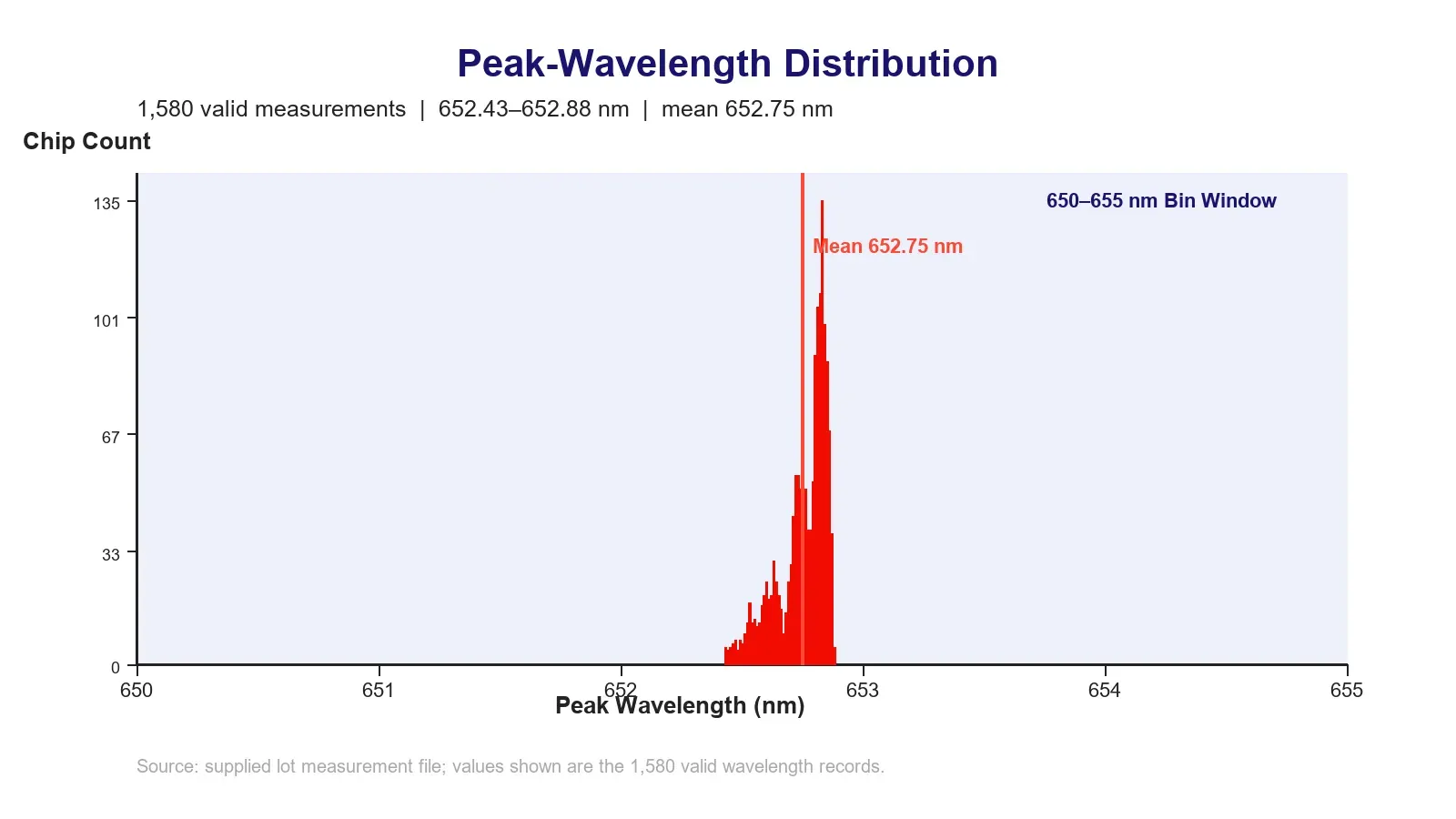
From one production lot, measured
Lot size: 1,580 chips
Peak wavelength: 652.43nm – 652.88nm
Total spread: 0.45nm
Optical power: 7.01–7.38 mW (0.37 mW spread)
Test conditions: 8 mA drive current, room temperature
Screening yield: 94.5%
A tightly binned lot like this means devices are built from parts that already match, rather than drifting unit to unit.
Why control has to start at chip selection
You cannot fix a wide chip population at final assembly. Once mixed chips are mounted, the batch already contains the spread. End-of-line testing can identify, grade, or reject finished units, but it cannot remove the underlying emitter-to-emitter variation already built into the assembly. The place to control production consistency is before assembly, by screening and binning chips to a defined wavelength and power range so every device is built from parts that already match.
This is why the selection step matters more than it looks. Screening removes off-spec parts and groups the rest into tight bins, which is why we provide individualized parameter screening to meet each laboratory’s specific technical requirements. A guide on how to read a VCSEL datasheet covers which parameters to specify when you set those limits.
How to make production match the prototype
The practical steps are straightforward. Specify the wavelength and power bin you need, not just a nominal wavelength, so the supplier sorts to your range. Ask for per-lot test data tied to the batch you receive, rather than a generic chart from an unrelated sample. Set an incoming criterion so a lot that misses the bin is caught before it reaches assembly, and keep batch traceability so a drift can be traced to its source.
The key is not adding more inspection at final assembly, but treating the chip as a specified and measured input from the beginning, the same discipline that separates a batch that matches its prototype from one that does not. Choosing which wavelength to specify is its own decision, covered in a guide on wavelength selection for red light devices.
About 1ONEVCSEL
1ONEVCSEL is the VCSEL product line of 1ONELASER. It supplies VCSEL components rather than finished devices: single emitters and arrays across 650 to 1064nm, screened and binned to a project’s wavelength and power requirements, in selected bare-die, SMD, and COB configurations. The device maker remains responsible for the finished product; the chip is delivered as a specified, measured part.
A practical way to confirm consistency is to evaluate a small batch before committing to a production run, so engineering samples and small evaluation batches are available, along with per-lot test data. To match parts to a design, the useful starting information is the target wavelength and tolerance, the required optical output, and the packaging format.
Frequently asked questions
Why does a red light device work in prototype but not in production?
A prototype is usually built from a small chip population, while production pulls from a much larger population that carries the full manufacturing spread. If the chips are not sorted to a defined wavelength and power range, the production batch contains units with different peak wavelengths and optical output levels, which shows up as inconsistent performance.
Can production inconsistency be fixed at final assembly?
Not really. Once mixed chips are assembled, the batch already contains the spread. End-of-line testing can identify, grade, or reject finished units, but it cannot remove the emitter-to-emitter variation already built into the assembly. Consistency is better controlled before assembly, through screening and binning.
How much do chip wavelength and power vary?
It depends on the part, test conditions, and screening criteria. A screened and binned lot can hold a much tighter distribution than an unsorted population, but the actual spread should be confirmed from lot-specific test data.
Do VCSELs help with production consistency?
VCSELs generally have a narrower emission spectrum and hold wavelength more tightly than broad LEDs, which makes them easier to bin to a tight range. The population still has to be screened and sorted, since a device is only as consistent as the chips it is built from.
What should I specify to keep a batch consistent?
Specify the wavelength bin and tolerance and the optical power range, not just a nominal wavelength, and ask for per-lot test data tied to your batch. Setting an incoming criterion and keeping batch traceability closes the loop.