
Oct 24, 2026Technical Insights
Why Use VCSELs in PPG Wearables
VCSELs can give PPG wearable developers tighter optical geometry, controlled wavelength behavior, and compact near infrared packaging, but the benefit still has to be proven at the photodetector.
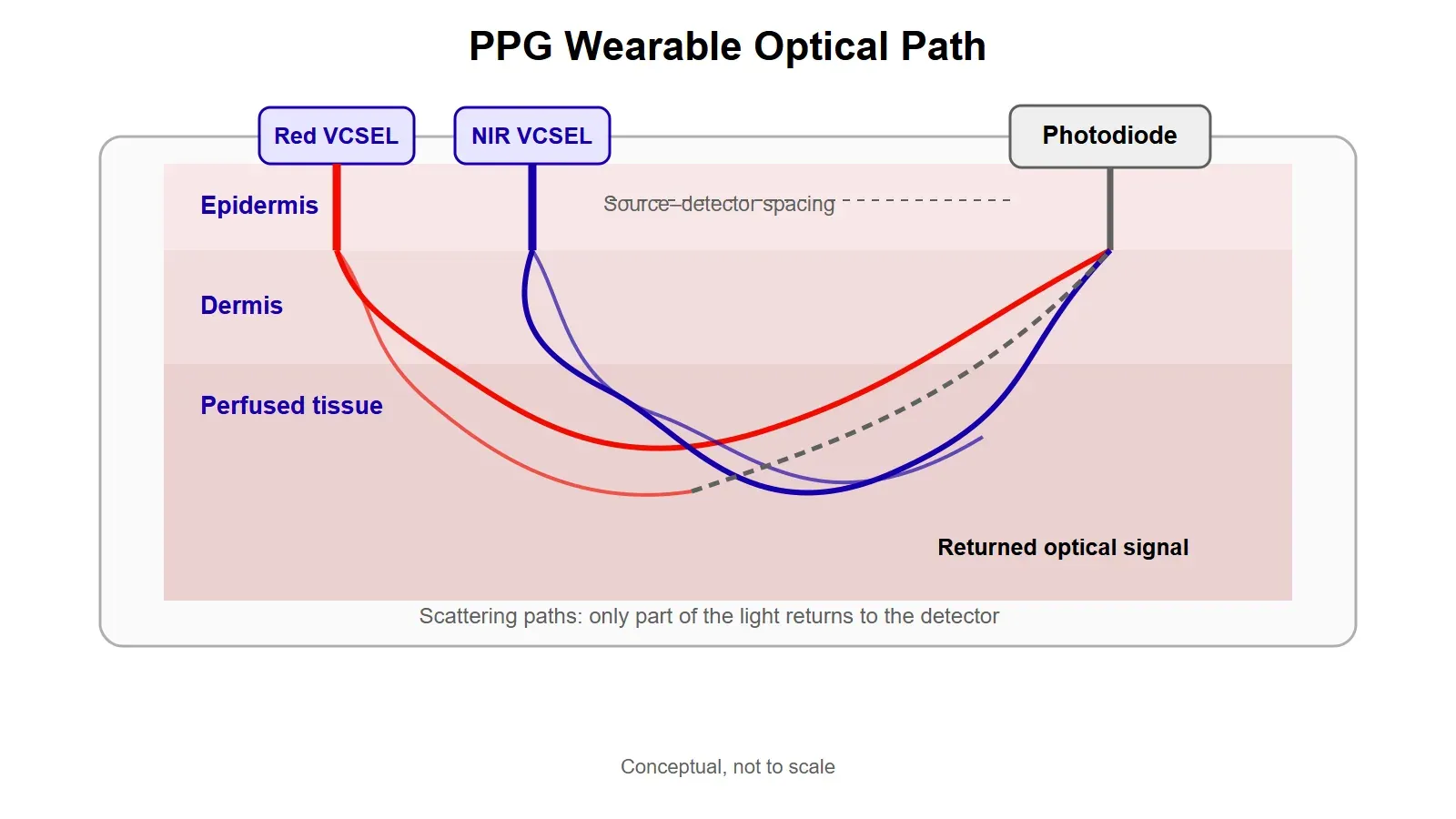
VCSELs are worth considering in a PPG wearable when the optical source needs tighter control over beam direction, wavelength, package geometry, or multi-wavelength integration than a conventional LED solution can provide.
That does not mean a VCSEL automatically produces a better PPG signal. The useful comparison happens at the photodetector. If a VCSEL produces a stronger or more repeatable received signal at lower system power, fits the mechanical stack better, or reduces variation between production units, it can be the better source. If an LED already meets those targets with less cost and simpler integration, changing the emitter adds complexity without solving a real problem.
For smart rings, compact watches, patches, and other reflective PPG devices, the source should be selected from the complete optical path backward.
What the light source actually controls in PPG
A reflective PPG system sends light into tissue and measures the modulated portion that returns to a photodetector as local blood volume changes.
The source does not measure heart rate or oxygen saturation by itself. It controls several inputs that determine how useful the returned signal can be:
1. wavelength
2. optical output at the actual drive condition
3. beam distribution
4. source-to-detector geometry
5. package footprint
6. thermal load
7. channel timing
8. unit-to-unit optical consistency
The photodetector, analog front end, mechanical contact, ambient-light rejection, motion compensation, algorithms, and calibration then determine how much physiological information can be extracted.
This is why the source should not be selected from headline optical power alone.
If the development team first needs a device-structure refresher, see what a VCSEL is. The rest of this article stays focused on PPG system decisions rather than basic laser construction.
Red and near infrared are the key wavelength channels in this discussion
For oxygenation-oriented PPG, paired red and infrared wavelengths are widely used because oxyhemoglobin and deoxyhemoglobin absorb the two spectral regions differently.
Engineering references commonly use approximately 660nm red and 940nm infrared as pulse oximetry wavelength anchors. A PPG education platform published in Sensors describes red around 660nm and infrared around 940nm as standard wavelength references for SpO2 calculation, while Analog Devices also identifies red and IR as the relevant wavelength pair for SpO2-oriented wearable sensing.
That does not make 660nm and 940nm universal component specifications for every wearable.
A finished wearable can use a nearby wavelength if its optical response, detector, tissue path, and calibration model are designed around the actual spectrum. The important point is that the red and infrared channels cannot be treated as arbitrary colors. The extinction curves and calibration model are wavelength dependent.
For a sourcing specification, the development team should define:
- target center wavelength
- acceptable wavelength tolerance or bin
- spectral width
- wavelength shift with current
- wavelength shift with temperature
- detector spectral response
- calibration assumptions tied to the chosen source
A nominal wavelength label without those conditions is not enough for a production design.
Why wavelength control can matter more in SpO2 than in a simple presence sensor
In a proximity sensor, a small source wavelength shift may have little effect if the detector is broadband and the target reflectivity changes slowly with wavelength.
SpO2 is different because the calculation uses the difference in absorption behavior between the red and infrared channels.
A source that drifts or varies from lot to lot can move the effective optical spectrum used by the algorithm. Whether that variation produces a meaningful measurement error depends on the wavelength pair, spectral shape, detector response, optical path, and calibration method.
This is one reason a narrower and more controlled laser spectrum can be attractive.
The engineering benefit is not that lasers are inherently more accurate than LEDs. The benefit is that a VCSEL can give the OEM another way to control the optical input to the system. The team still has to show that the tighter source behavior improves repeatability or reduces calibration burden in its own hardware.
Spectral bandwidth is now part of the pulse oximetry accuracy discussion
Source spectral width has become a more visible design variable in pulse oximetry accuracy research, particularly as researchers examine sources of skin-pigmentation-related error.
Clinical and regulatory work has shown that many pulse oximeters read differently across skin pigmentation, with SpO2 tending to sit erroneously high for darker skin. In January 2025 the FDA issued draft guidance for pulse oximeters intended for medical purposes, with proposed recommendations for evaluating performance across a range of skin pigmentation. That draft is not final and does not apply to general-wellness wearable products, but it makes skin-pigmentation performance a formal validation concern for medical-purpose pulse oximeters. Separate optical research provides the reason to examine source spectral bandwidth as one possible contributor to that performance.
Part of the mechanism is optical. Melanin absorbs more strongly in the red region than in the near infrared, so a red channel near 660nm is more sensitive to pigmentation than a 940nm channel. A 2024 study in the British Journal of Anaesthesia went further and attributed part of the measured bias to the broad emission spectrum of conventional LED sources, concluding that a narrower source spectral bandwidth would reduce melanin-related error.
This is where source selection meets the accuracy problem. Many VCSELs can provide a substantially narrower source spectrum than conventional LEDs, which makes spectral bandwidth a variable worth evaluating. But current evidence does not establish narrower VCSEL emission as a general solution to skin-tone-related error in reflective wearable SpO2. The spectral-bandwidth findings above come largely from transmission pulse oximetry and spectrally resolved measurements at the fingertip. Recent modeling work has begun to examine VCSEL beam profiles and melanin in reflective pulse oximetry, but validated reflective smart-ring evidence across skin tones does not yet exist.
The pigmentation problem is not solved by source spectrum alone. It also depends on the calibration population, the algorithm, detector response, the optical path, and source-to-detector geometry, and a narrower source only helps if the rest of the system and the calibration data set are built to use it. The practical conclusion is that source spectral width should be specified and characterized across the intended current, temperature, and production range, while finished-device SpO2 performance should be validated across the intended user population.
Directionality can help a compact reflective optical path
Many VCSELs have a more directional native emission profile than conventional broad-angle LEDs.
In a compact wearable, that can change how much emitted optical power actually reaches the tissue region that contributes to the detector signal. A more directed source may reduce the amount of light sent into unused directions and may make the source-to-skin path easier to control with a short optical stack.
That can be useful in:
- smart rings with limited internal volume
- watch backs with crowded optical and electrical layouts
- modules using a defined aperture
- compact systems that need optical partitions between source and detector
- designs where the emitter has to sit close to the skin
A 2025 ACM ISWC study modeled and prototyped this effect directly. In the geometry modeled in that study, the lower-divergence VCSEL directed more optical power into the tissue near the intended source region than the broad-angle LED configuration. The authors reported a higher perfusion index and substantially lower source power under some tested VCSEL conditions than under the corresponding LED conditions. The work used red and infrared VCSEL channels near 680nm and 940nm, close to the pairing used in red-plus-NIR VCSEL packages. Those are study-specific results obtained under simulation and prototype conditions and should be reproduced in your own optical stack, but they show the coupling argument is measurable rather than only theoretical.
But directionality is not automatically an advantage.
A narrow beam can create stronger local irradiance or become more sensitive to source alignment, ring rotation, mechanical tolerance, or skin contact. Recent smart ring research shows that wavelength and emitter-to-detector geometry interact strongly with the tissue path, especially when the ring rotates around the finger.
The right metric is therefore not emitter divergence by itself.
Measure:
received AC signal, DC level, signal-to-noise ratio, optical crosstalk, and stability across realistic mechanical positions.
A beam specification is useful only when it improves one of those system results.
VCSELs can help when the optical stack has very little space
Wearables force optics into a small mechanical envelope.
The light source may need to share a few square millimeters with:
- one or more photodiodes
- optical barriers
- an analog front end
- battery and power management
- antennas
- temperature sensors
- mechanical seals
- a skin-contact window
Surface-emitting geometry makes VCSELs practical for compact SMD and multi-chip optical packages because the optical axis exits normal to the package or die surface. That can simplify a PCB-level layout compared with architectures that need light redirected from the side of a chip.
The real advantage is not the words surface emitting. It is whether the package lets the team reduce stack height, optical path complexity, or source-to-detector spacing while maintaining enough optical isolation.
For a smart ring, package height can matter as much as package length and width.
One current 1ONELASER component example is a 665nm and 940nm dual-wavelength VCSEL in a 2.0 × 0.8 × 0.75 mm 7015 SMD package. The source specifies a 665nm channel at 5.5 mW typical under 15 mA and a 940nm channel at 7 mW typical under 10 mA, under its published CW test conditions.
Those values belong to that component and those test conditions. They are not a recommended wearable drive point and do not establish PPG accuracy, SpO2 performance, or skin exposure limits.
Multi-wavelength packaging can simplify the source footprint
A PPG design that needs two or more wavelength channels can use separate emitters, but separate components create additional work:
- more PCB area
- more placement tolerance
- separate optical axes
- more assembly variables
- more sourcing line items
- more potential channel-to-channel geometry variation
A multi-wavelength package can reduce some of that complexity by putting several source channels into one defined mechanical footprint.
For a red plus infrared architecture, the 665nm and 940nm dual-wavelength VCSEL gives the OEM two independently driven wavelength channels in one compact package.
Where a project needs additional near infrared channels, an 850nm and 940nm dual-wavelength VCSEL provides two NIR sources in one 3528 SMD package as an additional NIR architecture example. Designs that need three or more channels, or a specific wavelength combination, are usually better handled as a custom multi-wavelength integration than as a stock part.
The packaging benefit should not be overstated.
Combining channels does not automatically solve:
- optical crosstalk
- detector saturation
- current sequencing
- thermal interaction between channels
- package-to-skin optical geometry
- calibration
- wavelength-dependent detector response
The package simplifies the source assembly. The optical system still has to be designed.
More output power is not automatically better for PPG
Wearables usually operate under tight battery and thermal limits.
The optical source only needs enough power to achieve the required detector signal margin under the worst realistic combination of:
- skin contact
- tissue optical properties
- mechanical tolerance
- motion
- ambient light
- detector area
- detector responsivity
- source aging
- battery condition
Driving beyond that point increases electrical consumption and can increase local optical irradiance and source temperature without improving the useful signal.
This is why a part should be qualified at several current levels rather than only at its headline output.
When a component family offers several output levels in the same package, compare the options at the actual detector signal and system power the wearable requires, not by the headline mW number. A part with a higher rated output and one with a lower rated output can behave very differently once drive current, pulse condition, and optical coupling are accounted for.
A higher-output part is useful only when the extra output solves a measured signal-margin problem.
Battery budget should be evaluated per measurement cycle
The relevant wearable question is not simply how many milliamps the emitter draws when on.
PPG systems often time-multiplex optical channels. The energy used by each channel depends on peak current, pulse width, repetition rate, duty cycle, and how often the measurement runs.
A useful first-order electrical comparison is:
energy per optical pulse ÷source voltage × drive current × pulse width
For a measurement sequence using multiple channels:
optical-source energy per cycle ÷sum of the electrical energy used by each channel
That still does not include driver loss or AFE power, but it gives the development team a consistent way to compare source candidates.
A VCSEL can be attractive when the needed detector signal is achieved with a favorable combination of current, pulse duration, and optical coupling. It should not be called lower power until that comparison is made under the same system target.
Thermal behavior matters even when the average source power looks small
Smart rings and watches have little thermal mass and limited paths for heat to escape.
The source itself may only consume a modest amount of power, but localized heating can still affect:
- VCSEL wavelength
- optical output
- detector baseline
- mechanical stress
- battery temperature
- skin-facing temperature
- calibration stability
A 2026 study in npj Flexible Electronics demonstrated a 930nm VCSEL integrated into a skin-compatible PPG platform and specifically examined thermal resistance, optical output degradation, and wavelength shift as temperature changed. The device architecture in that paper is highly specialized and should not be treated as a generic wearable VCSEL specification, but it demonstrates why thermal behavior belongs in the optical design rather than being left to enclosure design at the end.
For a product team, log source output and detector signal after the wearable reaches its normal operating temperature.
Cold-start performance alone is not enough.
Optical crosstalk can erase the benefit of a better source
In reflective PPG, the detector should measure light that has interacted with tissue.
Any direct source-to-detector leakage creates a DC background that consumes detector and AFE dynamic range without adding physiological information.
A more directional source may help the optical architecture, but it can also send a strong direct path into the detector if the package geometry or cover window creates reflections.
Validate crosstalk with:
1. the source and detector in the final mechanical stack
2. the real skin-contact window
3. representative optical barriers
4. each wavelength channel separately
5. worst-case assembly tolerance
6. multiple contact pressures
7. realistic ring or watch rotation
The best emitter on a benchtop can become a poor system source after cover glass, adhesive, partitions, and housing reflections are introduced.
A VCSEL is most useful when it removes a measured wearable constraint
A practical decision table looks like this:
Development constraint | Why a VCSEL may help | What must be verified |
|---|---|---|
Very limited optical footprint | Surface-emitting SMD and multi-wavelength packages can reduce source footprint | PCB area, height, optical axis, reflow and mechanical clearance |
Red and IR channels must be tightly colocated | Dual-wavelength packaging reduces separate source placement | Crosstalk, channel isolation, drive timing and calibration |
Detector signal margin is weak | Directional emission may improve useful optical coupling | AC signal, DC level, SNR and skin-plane irradiance |
Lot-to-lot source variation creates calibration burden | Narrower controlled spectrum and binning may improve source consistency | Actual wavelength distributions and finished-device calibration |
Battery budget is tight | Better optical coupling may reduce needed drive energy | Energy per measurement cycle, not only source current |
Mechanical rotation changes the signal | A defined beam can make the optical path more predictable | Full rotation and contact-pressure test |
Existing LED already meets all targets | VCSEL may add no useful system benefit | Compare total cost and validation burden before changing |
What to ask a VCSEL supplier before building the PPG board
A wearable team should request data that map directly to the finished optical system.
At minimum, ask for:
1. center wavelength and tolerance
2. spectral width
3. optical output under a stated current and temperature
4. beam divergence and its measurement definition
5. current and voltage conditions
6. CW or pulse limits
7. wavelength shift with current and temperature
8. optical output shift with temperature
9. package dimensions and optical center location
10. pinout and channel independence
11. reflow and ESD handling requirements
12. available wavelength bins
13. lot traceability
14. sample quantity for validation
For multi-wavelength packages, add:
15. per-channel output
16. per-channel current
17. common-anode or common-cathode arrangement where applicable
18. channel spacing
19. internal optical partitions if present
20. thermal interaction when channels are sequenced or operated together
The goal is to reduce surprises before PCB release.
How to qualify the source in the actual wearable
Do not qualify a PPG emitter with an integrating sphere alone.
Use the actual optical stack and record at least:
Test | What to record |
|---|---|
Source characterization | wavelength, spectral width, optical output, beam distribution |
Electrical test | peak current, pulse width, repetition rate, duty cycle, voltage |
Skin-plane optical test | peak irradiance, useful area and spatial uniformity |
Detector test | AC level, DC level, SNR and saturation margin |
Mechanical test | contact pressure, rotation, spacing and housing tolerance |
Thermal test | source or board temperature and detector signal after warm-up |
Ambient-light test | detector headroom and rejection performance |
Population test | multiple devices, source lots and assembly builds |
Skin-tone validation | source spectrum, skin pigmentation range and calibration subgroup performance |
Battery test | energy per measurement cycle and full-device current |
Algorithm test | error and stability with the actual source distribution |
A source should move forward only when it improves the finished PPG system against the metric that originally justified the change.
About 1ONEVCSEL
1ONEVCSEL is 1ONELASER's specialized product brand focused on VCSEL technology.
For PPG-oriented component evaluation, current red and near infrared product directions include 665nm / 940nm dual-wavelength SMD packages and 850nm / 940nm dual-wavelength SMDs. Custom wavelength combinations, output conditions, package layouts, and multi-channel integration can also be reviewed as project-specific development work.
These are component and optical-source development paths, not finished PPG sensors. Heart-rate performance, SpO2 accuracy, medical claims, optical safety, regulatory status, skin-contact performance, algorithms, and finished-device validation remain the OEM's responsibility.
If your team is deciding whether a VCSEL removes a real size, optical, wavelength, or power constraint in a wearable, start with Request Evaluation Kits or submit your requirements through Custom Development and ODM.
Frequently asked questions
Why would a PPG wearable use a VCSEL instead of an LED
A VCSEL can be useful when the design benefits from more directional emission, tighter spectral control, compact surface-emitting packaging, or multi-wavelength integration. The benefit should be verified through received detector signal, power consumption, thermal behavior, and mechanical tolerance in the finished device.
What wavelengths are commonly used for red and infrared PPG
Around 660nm red and 940nm infrared are common pulse oximetry reference wavelengths. Wearable products may use nearby wavelengths, but the optical hardware and calibration have to be designed around the actual source spectrum.
Is 665nm interchangeable with 660nm in SpO2
Not automatically. A 665nm source can be evaluated in an SpO2 architecture, but the calibration and system response must be validated at the actual wavelength and spectral distribution. Do not substitute one wavelength for another based only on package compatibility.
Does a narrower VCSEL spectrum automatically improve PPG accuracy
No. It may reduce one source of spectral variation, but PPG accuracy also depends on tissue path, photodetector response, analog electronics, mechanics, motion, algorithms, calibration, and production variation.
Can a VCSEL help with skin-tone bias in SpO2
Potentially, but that has not been established as a general clinical advantage of VCSEL-based reflective wearables. Narrower source bandwidth may reduce one optical contributor to melanin-related bias, while calibration population, detector response, geometry, algorithms, and the complete optical path remain critical. Any benefit has to be validated across the intended range of skin tones and reported as subgroup performance.
Can red and infrared VCSELs be packaged together
Yes. Dual-wavelength SMD packages can place red and infrared VCSEL channels in one footprint. The OEM still needs to verify channel drive, optical isolation, detector response, thermal interaction, and calibration.
Is more VCSEL power better for a smart ring
Only if the design needs more received-signal margin. Higher source output can increase battery demand, local irradiance, and thermal load. Select the lowest practical operating point that meets the required detector performance with production margin.
Can a VCSEL reduce wearable size
It can in some architectures because surface emission and multi-wavelength packaging can simplify the optical-source footprint. The final size benefit depends on the detector, optical barriers, cover window, PCB, battery, and housing.