
Aug 29, 2026Technical Insights
VCSEL or LED: Which Light Source Fits Your Device?
VCSEL or LED? Compare wavelength, beam direction, system efficiency, cost, and validation steps to choose the right source for an OEM device.
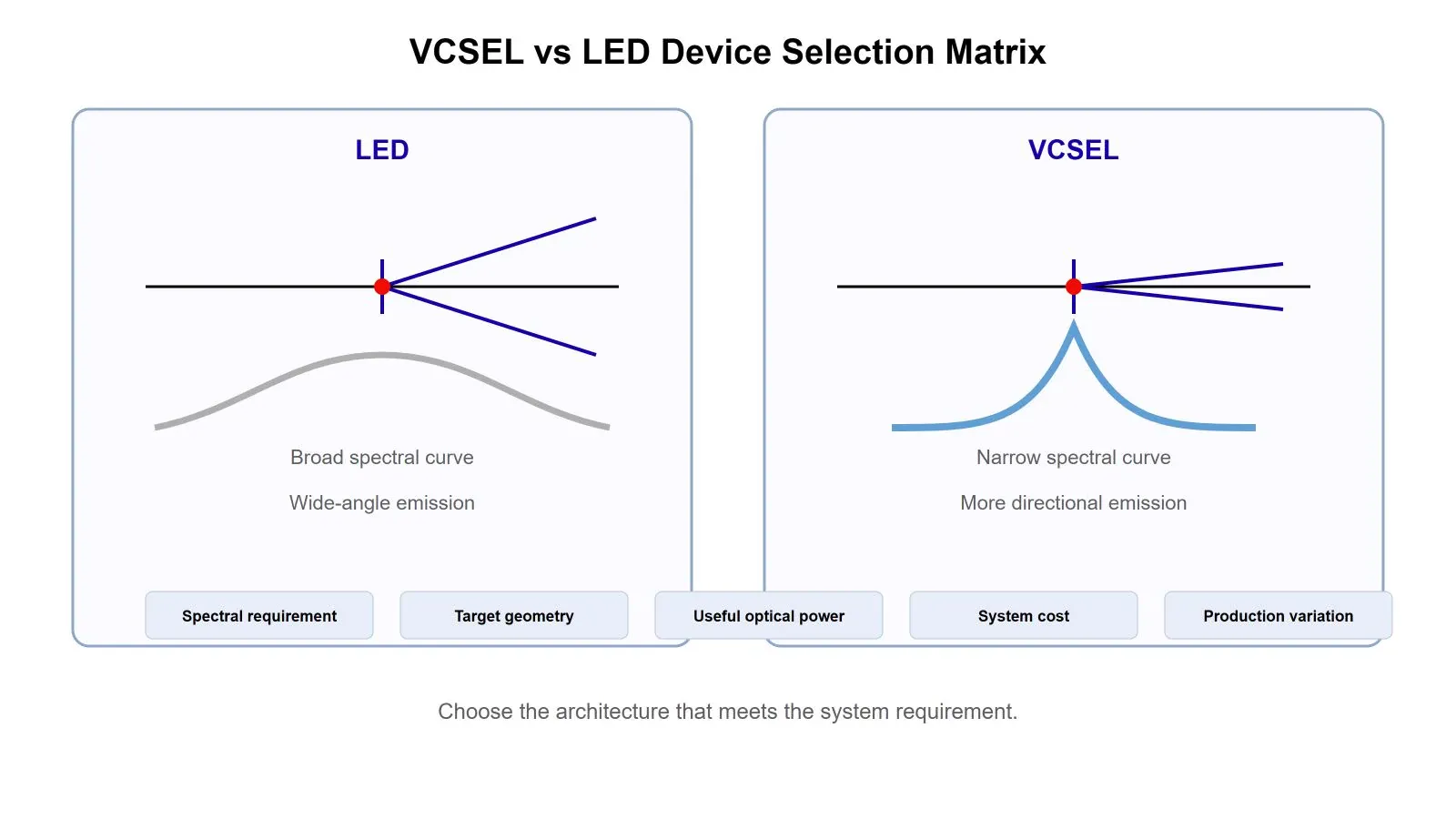
Choose an LED when your device mainly needs broad, inexpensive illumination and can tolerate a wide emission angle and a broader spectrum. Evaluate a VCSEL when the design benefits from a narrower optical spectrum, more directional source emission, or compact monolithic emitter arrays. Neither technology is automatically more efficient or better. The right comparison is the complete optical system under the same operating conditions.
That distinction matters because many source selections are made backward. A team starts with the component it already knows, then tries to make the optics, driver, thermal design, and enclosure fit around it. A better sequence is to define what the target or detector must receive first, then choose the source that reaches that requirement with the least system complexity.
Start with the optical job, not the source category
An LED and a VCSEL are both semiconductor light sources, but they solve different optical problems. LEDs are usually the simpler starting point when a design needs a broad field and does not depend on a tightly controlled spectral or angular output. VCSELs become worth evaluating when the source needs to contribute a narrower optical spectrum, more directional emission, or a specific emitter geometry on a single die.
The decision therefore begins with five questions: what wavelength band does the target or detector require, how much optical power must arrive at the useful area, what angular distribution can the system accept, how much variation is tolerable from unit to unit, and how much optical or mechanical complexity can the product afford around the emitter?
If your team is still establishing the basic architecture, a separate guide explains what a VCSEL is and why its surface-emitting structure changes how the device can be tested, arrayed, and integrated.
A practical VCSEL vs LED decision table
The table is not a ranking. It is a way to identify which source characteristic is actually carrying the decision.
Compare wavelength numbers correctly
“VCSELs have a more precise wavelength” is a common shorthand, but it is incomplete. A datasheet may list peak wavelength tolerance, spectral width, and temperature dependence as separate parameters, and those values are not interchangeable.
The intrinsic difference between the two source types is spectral width: a VCSEL emits over a much narrower band than a broadband LED. Where the center wavelength actually sits in production is a different question, and it is largely set by the bin you specify and buy, because LED and VCSEL suppliers both sort parts into defined wavelength bins.
Do not compare an LED spectral FWHM with a VCSEL peak-wavelength tolerance and call the smaller number “more precise.” One describes the width of the emitted spectrum and the other describes where the peak is allowed to sit. Compare tolerance with tolerance and spectral width with spectral width. Also align current and temperature, because the emission peak of a semiconductor source can shift with operating conditions.
This matters in detector-based systems, wavelength-sensitive optical designs, and any project where a narrow source band is part of the signal budget. If wavelength is only there to create visible illumination over a broad response region, the extra control may add no useful value. A guide on how to read a VCSEL datasheet covers the same comparison discipline parameter by parameter.
Directionality can save light, but it can also create a new design problem
A wide LED beam is not automatically wasteful. If your target is a large nearby surface, broad emission may give you the coverage you need with fewer optical elements. A more directional source can be an advantage when the receiver, lens, aperture, or target occupies a limited angular field because less output leaves in directions the system cannot use.
VCSELs are also attractive because their surface-emitting geometry can support comparatively symmetric beams and two-dimensional emitter arrays formed on a single die. The same vertical emission means the finished emitter can be measured optically before the wafer is diced, and RP Photonics notes that the architecture supports wafer-level testing and characterization, which can move part of the screening process earlier in manufacturing. Treat this as a VCSEL manufacturing characteristic rather than a selection criterion against LEDs: it is most distinctive next to edge-emitting lasers, whose facets generally have to be created by cleaving before the output can be measured properly, while LED production also uses wafer-level probing, testing, and binning.
Directionality, however, is not the same as uniformity. A narrow or structured beam can create peaks, gaps, rings, or local hot spots if emitter spacing and working distance are wrong. The correct question is not “Which source has the smaller angle?” It is “Which source produces the required field at the actual target plane?”
Efficiency has to be measured at the system level
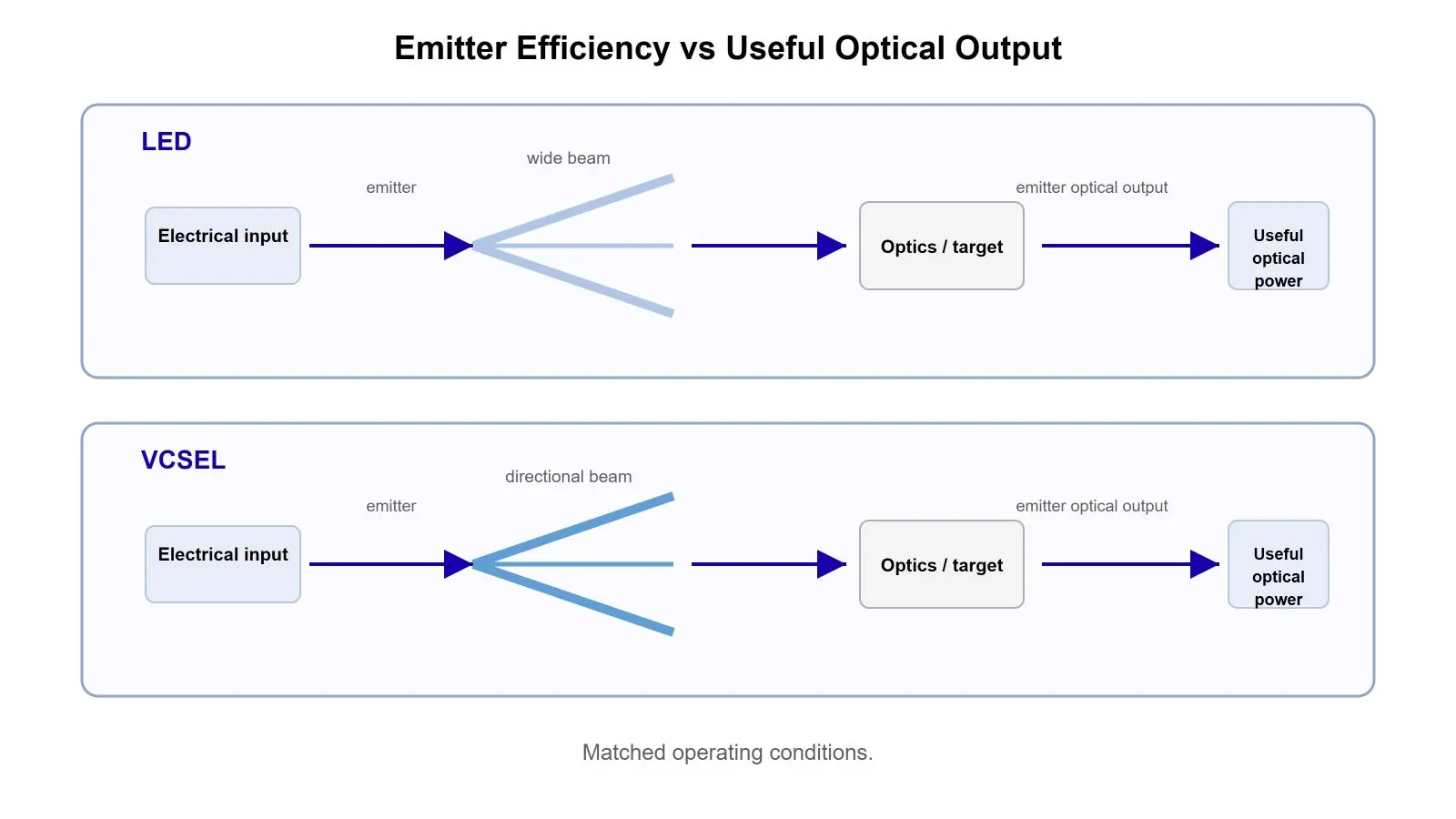
The easiest comparison to misuse is efficiency. A component datasheet may show optical output at a particular current, but that does not tell you how much useful optical power reaches the target after beam spread, lenses, diffusers, windows, filters, and mechanical losses.
At the emitter level, compare electrical input to optical output under matched conditions. For a finished laser system, wall-plug efficiency is a system-level metric and can include power-supply and cooling losses. For an OEM device, the question that matters is how much of that optical output actually reaches the useful area or detector.
This is why “LEDs are more efficient” and “VCSELs are more efficient” are both poor category-level rules. An LED may have the simpler electrical and thermal path in one design. A VCSEL may send a larger fraction of its light into the useful angular field in another. Compare the two sources at the same wavelength, temperature, drive condition, working distance, optical stack, and target geometry. If those conditions are not aligned, the efficiency comparison is not meaningful.
Compare total system cost, not emitter price
For a simple broad-area light source, an LED usually starts with a lower component cost and a mature supply base. That is a real advantage and should not be hidden. A VCSEL only earns its place if a source-level capability removes enough difficulty elsewhere in the design.
A useful cost comparison is:
total optical-source cost = emitter + driver + optics + thermal path + assembly + test + compliance work
If an LED needs extra collimation, more emitters, tighter mechanical shielding, or more calibration to meet the optical requirement, the lowest emitter price may not produce the lowest system cost. The reverse is also true. If a VCSEL still needs a diffuser and added safety controls to create the same broad field an LED already provides, the laser source may be solving a problem the product never had.
The cheapest component and the cheapest architecture are not always the same thing.
Red-light and PBM devices are a good example of why the answer is conditional
Red-light products are often presented as a simple laser-versus-LED argument, but the device requirement is more useful than the label. Both lasers and LEDs have been used in PBM research, and a review of laser and LED photobiomodulation discusses why coherence alone is not a sufficient reason to assume one source will produce a better biological result.
For an OEM team, that shifts the comparison back to engineering. If a facial panel needs inexpensive broad-area coverage and the optical field is easy to validate with LEDs, an LED architecture may be the sensible choice. If a compact scalp or localized device benefits from narrower spectral output or a project-specific wavelength bin, directional emission, a specific emitter layout, or a laser-based product architecture, choose a VCSEL architecture.
For the red-light-specific version of this decision, see Laser vs LED for Red Light Therapy Devices. For a hair-growth device specifically, a companion guide covers how to select a red light source for a hair-growth device from evidence, wavelength, delivered irradiance, and production control.
Wearable PPG is another case where “better source” is the wrong question
A wearable PPG team should not move from LED to VCSEL because laser light sounds more precise. The source only matters through the signal that reaches the photodetector after passing through the complete optical and mechanical stack.
For a compact wearable using red or near-infrared channels, a VCSEL can be worth testing. Directionality and emitter geometry may change how much optical power reaches the detector, while narrower spectral output, or a wavelength bin specified for the project, may instead improve spectral consistency from unit to unit. The proof is not the source datasheet. The proof is the received signal, signal-to-noise ratio, electrical budget, thermal behavior, and tolerance to skin contact and mechanical variation in the finished device.
If the existing LED already meets those system targets with lower cost and simpler integration, there is no engineering reason to replace it. A source technology should remove a measured limitation, not create a new line in the feature list.
Use this five-step selection sequence
1. Define the target plane
Specify the surface, detector, fiber, aperture, or tissue plane that actually needs the light. Record the working distance and useful area.
2. Set the wavelength requirement
Separate the nominal wavelength, allowable peak tolerance, and spectral-width requirement. If the application only cares about a broad band, do not pay for a narrower spectrum or a tighter bin without a reason.
3. Set the beam requirement
Define spot size or illuminated area at the working distance. When comparing datasheets, confirm whether divergence is full angle or half angle and whether it is specified at FWHM, 1/e², D86, or another definition.
4. Compare electrical input to useful optical output
Run both candidates under the conditions the product will actually use. Include optics and target geometry rather than comparing isolated emitter numbers.
5. Price the complete architecture
Add optics, driver, cooling, assembly, test, and any additional safety or compliance work. Only then decide whether the source-level advantage is worth paying for.
Once the source category is settled, the next decision is which VCSEL wavelength to choose, if the project lands on the VCSEL side of the comparison.
About 1ONEVCSEL
1ONEVCSEL is the VCSEL product line of 1ONELASER. It supplies VCSEL components rather than finished devices: single emitters and arrays across 650 to 1064 nm, in selected bare-die, SMD, and COB configurations for OEM and R&D evaluation. The device maker remains responsible for the finished product; the source is delivered as a specified, measured part.
A source comparison is most reliable when it starts from the device requirement, so engineering samples and small evaluation batches are available, along with test data tied to the parts supplied. To match a source to a design, the useful starting information is the target wavelength and tolerance, the required optical output, the working distance and beam requirement, CW or pulsed operation, the package preference, and the limitation in the current design. A small batch can then be compared in the real optical stack before the architecture is committed to production.
Frequently asked questions
Is a VCSEL always better than an LED?
No. An LED is often the better choice for low-cost broad-area illumination where wavelength tolerance and beam direction are not critical. A VCSEL becomes useful when narrower spectral output, directional emission, a project-specific wavelength bin, compact monolithic emitter arrays, or another source-level characteristic solves a real system requirement.
Is a VCSEL more efficient than an LED?
Not as a universal rule. Compare electrical input and useful optical output under the same wavelength, temperature, drive condition, optics, and target geometry. Device-level efficiency can change because one source may waste less light outside the useful field, while the other may require less electrical or optical overhead.
Does a VCSEL have a more precise wavelength than an LED?
VCSELs generally emit over a narrower spectrum than broadband LEDs. Both are sorted into defined wavelength bins by their suppliers, so the meaningful difference is spectral width rather than the existence of binning. Compare like with like, since peak-wavelength tolerance and spectral width are different quantities, and include the stated test temperature and current.
Is a VCSEL automatically better for wearable PPG?
No. A VCSEL is worth evaluating only if its spectral output, beam geometry, package, or screening produces a measurable improvement in the receiver signal, power budget, or mechanical design. If an LED already meets the system targets, changing the source may add cost without solving a problem.
What should you test before replacing an LED with a VCSEL?
Test the finished device, not the source datasheet. Run both sources under the drive current, temperature, and duty cycle the product will use, then measure the optical field at the target plane, the useful power or receiver signal that actually arrives, uniformity, thermal behavior, and unit-to-unit consistency across a small batch. Replace the LED only if the VCSEL removes a limitation you can measure. If the LED already meets the system targets at lower cost and simpler integration, there is no engineering reason to switch.
Does a VCSEL usually cost more than an LED?
At the component level, a simple LED is often cheaper. The relevant B2B comparison is total architecture cost. A VCSEL can still be the lower-cost system choice if it removes enough optics, source count, calibration, or mechanical complexity, but that has to be demonstrated in the actual design.