
Aug 10, 2026Application Insights
Which VCSEL Wavelength Should You Choose?
Which VCSEL wavelength should you choose? A quick map from 650 to 1064 nm to red light, hair removal, high-power, and atomic sensing uses.
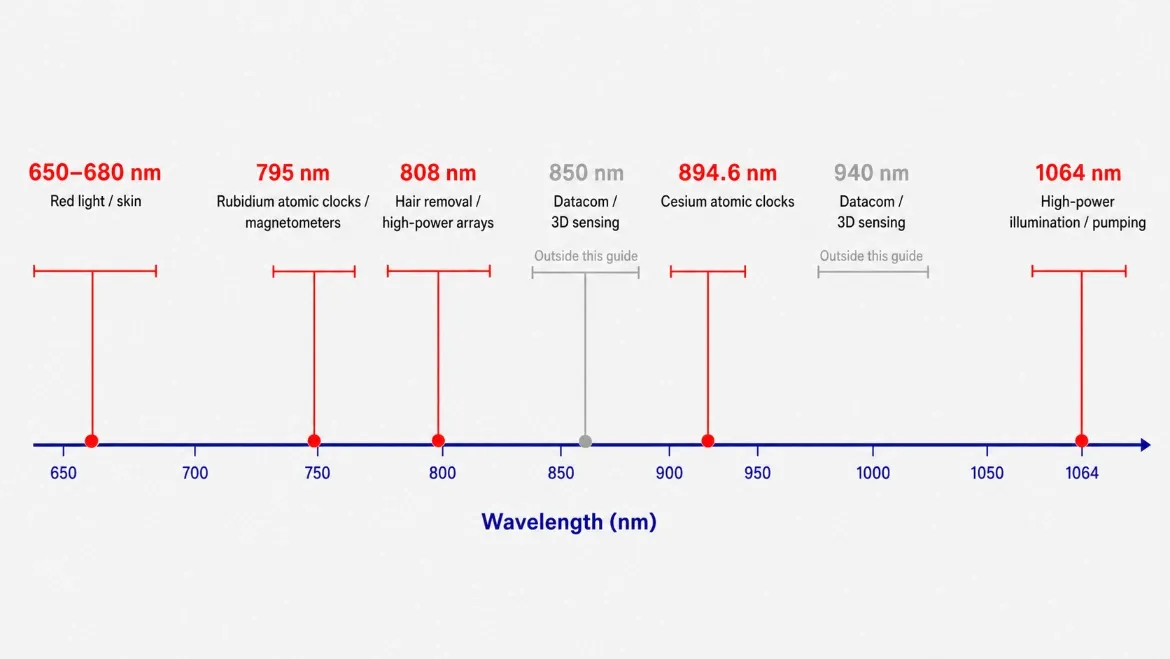
Which VCSEL wavelength you choose comes down to the application, because the wavelength has to match what your target absorbs, reflects, or resonates with, not a preference for a higher or lower number. 1ONEVCSEL supplies VCSEL chips from 650 to 1064 nm, across visible red and the near-infrared, as single emitters and arrays. As a rough map: 650–680 nm is relevant to red-light and skin or scalp devices; 808 nm is widely used in diode-based hair-removal systems; 808 and 1064 nm can support higher-power illumination and pumping; and 795 and 894.6 nm are important in atomic clocks and magnetometers. The right choice follows the target, not the size of the number.
Wavelength | Typical starting point | Main selection concern |
650–680 nm | Red-light / skin and scalp devices | Target spectrum, optical output |
795 nm | Rubidium atomic sensing | Atomic transition, tuning, linewidth and mode |
808 nm | Diode hair-removal / high-power arrays | Output, array architecture, drive |
850 nm | Short-reach datacom | Modulation, coupling |
894.6 nm | Cesium atomic sensing | Atomic transition, stabilization |
940 nm | 3D sensing / outdoor sensing | Background-light rejection, power |
1064 nm | High-power illumination / pumping | Output, thermal design, array configuration |
How to think about VCSEL wavelength
Wavelength is an input, not a score. A source only does useful work if its light is absorbed, reflected, or resonantly matched by whatever it is aimed at, so the wavelength is set by the physics of the target rather than by preference. A longer wavelength is not a better wavelength; it is a different one, suited to a different target.
So the useful question is not which wavelength is best, but which target you are working with. The application groups below cover the main wavelength choices relevant to this guide, with each pointing to the wavelengths worth shortlisting.
650 to 680 nm for red light and skin devices
The visible red band from roughly 630 to 680 nm is where red light and photobiomodulation devices for skin and scalp sit. Within it, 660 nm is the most commonly selected wavelength for red devices, with 650 nm and 670–680 nm also in use depending on the design.
Which exact red wavelength to pick is its own decision, driven by the target and the device rather than by a rule that red is red. A separate guide covers wavelength selection for red light therapy devices in more depth.
808 nm for hair removal; 808 and 1064 nm for high-power applications
Moving into the near-infrared, 808 nm is widely used in diode-based hair-removal systems. Both 808 and 1064 nm can also be relevant where a design requires higher optical output, including illumination and pumping applications. These applications usually call for arrays rather than a single emitter, because the output is built by combining many emitters.
Power here is an array-and-drive question, not a wavelength one. The same 808 nm part can be a low-power emitter or a high-power array, and the rated output has to be read together with its CW, QCW, or pulsed test conditions. How much power a design actually needs is a separate selection question.
795 and 894.6 nm for atomic clocks and magnetometers
Atomic clocks and magnetometers are the strictest case, because the wavelength is fixed by the atom rather than chosen. These devices interrogate an alkali vapor, usually rubidium or cesium, and the source has to land on a specific atomic transition. The rubidium D1 line is at 795.0 nm and the cesium D1 line is at 894.6 nm, and the D1 lines are generally preferred over the D2 lines for atomic clocks.
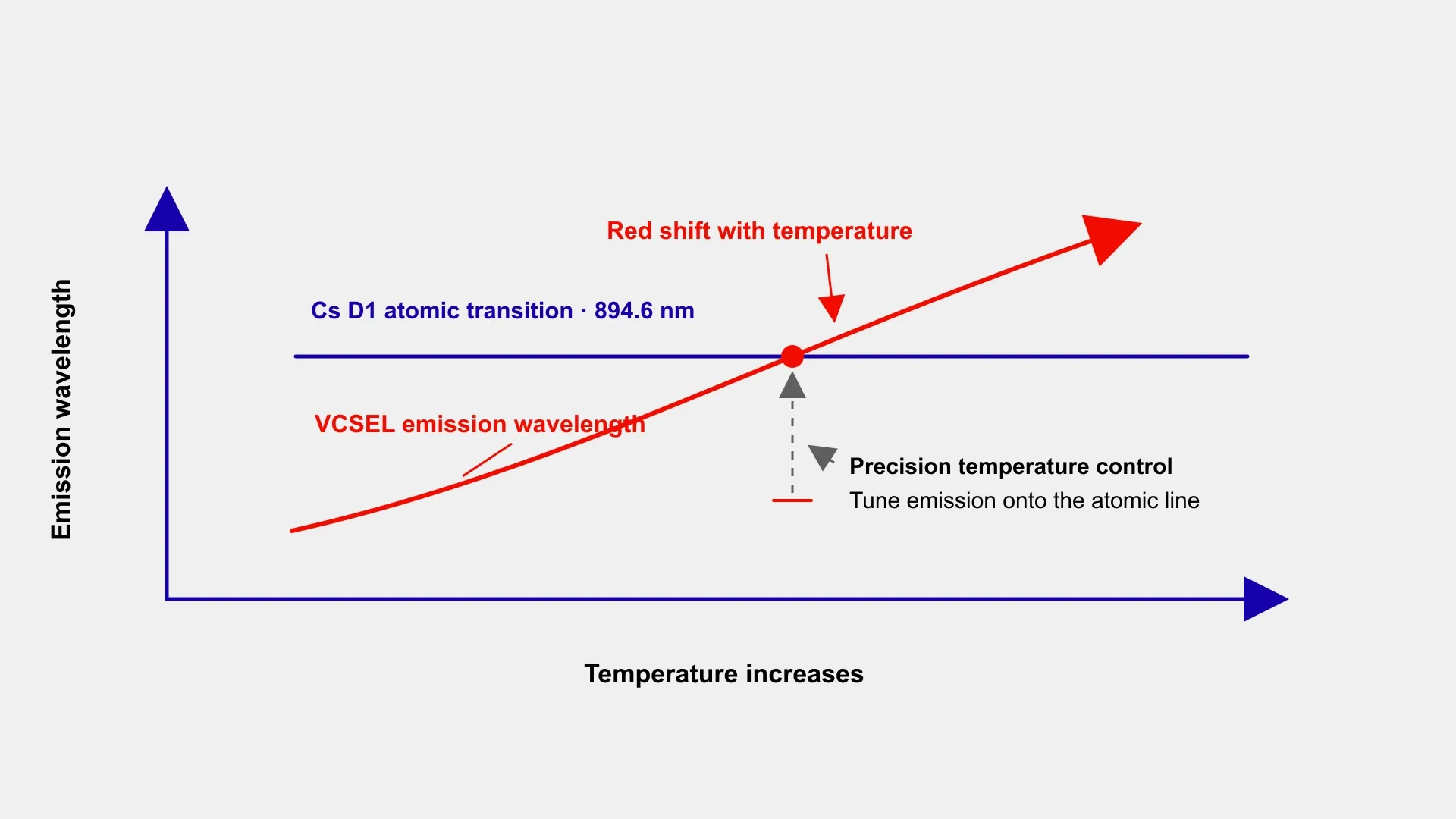
Landing on the line is not just a matter of ordering that center wavelength. The device has to be tuned to the transition, usually by setting temperature and current, and held there, and it typically has to run single-frequency, single-transverse-mode, and single-polarization. Those requirements, together with linewidth and side-mode suppression, are what separate an atomic-grade part from a general one, which is why we provide individualized parameter screening to meet each laboratory’s specific technical requirements. A dedicated guide covers atomic clock source selection in more detail.
850 and 940 nm, and where they sit
For completeness, 850 and 940 nm are two of the most widely used VCSEL wavelengths, particularly in short-reach optical communications and 3D sensing, with 940 nm often chosen outdoors to reduce sunlight interference. Those uses sit outside this guide, which focuses on the visible-red to near-infrared span for light devices, high-power illumination, and atomic sensing. If a design is a datacom or consumer 3D-sensing module, 850 or 940 nm is the usual starting point.
Reading the wavelength a datasheet promises
A datasheet center wavelength is quoted at a specific temperature, and the actual peak wavelength shifts with junction temperature and drive current. The shift is modest, on the order of a fraction of a nanometer per degree, but for a precision application it is the difference between sitting on an atomic line and missing it, so temperature control becomes part of the design. For broadband illumination or many red-light devices, the same shift is often less critical, although it can still matter where the optical system uses narrow spectral tolerances.
The achievable wavelength range also depends on the epitaxial material system and cavity design. Visible-red, conventional near-infrared, and longer-wavelength VCSELs do not necessarily use the same active-layer structure, so wavelength availability should be confirmed at the device level. Much longer wavelengths require different semiconductor material systems and are a separate sourcing question. How wavelength holds with temperature has its own treatment.
Is a higher or lower wavelength ever better?
No. Wavelength is not a quality ladder. In tissue, a longer near-infrared wavelength penetrates more deeply than a visible-red one, but that makes it suited to deeper targets, not better in general, and for a surface target the shorter wavelength is the right tool. The practical rule is simple: select the wavelength from the target first, then optimize power, beam characteristics, and drive conditions around it.
If you are still deciding whether a VCSEL is the right source before picking a wavelength, that is a separate question, covered in a guide on what a VCSEL is and how its structure behaves.
About 1ONEVCSEL
1ONEVCSEL is the VCSEL product line of 1ONELASER. It supplies VCSEL components rather than finished devices: single emitters and arrays, delivered in selected bare-die, SMD, and COB configurations across 650 to 1064 nm, and it can screen parts individually to a project’s wavelength and other requirements.
Most teams settle a wavelength choice by evaluating a small batch before committing, so engineering samples and small evaluation batches are available to check wavelength, optical output, and device behavior at that stage. To point a team at suitable parts, the useful starting information is the target application, the required wavelength or atomic line, CW or pulsed operation, required optical output, and package format.
Frequently asked questions
What wavelengths do 1ONEVCSEL products cover?
1ONEVCSEL products run from 650 to 1064 nm, spanning visible red through the near-infrared. That range covers red light and skin devices, hair removal and high-power illumination, and atomic clocks and magnetometers.
Which wavelength is used for red light therapy?
Red light and photobiomodulation devices generally use the visible red band from about 630 to 680 nm, with 660 nm the most commonly selected. The exact choice depends on the target and the device, which a separate guide covers in detail.
Which wavelength is used for diode laser hair removal?
808 nm is one of the most common wavelengths used in diode-based hair-removal systems. Other wavelength combinations also exist, so the required source should be selected around the specific device architecture rather than wavelength alone.
What wavelength does an atomic clock VCSEL need?
It depends on the atom: the rubidium D1 line is at 795.0 nm and the cesium D1 line is at 894.6 nm, and D1 is generally preferred for atomic clocks. The source has to be tunable and stabilized to that line and run single-frequency and single-mode.
Why are 850 and 940 nm so common if the range is 650 to 1064 nm?
850 and 940 nm are widely used in datacom and 3D sensing. Those applications sit outside the main focus of this guide, which covers light devices, high-power illumination, and atomic sensing.
Does a longer wavelength mean better performance?
No. Wavelength is matched to the target, not ranked. A longer near-infrared wavelength penetrates tissue more deeply, which suits deeper targets, while a surface target calls for a shorter one. Choose by target, then optimize power and beam.