
Aug 25, 2026Application Insights
What Makes VCSELs Suitable for LLLT and PBM Devices?
When does an LLLT or PBM device need a VCSEL? Compare wavelength precision, beam control, array uniformity, and when an LED is enough.
VCSELs suit LLLT and PBM devices when the design depends on wavelength precision, beam direction, uniform irradiance in a small footprint, or a wavelength that stays steady with temperature. A single-mode VCSEL emits a much narrower optical spectrum than a typical red or near-infrared LED, sends light in a defined cone rather than scattering everywhere, and can be sorted to tight wavelength and output bins. 1ONEVCSEL supplies red and near-infrared VCSEL chips for these devices. Where a design needs broad, low-irradiance coverage at low cost, an LED is often the better choice.
What photobiomodulation actually asks of the light source
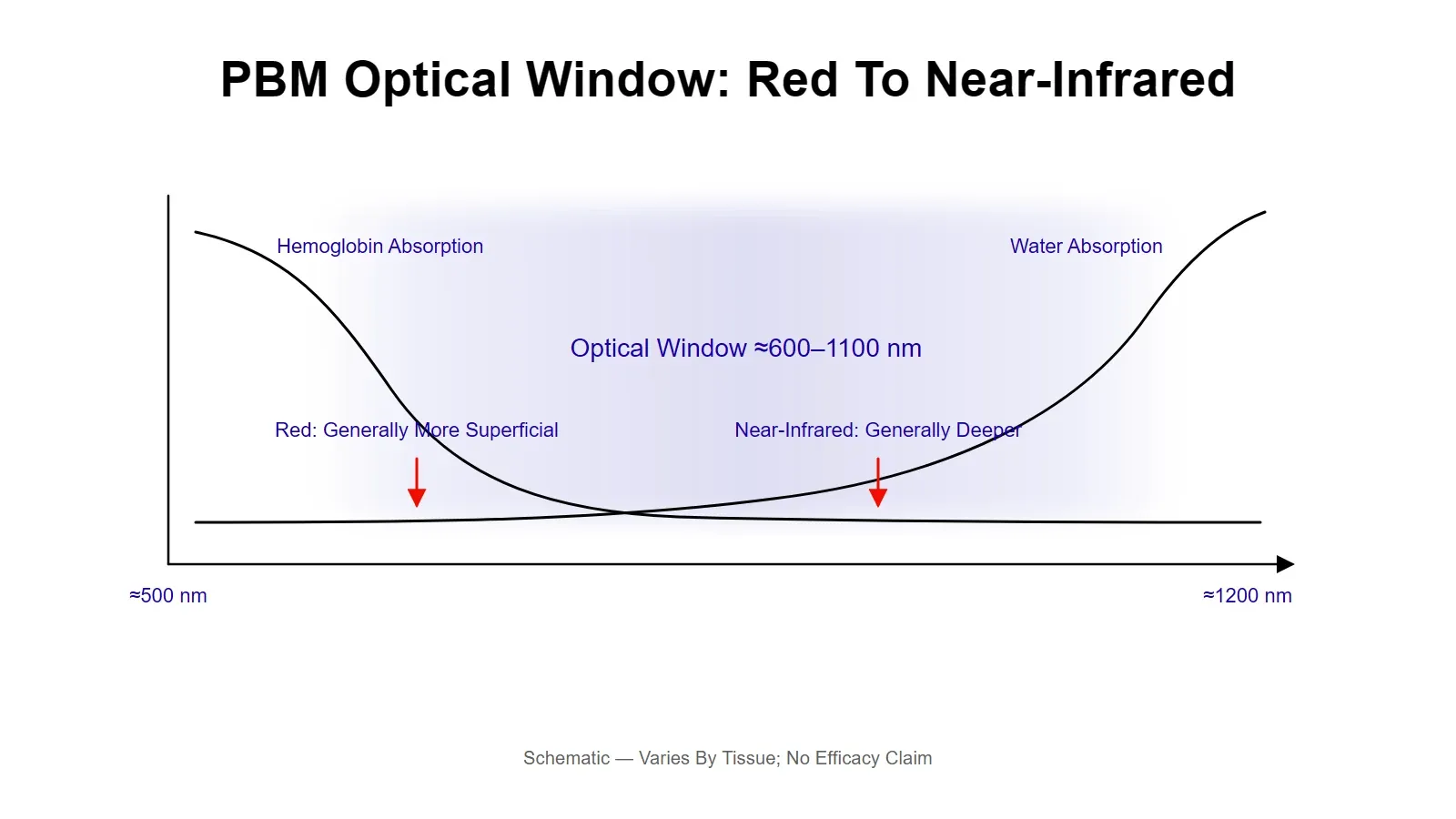
PBM commonly uses red and near-infrared wavelengths, often within roughly 600 to 1100 nm, where tissue absorption tends to be lower than in neighboring parts of the spectrum. The window is not a hard boundary, and it varies with tissue composition and treatment depth. Inside it, red wavelengths near 630 to 680 nm generally act more superficially, and near-infrared wavelengths near 800 to 850 nm generally reach deeper under otherwise comparable conditions. Penetration is not a single figure. It depends on absorption and scattering at the chosen wavelength, the tissue, and how the depth is defined, so it is a property to characterize for your target rather than a number to quote. Which wavelength to choose is its own decision, covered in a guide on wavelength selection for red light devices.
Dose behaves the same way. PBM often shows a biphasic dose response, in which insufficient exposure may produce little measurable effect while excessive exposure can reduce or even reverse the desired response. There is no universal optimal dose in joules per square centimeter, because it shifts with wavelength, target, and delivery.
The mechanism matters here because it decides how much wavelength precision is worth. The most widely cited photoacceptor is cytochrome c oxidase in the mitochondria, but the mechanism is still debated, with interfacial water, light-sensitive ion channels, and other chromophores also proposed. The practical consequence is simple. If a device is designed around a relatively narrow wavelength-dependent response, a narrower source can place a larger share of its output within that band. If the response is broad, the spectral advantage matters less.
The claim to set aside first: coherence and penetration
The most common reason given for choosing a laser over an LED in PBM is that coherent light penetrates deeper. In tissue, that argument is weak, and a device team is better off not building a product on it. Spatial coherence is rapidly degraded by multiple scattering in tissue and is not generally preserved over therapeutic propagation depths, so coherence alone is not a sound basis for claiming greater penetration. Heiskanen and Hamblin’s review comparing lasers and LEDs concluded that coherence is not essential to the PBM effect, and that LED and laser sources produce broadly similar biological results at matched wavelength and dose. A 2026 systematic review of LED and laser wound healing found broadly comparable overall effects as well, though laser treatment was quantitatively superior for a few individual outcomes such as blood vessel density and type I collagen.
Setting this claim aside is not a concession. It sharpens the real case, and it arms you against a competitor who leads with coherence, since that claim does not hold up in tissue. The reasons to choose a VCSEL are about the beam and the spectrum reaching the skin, not about coherence inside it.
What actually separates a VCSEL from an LED
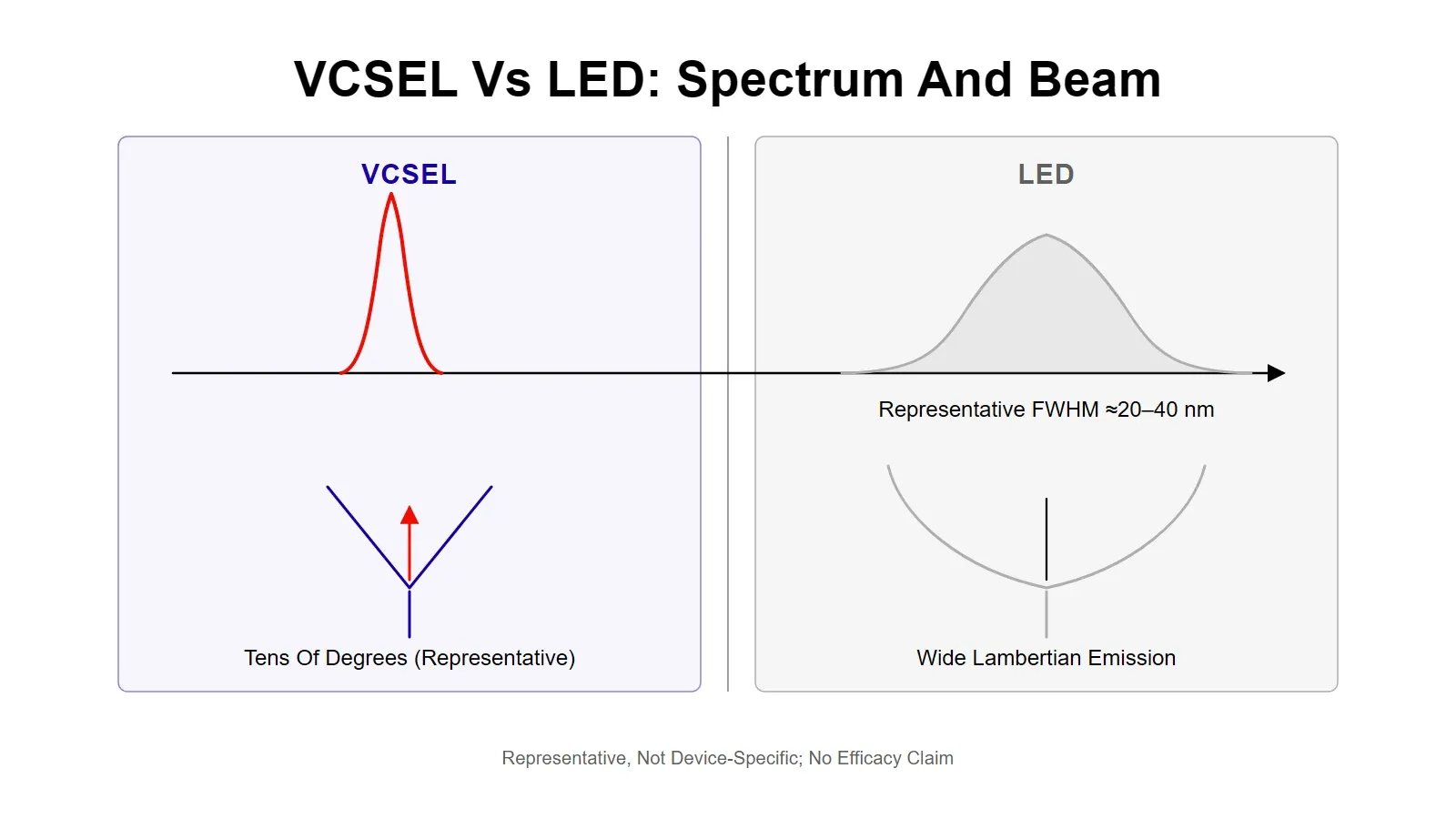
Wavelength precision and stability. A single-mode VCSEL produces a much narrower optical spectrum than a broadband LED, and its center wavelength is comparatively stable, moving only around 0.06 nm per kelvin for representative devices. Many red and near-infrared LEDs emit over a band on the order of tens of nanometers, often around 20 to 40 nm FWHM for representative devices, and both drift and broaden more with temperature. Both source types shift with temperature, but a VCSEL’s narrower spectrum and predictable tuning can make center-wavelength control easier when the application needs tight spectral placement. The exact linewidth and wavelength tolerance depend on the device and operating condition, so confirm them from the datasheet for the part you plan to use.
Beam direction. Depending on the device, a VCSEL may have a divergence on the order of tens of degrees, which optics can collimate or shape. Many conventional LEDs emit into a much broader, Lambertian-like pattern, so a large share of the output never reaches the intended spot without heavy optical loss. For directed or contact delivery, that control helps translate the specified optical output into a predictable irradiance distribution at the target.
Unit-to-unit consistency. VCSELs can be wafer-level tested and binned for optical power, wavelength, and other parameters. LEDs are also routinely binned, so binning itself is not unique to VCSELs. The relevant question is how tightly the selected source can meet the wavelength, output, and spatial-uniformity tolerances your finished device needs. Tight emitter matching can simplify array calibration and reduce one source of unit-to-unit dose variation, though final dose uniformity also depends on emitter placement, drive tolerance, optics, distance to tissue, thermal drift, and calibration.
Thermal design. A VCSEL concentrates optical output into a small emitting area and a directional beam, which changes how heat and optical power are managed in an array. Evaluate thermal performance from the actual wall-plug efficiency, drive current, duty cycle, package thermal resistance, and operating temperature of the selected device, rather than assuming one source type is more efficient than the other at these wavelengths.
When an LED is the right choice
An LED is often enough, and saying so is part of choosing well. If a device covers a large area at low irradiance, tolerates a wide wavelength spread, and competes mainly on price, an LED array meets the brief. General wellness face masks and broad panels sit here. The target is diffuse, irradiance requirements may be modest, and a broad spectrum is acceptable. Paying for VCSEL precision that the design never uses is the mirror image of the mistake this article warns against.
The honest test is whether the design benefits materially from any of the properties above. If it does not, the additional complexity or cost of a VCSEL may not be justified, and an LED is the better choice.
When a VCSEL earns its place
Three questions sort most designs. Does your effect track a specific wavelength, so a narrow, stable line matters? Does the device need uniform, higher irradiance in a compact or contact form, such as a cap, a handheld, or a patch? Does the delivery need direction or collimation rather than a diffuse glow?
If one or more of these matter, a VCSEL becomes worth evaluating against LED and other laser options, since a narrow spectrum can also come from a narrow-band LED or a filtered source, and direction can come from secondary optics. Hair-growth caps are one example where a designer may value compact arrays, wavelength control, and repeatable emitter output, particularly when the optical architecture calls for directed delivery close to the scalp, a use case addressed by the 680 nm hair-growth VCSEL. Wavelength-sensitive dermatology and controlled-dose clinical devices follow similar reasoning. The judgment is not laser versus LED in the abstract. It is whether these specific properties change your device’s result.
About 1ONEVCSEL
1ONEVCSEL is the VCSEL product line of 1ONELASER. It supplies VCSEL components rather than finished devices: single emitters and arrays across 650 to 1064 nm, screened and binned to a project’s wavelength and power requirements, in selected bare-die, SMD, and COB configurations, with datasheets and test data to support evaluation. The device maker remains responsible for the finished product, and the chip is delivered as a specified, measured part.
The main value on a PBM program is in matching the chip to the build and supplying the data to stand behind it. Wavelength selection and binning put the emission where the effect needs it, at 660 nm, 665 nm, 680 nm, or in the near-infrared. Packaging moves the part from bare die into the form the device uses, whether SMD, chip-on-board, or surface-mount for arrays. The 660 nm red light therapy VCSEL chips show one standard wavelength and package point, and the medical and personal care VCSEL solutions page covers the range. A component supplier can also provide component-level documentation to support certification, while the finished-device maker keeps responsibility for laser classification, labeling, intended-use claims, and the regulatory filing. To evaluate, an evaluation kit lets you test wavelength, beam, and output on your own bench, and custom development and ODM covers the form and thermal configuration your device needs.
Frequently asked questions
Is a VCSEL better than an LED for red light therapy?
Not in general. A VCSEL is better when the design depends on wavelength precision, directed or uniform delivery, temperature-stable wavelength, or tight unit-to-unit consistency. For large-area, low-irradiance, cost-driven devices that tolerate a wide spectrum, an LED is often the better choice. The right answer depends on what your effect actually needs.
Does coherent laser light penetrate deeper than LED light?
Not in a way you can rely on. Multiple scattering degrades coherence quickly in tissue, so it is not preserved over therapeutic depths. Penetration is governed mainly by tissue absorption and scattering at the chosen wavelength, rather than by whether the source is coherent. Choosing a VCSEL for penetration is choosing it for the wrong reason.
What wavelengths do LLLT and PBM devices use?
Most sit in the red to near-infrared range, often within roughly 600 to 1100 nm. Red wavelengths near 630 to 680 nm generally act more superficially, and near-infrared wavelengths near 800 to 850 nm generally reach deeper, though penetration also depends on the tissue and the dose. Many devices combine wavelengths.
Can VCSELs be arranged in arrays for masks, caps, or panels?
Yes. VCSELs are made and tested at wafer level and can be binned for close output matching, which suits arrays that need consistent emission across many points. LEDs are also used in arrays and are also binned, so the choice comes down to the wavelength, uniformity, and directionality the device needs.
Should a PBM device use bare die or packaged VCSELs?
It depends on the build. Bare die suits custom assemblies and the tightest footprints. SMD, chip-on-board, or surface-mount packaging suits mask, cap, and handheld products that need a ready-to-place part. The choice follows your assembly process and volume.
Who handles FDA classification of a finished PBM device?
Normally the manufacturer placing the finished device on the market. That company usually carries responsibility for the medical-device submission, labeling, intended-use claims, and final laser-product classification. Component-level documentation from the emitter supplier can support that work, but the exact obligations depend on each company’s regulatory role and how the laser component is supplied.