
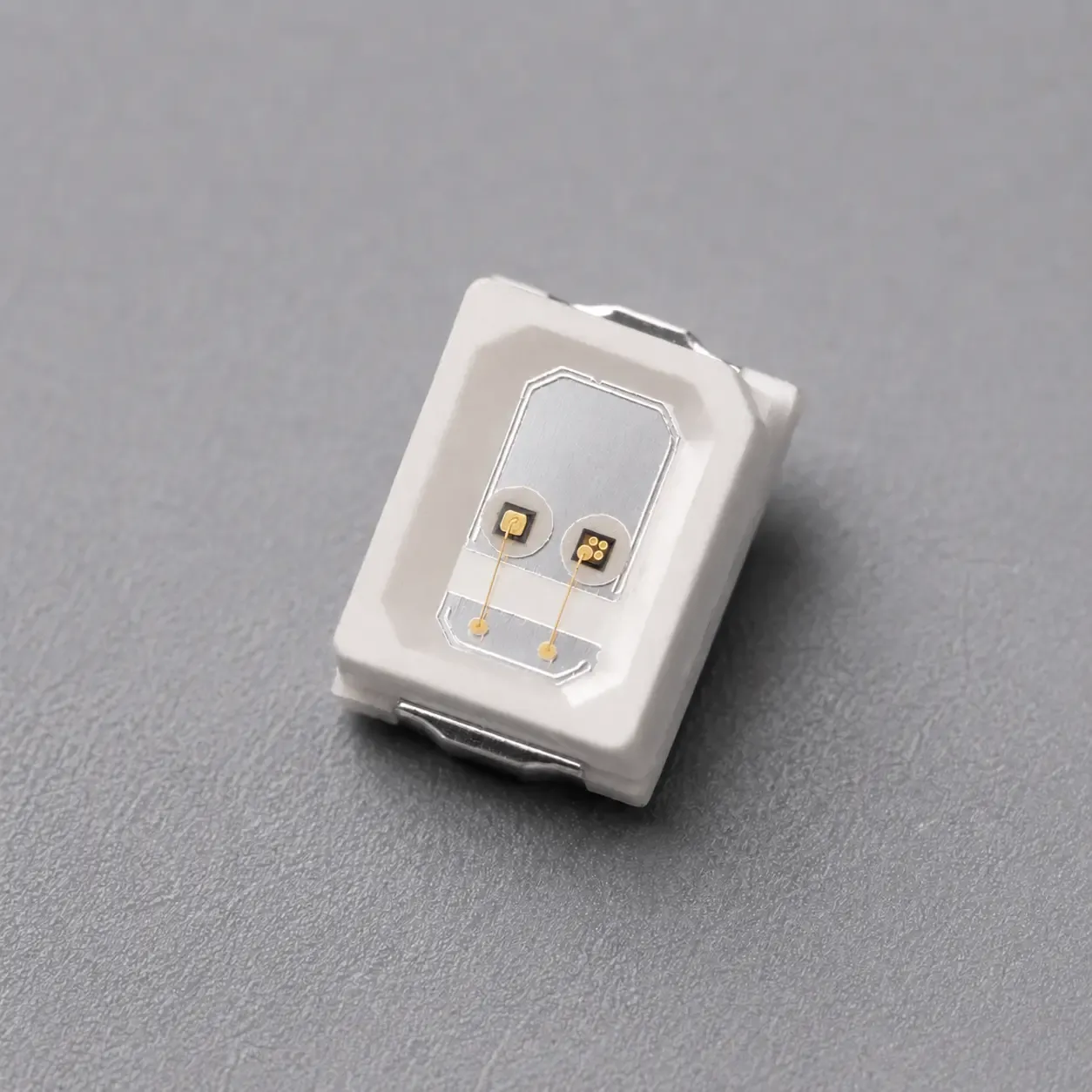
678nm
678nm 5mW 2835 VCSEL SMD
678nm 5mW QCW VCSEL SMD in a 2835 package with 22° divergence for visible-red optical-system evaluation, compact PCB integration and OEM development.
Specifications
- Product Type
- VCSEL SMD
- Wavelength
- 678nm typ.
- Optical Output Power
- 5mW typ.
- Transverse Mode
- Multi-mode VCSEL
- Operating Mode
- QCW
- Beam Divergence
- 22° typ.
- SMD Package Options
- 2835
1. 678nm VCSEL SMD for Wavelength-Specific Hair-Growth Device Evaluation
The 678nm 5mW VCSEL SMD is a wavelength-specific visible-red laser source supplied in a compact 2835 surface-mount package. It is intended for engineering teams evaluating 678nm and nearby 680nm-class optical architectures for laser hair-growth helmets, laser caps and localized scalp-light prototypes.
Unlike the broader 650nm VCSEL SMD Series, which is positioned as the primary surface-mount option for hair-growth equipment, this product serves projects that specifically require a 678nm-typ. source, a 2835 package and an annular beam profile.
The device is supplied for component evaluation and system development. Finished-device optical power density, optical dose, thermal performance, laser safety and regulatory compliance must be validated by the equipment developer.
Lead Time: In-stock products are dispatched within 3 business days; custom-packaged products have a lead time of 15–20 days.
MOQ: The minimum order quantity is 1 reel; selected special models support small-batch orders.
2. Core Optical Characteristics and 2835 Package
The VCSEL has a typical center wavelength of 678nm, with a specified wavelength range of 668nm – 688nm. Its typical optical output power is 5mW, with a specified range of 4–6mW.
The device uses a multi-mode VCSEL structure and operates in QCW mode. It has a typical beam divergence of 22° and produces an annular beam profile.
During system design, developers should evaluate the annular beam profile together with the emitter spacing, working distance and optical arrangement. Complete system-level testing is required to determine scalp optical power-density distribution, optical dose and operating conditions.
The 2835 package measures approximately 3.5 × 2.8mm and is suitable for compact rigid or flexible PCB assemblies, wearable scalp devices and multi-VCSEL layouts.
3. Applications
678nm- and 680nm-Class Hair-Growth Helmet Prototypes
The device supports multi-emitter helmet architectures requiring a 678nm-typ. visible-red source, compact 2835 SMD assembly and an annular beam profile. Emitter quantity, spacing, working distance and driving conditions must be defined and validated at the system level.
Compact Laser Caps and Wearable Scalp Assemblies
The 2835 package supports rigid or flexible PCB layouts for laser caps, scalp-light bands and other space-limited wearable prototypes. Mechanical layout, thermal design and optical coverage should be evaluated according to the finished-device architecture.
Wavelength-Specific Product Benchmarking
This product provides a dedicated component option for engineering teams comparing 678nm and nearby 680nm-class optical designs. It is not claimed as a drop-in replacement for any branded device or existing laser component.
Multi-Emitter PCB Integration
Multiple devices can be arranged in PCB-based optical assemblies for prototype evaluation. The annular beam profile should be assessed together with emitter spacing, working distance, beam overlap, thermal conditions and target optical power-density distribution.
Compare Visible-Red VCSEL SMD Options
Select the wavelength and package according to the optical architecture, product format and required output characteristics.
The primary SMD series for hair-growth devices and evaluation as an alternative to conventional 650nm TO-5.6 laser packages.
For beauty masks, localized red-light PBM devices and compact PCB-based optical systems.
678nm 5mW 2835 VCSEL SMD
For wavelength-specific 678nm and nearby 680nm-class hair-growth helmet and scalp-light prototype evaluation.
For localized scalp-light prototypes, higher-peak multi-point optical systems and visible-red optical research.
Related Articles
4. Evaluation Kit and Documentation Support
The 678nm 5mW VCSEL SMD is available as an Evaluation Kit with 10 pcs / KIT for optical, electrical, thermal and PCB assembly verification.
Samples & Pilot Production: Evaluation kits, low-volume pilot production, and pre-production validation are supported.
- 2835 VCSEL SMD samples
- Product datasheet and package-dimension documentation
- International shipping quoted according to destination
- We offer project-specific configuration of center wavelength, wavelength tolerance and optical power-bin requirements for qualified projects.
For component-level project evaluation, an Initial Product Report covering the Laser Diode Series and VCSEL Laser Diode Chip Series has been filed with the U.S. FDA CDRH. This filing supports technical documentation and product evaluation.
For applicable products, CE, EMC, EN 60825, LVD, RoHS, REACH and halogen-free certification and compliance documents are available. Documentation depends on the corresponding product model and does not represent certification of the customer's finished device.
5. Frequently Asked Questions
FAQ 1. What are the main optical specifications of this 678nm VCSEL SMD?
The device has a typical center wavelength of 678nm, with a specified wavelength range of 668nm – 688nm. Its typical optical output power is 5mW, with a specified range of 4–6mW.
It operates in QCW mode, has a typical beam divergence of 22° and produces an annular beam profile.
FAQ 2. What types of laser hair-growth devices can use this VCSEL?
The device is intended for the development and prototype evaluation of laser hair-growth helmets, laser caps, scalp photobiomodulation equipment, laser combs and localized scalp-light devices.
The device developer must validate emitter quantity, working distance, driving conditions, operating time, optical power-density distribution, thermal performance and complete-system safety.
FAQ 3. Does this 678nm VCSEL SMD support existing 680nm-class laser hair-growth helmet architectures?
Yes. It serves as a component option for 678nm- and nearby 680nm-class laser hair-growth helmet prototypes.
It is not claimed as a direct replacement or drop-in compatible component. Developers must verify wavelength tolerance, optical power, beam profile, divergence, package dimensions, driving conditions, thermal performance and complete-system optical dose.