
Sep 26, 2026Application Insights
How Do You Choose Between 630nm 660nm and 680nm for Red Light Skin Applications
Compare 630nm, 660nm and 680nm for red light skin devices by evidence, tissue depth, irradiance, dose and product design to choose the right wavelength or combination.
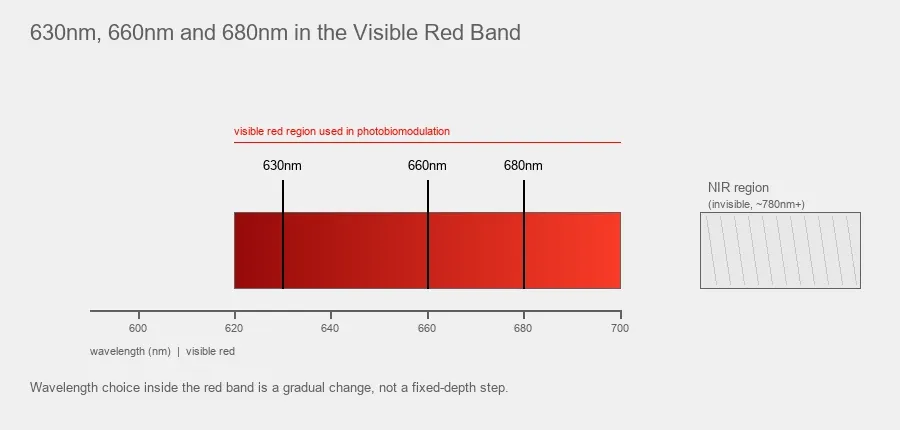
For a red light skin device, 630nm, 660nm and 680nm should not be treated as three quality levels.
All three sit in the visible red region used in photobiomodulation research and device development.
This guide is written for device makers and OEM engineers, not for someone choosing a finished panel. Most wavelength articles online answer the consumer question of which panel to buy, usually comparing 630, 660 and 850nm and mentioning 680nm only in passing. The engineering question is different: which red wavelength, or combination, lets a product deliver a stable, uniform and evidence aligned optical field at the skin. That is the question this article answers, and it is why 680nm gets equal treatment here.
The difference between the three is more practical than hierarchical.
630nm and nearby 633nm wavelengths have a long history in facial skin and photoaging studies.
660nm has one of the broadest research bases across skin, fibroblast, wound and photobiomodulation work and is a common choice for modern red light devices.
680nm sits toward the long wavelength end of the visible red band. It can be useful when a product specifically wants a longer red wavelength, a particular component architecture or somewhat lower superficial attenuation than shorter red wavelengths. However, 680nm does not suddenly behave like near infrared, and the facial skin clinical evidence at exactly 680nm is less extensive than the evidence around 633nm and 660nm.
For a device developer, the correct choice depends on four things:
- What skin target the product is designed around
- What clinical or technical evidence the product wants to follow
- What irradiance and dose reach the skin
- What source and optical architecture can produce a uniform field
The wavelength number alone cannot answer the product question.
The useful comparison in one table
Wavelength | Practical strength | Main design reason to choose it | Main caution |
|---|---|---|---|
630nm | Strong precedent around 630nm to 633nm for facial skin and superficial red light use | Facial rejuvenation concepts, surface skin treatment, evidence aligned products | Slightly greater superficial absorption and scattering than longer red wavelengths |
660nm | Broad PBM research base and extensive component availability | General red light skin devices, masks, panels and multi emitter systems | Do not assume that being common makes dose or layout unimportant |
680nm | Longer edge of the visible red PBM band and useful component options | Products deliberately targeting longer visible red or localized optical designs | Less direct facial clinical evidence at exactly 680nm and not a substitute for NIR when deeper targets matter |
This is a better starting point than saying:
630nm is shallow
660nm is medium
680nm is deep
That simplified ranking overstates what a 20nm to 50nm change can do in real tissue.
All three wavelengths are still visible red
Red light used in photobiomodulation commonly spans roughly 620nm to 680nm depending on the paper or device category.
Moving from 630nm to 680nm changes tissue absorption and scattering gradually. It does not cross a sharp biological boundary.
In general, longer visible red wavelengths experience somewhat less scattering in tissue, and melanin absorption also trends lower as wavelength increases through the visible red region.
That can allow a somewhat larger fraction of incident light to survive to deeper layers.
However, penetration is not determined by wavelength alone.
It also changes with:
- Skin pigmentation
- Blood content
- Tissue thickness
- Angle of incidence
- Contact or noncontact geometry
- Beam diameter
- Irradiance
- Optical source divergence
- Measurement threshold used to define penetration
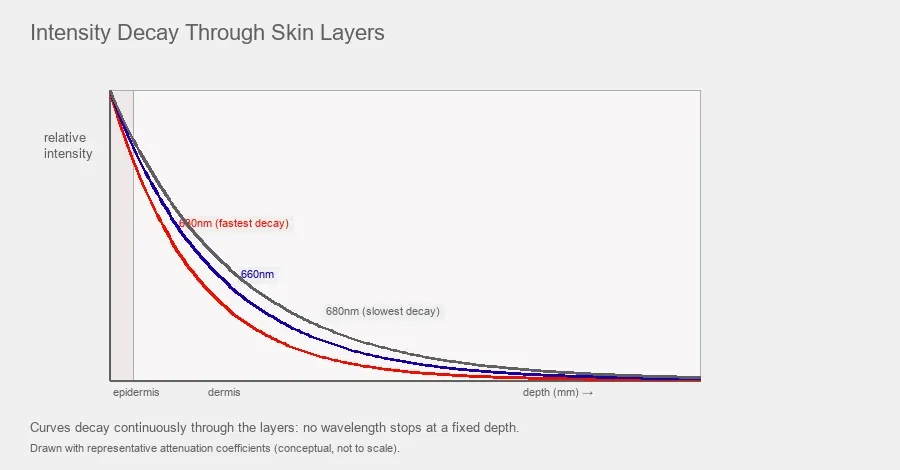
Light does not travel to one fixed depth and then stop.
It decays continuously.
This is worth stressing because most consumer wavelength guides quote a fixed figure, often four to five millimetres, for how deep red light reaches. That number traces back to review estimates for the visible red band, and as a rough order of magnitude it is not unreasonable. The problem is treating it as a hard wall. In reality the fraction of light surviving to a given depth falls off gradually and depends on pigmentation, blood content, tissue thickness, incidence angle, beam geometry and the threshold someone chooses to call the penetration limit. A statement such as 680nm penetrates a specific number of millimetres deeper than 630nm should therefore be treated cautiously unless the tissue model and measurement definition are stated. For device design, the honest version is that for typical skin-device geometries these wavelengths primarily support superficial and dermal exposure, with the surviving fraction changing gradually with wavelength and tissue conditions.
For most facial device developers, the useful conclusion is
:
630nm, 660nm and 680nm are all red light choices for superficial and dermal applications. If the target is substantially deeper than the dermis, adding or moving to near infrared is usually a more meaningful design change than moving from 660nm to 680nm.
Why 630nm remains important
A large part of the facial LED literature uses wavelengths around 630nm to 633nm.
That makes 630nm valuable for a product team whose priority is to stay close to established facial skin protocols.
A systematic review of randomized controlled trials in dermatology includes facial rejuvenation studies using 630nm and 633nm LED light. One well known placebo controlled study used 633nm red light and reported improvements in wrinkles and elasticity under its specific treatment conditions.
Other work combined 633nm with 830nm near infrared for photoaged skin.
This does not prove that 633nm is universally superior to 660nm or 680nm.
It means that the developer has a relatively rich human skin evidence base to study when defining the wavelength, dose and treatment schedule.
When 630nm is a logical starting point
Consider 630nm or a nearby 633nm design when:
- The product is focused on facial skin
- The evidence package is built around published 630nm to 633nm protocols
- The device treats a large superficial area
- The optical design benefits from readily available red LEDs or other emitters in this region
- The product is paired with NIR for a second wavelength channel
What not to assume
Do not assume that 630nm can only act on the epidermis.
Visible red can reach into the dermis, and actual optical distribution depends on the complete tissue and device geometry.
Also do not assume that a product using 630nm automatically reproduces results from a 633nm clinical study.
The delivered irradiance, radiant exposure, treatment frequency, beam geometry and patient population still matter.
Why 660nm is so common in device development
660nm appears frequently in photobiomodulation research and commercial red light devices.
There are practical reasons.
It falls well inside the red PBM region.
660 to 670nm also overlaps a reported red absorption and action region associated with cytochrome c oxidase in several PBM models. CCO remains an important mechanistic hypothesis rather than a complete explanation for every reported PBM effect, so this should support rather than replace application-specific evidence.
It has been studied in skin, fibroblast biology, wound related research and facial rejuvenation.
It is also widely available in LED and laser component formats, which makes it easier to design around cost, package size and optical power.
A randomized facial study comparing 660nm red light with 590nm amber light used equal radiant exposure and reported a reduction in periocular wrinkle volume after the treatment program. Other dermatology reviews cite work in which 660nm light affected collagen related pathways or produced measurable facial outcomes under specific protocols.
Again, that does not create a universal “660nm dose.”
The research uses different irradiances, exposure times and treatment frequencies.
The useful engineering conclusion is that 660nm has a broad enough evidence base to serve as a practical default wavelength when the product team wants one visible red channel and has no strong reason to prioritize 630nm or 680nm.
When 660nm is a logical starting point
Consider 660nm when:
- The product needs a general purpose visible red PBM channel
- The team wants broad component availability
- The design is a wearable mask, panel or multi emitter array
- The product evidence strategy can use studies in the 650nm to 670nm region
- The device may later add an NIR channel
- The sourcing team wants several package and power options
1ONELASER currently has multiple 660nm red light source options and discusses this wavelength as a common device development choice in its 660nm red light source guide.
What 680nm changes
680nm is near the upper end of the visible red region commonly used in PBM.
From an optical perspective, moving toward 680nm can modestly reduce scattering and superficial absorption compared with shorter visible red wavelengths.
That can be useful for some products.
But the difference should be kept in proportion.
A 680nm source is still visible red. It does not become equivalent to 810nm, 830nm or 850nm near infrared.
If the design objective is a clearly deeper optical target, changing from 630nm or 660nm to an NIR wavelength will usually change tissue propagation more significantly than moving within the red band.
The second issue is evidence.
There is experimental skin research at the long red edge near 675 to 680nm. For example, an in vitro study applying 675nm light to human dermal fibroblasts reported modulation of type I and type III collagen expression, including increased type III collagen at 390 J/cm², without reduced cell viability under the tested conditions.
However, when the question is specifically facial rejuvenation in humans, the search landscape is richer around 633nm and 660nm than around exactly 680nm.
That does not make 680nm unsuitable.
It means the developer should be more careful about claiming that 680nm is clinically established for a specific facial outcome unless the supporting evidence actually uses a comparable wavelength and protocol.
When 680nm is a logical choice
Consider 680nm when:
- The product intentionally wants the longer edge of visible red
- The system benefits from available 680nm VCSEL packages or higher peak output options
- The application is localized rather than a broad face mask
- The project has its own validation plan rather than relying mainly on legacy 633nm protocols
- The optical system is being designed around a specific 680nm source
Current 1ONELASER product data includes 680nm VCSEL SMD options in several package and peak output configurations for localized red light and OEM device development.
Those component power numbers should not be read as treatment dose. Some configurations are characterized under QCW conditions, so the pulse width and duty cycle must be included before comparing them with CW sources.
Do not choose a wavelength from penetration alone
“Which wavelength penetrates deepest” is one of the most common red light search queries.
For product development, it is often the wrong primary question.
Suppose a 680nm emitter transmits a somewhat larger fraction of incident light to a given depth than a 630nm emitter.
That advantage can disappear if:
- The 630nm array delivers higher and more uniform surface irradiance
- The 680nm beam has poor overlap and leaves untreated gaps
- The working distance is different
- The 680nm device must run at a lower average power because of thermal limits
- The treatment time changes
- The skin contact geometry changes
- The final device cannot maintain optical output as it warms
A wavelength with theoretically better tissue transmission can therefore produce less useful light at the actual target if the system is poorly designed.
The target metric is not wavelength in isolation.
It is the optical exposure reaching the intended tissue under the real device geometry.
Evidence should be matched to the wavelength band honestly
A common marketing problem is citing one red light study to support every wavelength in the red region.
That is not a good engineering evidence strategy.
A study at 633nm is strongest evidence for the tested 633nm protocol.
It may support a broader biological rationale for red light, but it should not be presented as direct clinical proof for a 680nm product.
Likewise, a 660nm trial does not automatically validate a 630nm device at a different irradiance and treatment duration.
For product development, organize the evidence into three levels.
Level 1
Same or very close wavelength, same application, human clinical study.
This is the most directly useful.
Level 2
Same wavelength region and same tissue target, but different protocol or device geometry.
Useful for design rationale, but not a direct replication.
Level 3
In vitro, animal or different tissue application.
Useful for mechanism or early engineering direction, but weaker for finished product outcome claims.
This framework is especially useful when comparing 630nm, 660nm and 680nm because the quantity of evidence is not equal across all three exact wavelengths.
Irradiance can matter as much as the wavelength choice
Once a suitable red band is selected, the engineering team must define irradiance at the skin.
A source datasheet may state optical power in mW.
The user receives irradiance in mW/cm² across a treatment area.
Those are not the same parameter.
Irradiance depends on:
- Emitter optical power
- Beam divergence
- Working distance
- Emitter pitch
- Number of emitters
- Secondary optics
- Mask or panel geometry
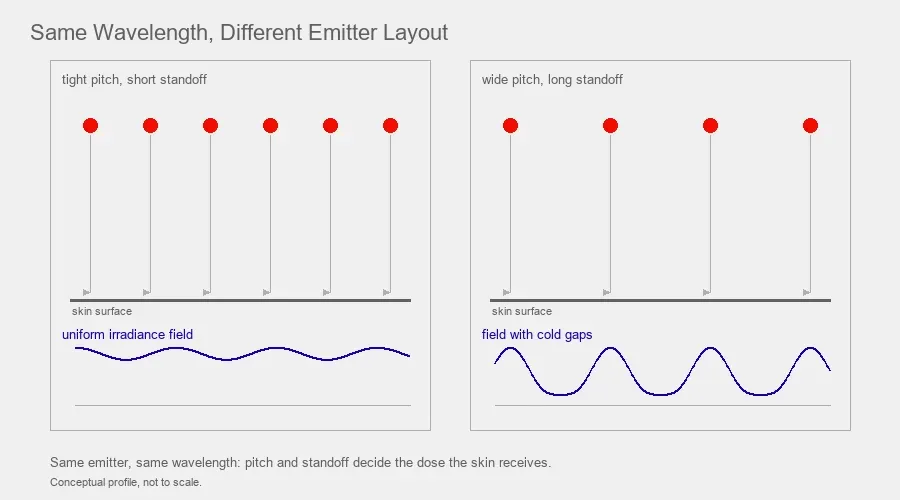
The same 660nm component can produce very different skin exposure in two devices.
Published device irradiance values vary widely and are not directly comparable unless measurement distance, sensor geometry, operating mode and illuminated area are stated. This is why per-emitter optical power cannot be used as a proxy for skin irradiance. A 630nm device with a well designed uniform field may therefore be a better system than a 660nm device with higher per emitter power but poor array geometry.
For wearable devices, test irradiance on a three dimensional facial surface, not only a flat sensor plane
Dose does not make wavelength irrelevant
Radiant exposure is often calculated as:
Radiant exposure in J/cm² = irradiance in mW/cm² × time in seconds ÷ 1000
This calculation is useful, but a matching J/cm² value does not make 630nm, 660nm and 680nm biologically identical.
Wavelength changes absorption.
Irradiance changes the delivery rate.
Pulse structure can change the exposure pattern.
Treatment frequency changes the repeated biological stimulus.
The literature also describes biphasic dose responses, meaning that increasing dose does not always increase the desired response.
A product developer should therefore avoid this reasoning:
“Study A used 633nm at 6J/cm², so our 680nm device only needs to deliver 6J/cm².”
That conclusion skips wavelength, irradiance and protocol differences.
This is not a theoretical worry. A methodological review of visible light LED therapy in dermatology found that studies report such a wide range of irradiances, wavelengths and outcome measures that comparing doses across papers, and sometimes even evaluating efficacy, becomes very difficult. In other words, the published dose numbers a developer might want to copy were often collected under conditions that are not directly comparable. Use published doses as references for protocol development, then validate the actual device.
When a combination of red wavelengths makes sense
Some products use more than one red wavelength.
A combination such as 630nm plus 660nm can be reasonable, but the justification should be stronger than “more wavelengths are better.”
There are several legitimate engineering reasons to combine channels.
Reason 1
Follow multiple evidence bases.
A product may want a 630nm class channel close to established facial studies and a 660nm channel with broad PBM precedent.
Reason 2
Shape the spectral distribution.
Using two source populations can widen the effective red spectrum while keeping both peaks inside the desired band.
Reason 3
Use different emitter architectures.
One wavelength may be supplied by broad angle LEDs and another by a more directional laser source.
Reason 4
Create selectable treatment modes.
The product can expose one wavelength, the other wavelength or both, provided irradiance is measured separately for each mode.
Reason 5
Optimize sourcing and optical layout.
Different available packages may fit different zones of a mask or localized applicator.
What combination wavelengths do not do automatically is double efficacy.
The total treatment field still needs dose, thermal and safety validation.
Red plus near infrared is a different design strategy
Combining 630nm or 660nm red light with 810nm, 830nm or 850nm NIR is more optically distinct than combining two neighboring red wavelengths.
The visible red channel emphasizes superficial and dermal exposure.
The NIR channel usually provides lower visible absorption and scattering and can deliver a different depth distribution.
This is why many facial PBM studies and modern devices pair red with near infrared.
A well known facial skin study combined 633nm and 830nm.
For an OEM, this creates two separate engineering channels rather than one blended number.
Each wavelength should have its own:
- Irradiance
- Emitter count
- Drive current
- Thermal load
- Dose
- Uniformity map
Do not report one combined irradiance value if the user can operate the wavelengths independently.
How to choose between 630nm 660nm and 680nm by product goal
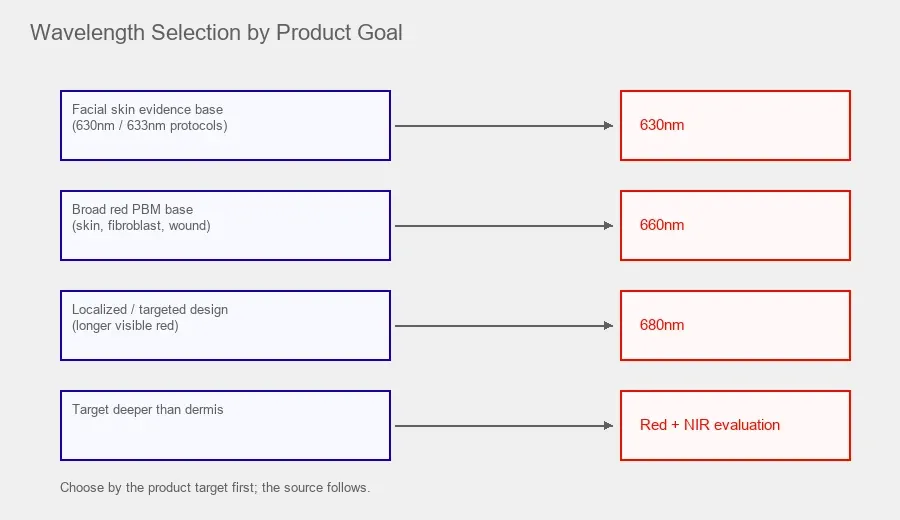
Facial rejuvenation product following established human literature
Start by reviewing 630nm to 633nm and 660nm evidence.
These regions have stronger direct facial skin precedent than 680nm.
If deeper dermal coverage is part of the design rationale, consider adding an NIR channel rather than assuming 680nm alone solves the problem.
General red light wearable device
660nm is a practical starting point because of evidence breadth and component availability.
The final decision should then be based on optical field, thermal design and sourcing.
Localized red light applicator
660nm or 680nm may both be practical.
If the design benefits from a particular 680nm VCSEL power or package configuration, evaluate it in the actual optical geometry.
Research device comparing wavelength response
Use separate channels with measured spectra rather than relying on nominal labels.
A 630nm LED may have a relatively broad emission band, while a VCSEL around 680nm can be much narrower. The experiment should record the actual spectral output of each channel.
Product that needs substantially deeper optical delivery
Do not spend the entire design effort debating 660nm versus 680nm.
Evaluate NIR around the relevant evidence supported region.
That changes the optical propagation more meaningfully.
LED and VCSEL availability can influence the wavelength decision
Clinical evidence is only one part of OEM design.
A wavelength also has to exist in a source format that fits the product.
LEDs are widely available in the red region and are often the easiest route for large area facial masks because their broad emission can create overlap across a curved surface.
VCSELs can be attractive where the design benefits from a more directional source, compact SMD integration, a narrower optical spectrum or specific package options.
At 680nm, for example, 1ONELASER currently lists several VCSEL SMD and bare die configurations.
At 660nm, there are also red VCSEL options for device development.
The wavelength decision should therefore include:
- Evidence
- Source availability
- CW or QCW operation
- Package size
- Optical power
- Beam divergence
- Thermal load
- Driver requirements
- Cost
- Production consistency
This is why two companies building the same type of skin device may rationally choose different red wavelengths.
A procurement specification should include more than wavelength
Do not send a supplier an inquiry that says:
Need 660nm red light source for skin therapy
Send something closer to:
Application
Wearable facial red light device
Target wavelength
660nm typical with agreed wavelength tolerance
Source preference
LED or VCSEL for comparison
Optical requirement
Target irradiance at the skin surface under defined working distance
Working distance
Minimum, nominal and maximum emitter to skin distance
Operating mode
CW or pulsed
Treatment time
Defined session duration
Mechanical layout
Emitter pitch and package size target
Thermal requirement
Maximum board and skin facing surface temperature
Production requirement
Expected volume and required wavelength or optical power binning
If comparing 630nm, 660nm and 680nm samples, keep the geometry as similar as possible and measure actual irradiance rather than comparing datasheet mW values.
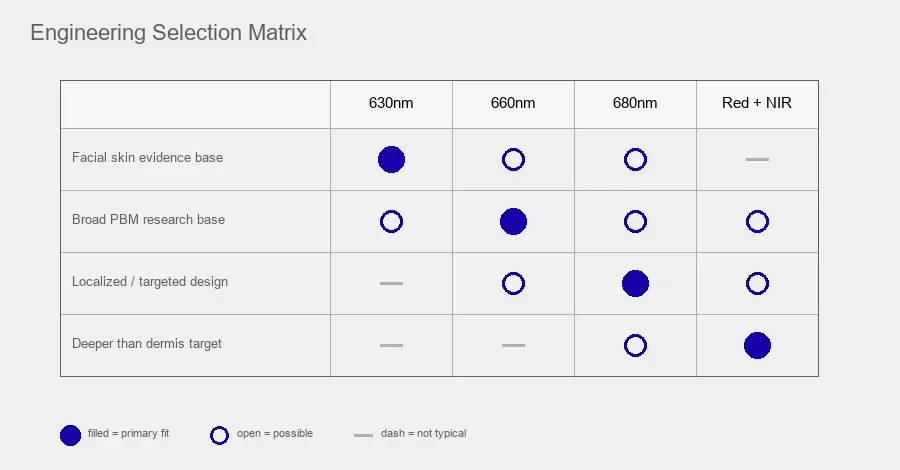
A practical decision matrix
Product priority | 630nm | 660nm | 680nm |
|---|---|---|---|
Strong facial clinical precedent | Strong | Strong | More limited at exact wavelength |
Broad PBM literature | Strong | Very strong | More limited at exact wavelength |
Slightly longer visible red propagation | Baseline | Incrementally longer | Incrementally longer again |
Large area LED mask design | Very practical | Very practical | Practical |
VCSEL component options | Project dependent | Available | Available including higher peak QCW options |
Replacement for NIR | No | No | No |
Best reason to choose | Evidence alignment | General purpose red PBM development | Specific longer red architecture or component need |
This table is a product development guide, not a biological ranking.
The correct final choice still depends on the actual device protocol.
What should be validated before locking the wavelength
Before production, measure the finished device rather than relying on the emitter datasheet.
At minimum:
- 1. Measure the actual output spectrum.
- 2. Confirm wavelength peak and spectral width at operating temperature.
- 3. Map irradiance across the treatment area.
- 4. Measure each wavelength channel separately.
- 5. Calculate radiant exposure from the real treatment time.
- 6. Repeat optical measurements after thermal stabilization.
- 7. Test minimum and maximum user working distance.
- 8. Confirm optical and photobiological safety requirements for the finished product.
- 9. Validate the treatment protocol against the intended product claim and evidence strategy.
This process matters more than debating a nominal 20nm difference without a prototype.
Final engineering rule
Choose 630nm when the product wants to stay close to a strong body of 630nm to 633nm facial skin evidence.
Choose 660nm when the project wants a broadly studied and widely available general purpose red PBM wavelength.
Choose 680nm when the design intentionally benefits from the longer edge of the visible red region or from a specific 680nm source architecture.
Do not choose 680nm merely because it is the largest number.
Its penetration advantage over 660nm is incremental, not a jump into near infrared.
Do not choose 630nm merely because a famous facial study used 633nm.
The finished device still needs the correct irradiance, dose, uniformity and treatment schedule.
And do not treat 660nm as automatically best simply because it is common.
The strongest wavelength decision is the one that connects the biological evidence to a source that can deliver a stable and uniform optical field in the actual product.
For a broader wavelength overview, see Best Wavelength for Red Light Therapy A Guide for Device Makers.
For system level mask design, pair the wavelength decision with emitter layout, working distance, irradiance and thermal validation.
Frequently Asked Questions
Is 660nm better than 630nm for skin
Not universally. Both wavelengths sit in the red PBM region and both have relevant skin research. 630nm to 633nm has strong facial skin precedent, while 660nm has a broad photobiomodulation evidence base and extensive device component availability.
Does 680nm penetrate deeper than 660nm
Longer visible red wavelengths can show somewhat lower scattering and superficial absorption, so 680nm may deliver a somewhat different depth distribution. The difference is gradual and depends on tissue and device geometry. It should not be treated as equivalent to moving into the near infrared region.
Is 680nm better for wrinkles
There is not enough basis to make that general claim. Human facial rejuvenation evidence is richer around 633nm and 660nm than at exactly 680nm. A 680nm product should be validated with its own protocol and evidence strategy.
Can a skin device use both 630nm and 660nm
Yes. Multiple red wavelengths can be used if the design has a clear reason and each channel is properly characterized. Combining wavelengths does not automatically improve efficacy, so irradiance and dose should be measured for every operating mode.
Should a developer choose red or near infrared for deeper tissue
For targets meaningfully below superficial skin and dermis, evaluating NIR is generally a more significant optical change than moving from one visible red wavelength to another.
Does the highest optical power source give the best red light device
No. Per emitter optical power must be converted into a uniform irradiance field at the skin. Working distance, beam divergence, emitter pitch, duty cycle, heat and treatment time all affect the finished device.
What is the therapeutic window for red light
In PBM literature, commonly studied response regions are often grouped around the visible red band and selected near-infrared bands, rather than treated as one sharply defined universal therapeutic window. 630nm, 660nm and 680nm all sit in the visible red portion of that studied range. Sitting inside a studied band does not by itself guarantee a result, because irradiance, dose and protocol still govern the outcome.
How deep does red light actually penetrate the skin
There is no single correct depth. Reviews often cite a few millimetres for visible red light, but penetration is a continuous decay rather than a fixed stopping point, and it changes with skin pigmentation, blood content, tissue thickness, beam geometry and the threshold used to define the limit. For typical skin-device geometries, 630nm, 660nm and 680nm primarily support superficial and dermal exposure, while the fraction of light surviving to greater depths changes continuously with wavelength, tissue properties and device geometry. For clearly deeper targets, near infrared is a more meaningful change than moving within the red band..