
Aug 29, 2026Technical Insights
Which Light Source Does an Equine Red Light Therapy Device Need?
Equine red light therapy devices: why 660nm is a surface tool on a horse, how the coat eats irradiance, and when near-infrared is required.
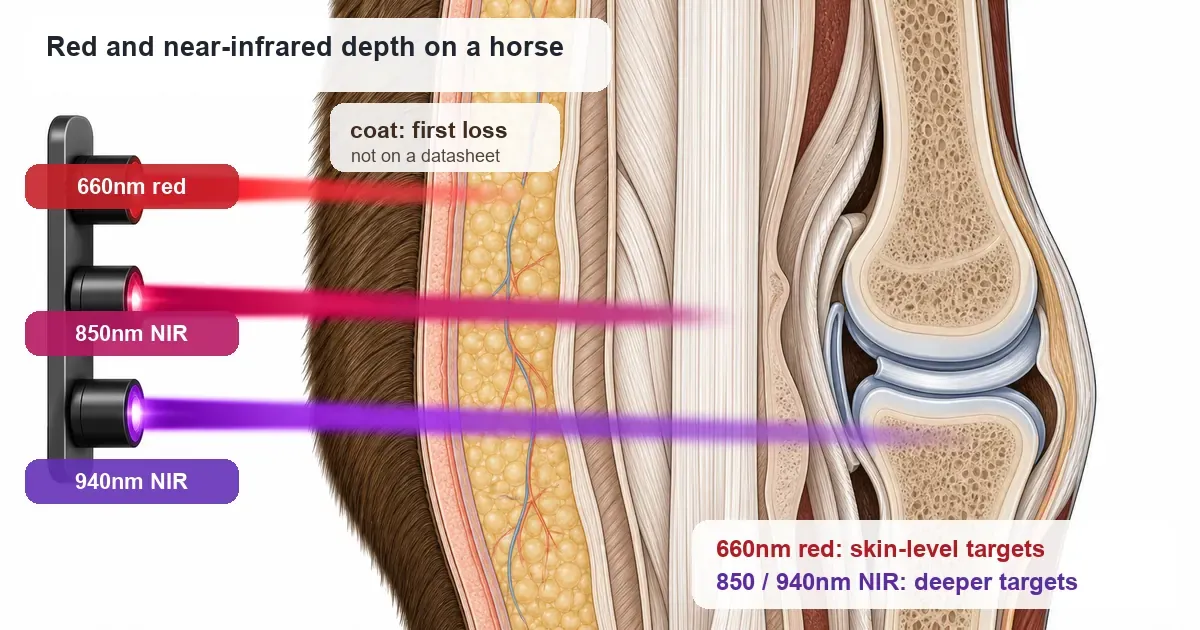
In an equine red light therapy device, 660nm red is a skin, wound, and surface-circulation tool. It does not reach a tendon or a joint on a horse, and driving it harder will not change that. Deep targets need near-infrared. The two variables that actually decide the design, the coat and the working distance, appear on no datasheet. This article covers what they do to your light budget before you pick an emitter.
An equine device is not a scaled-up human device
Every red light source you can buy is characterized the same way: optical power in milliwatts, measured in air, at the face of the emitter. That number is honest, and it is also the last point in the system where anyone knows what is going on.
Between that emitter face and an equine target sit three things a human device never has to cross. A hair coat, which changes with season, breed, and whether anyone clipped. Skin that is thicker than human skin. And pigment that varies across the same animal, since a bay with four white socks has dark skin under the body and pink skin under the markings. Scale then compounds all three, because a treatment area on a horse is measured in hundreds of square centimeters, not the twenty of a face mask.
None of that is exotic biology. It is optics, and it is all subtraction. What survives to the tissue is what treats it, and every one of those layers takes a cut before you get a vote.
The coat is the first loss and it is not on your datasheet
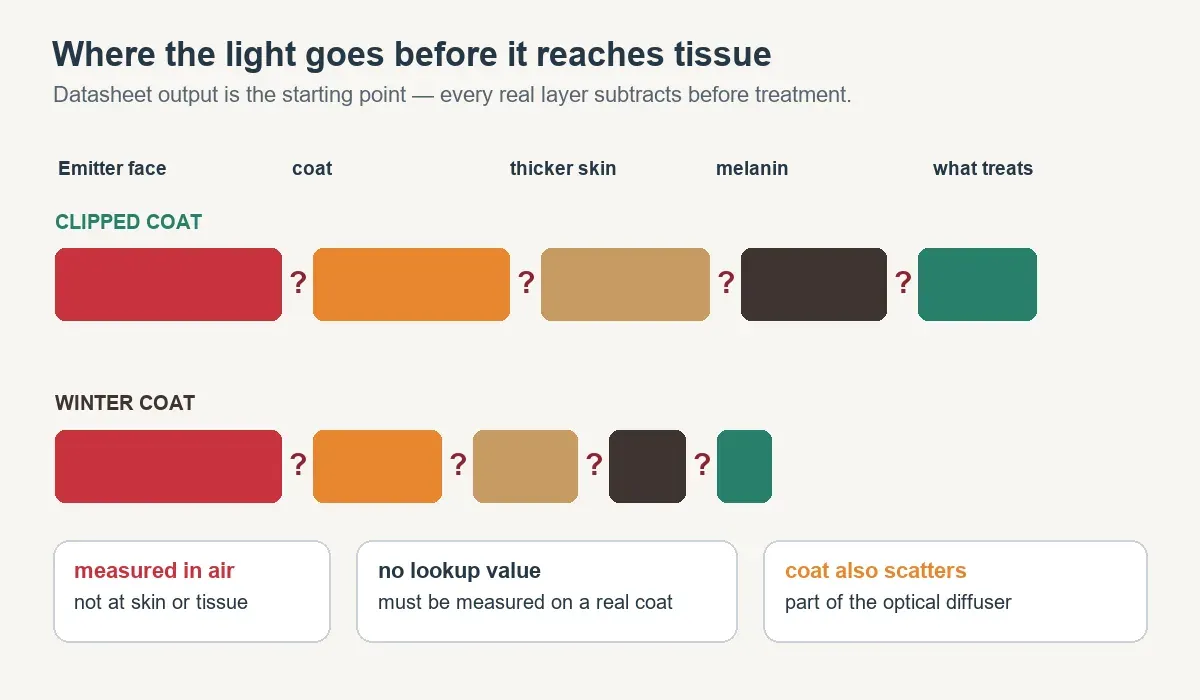
Light meets hair before it meets skin. Hair scatters and absorbs, and a winter coat on an unclipped horse is a different optical system from a clipped summer leg. Same animal, same hardware, different physics.
The industry already knows this, even if nobody writes it down as engineering. Read any practitioner protocol and you will find some version of clip the hair and clean the skin over the target. That instruction is the admission. Clipping is what people do when the coat is taking too much of the light, and a device that only works on a clipped horse has quietly narrowed its market to the horses someone was willing to clip.
An in-vivo equine tendon transmission study at 810nm found greater light transmission after clipping, with or without alcohol cleaning, than in the unprepared condition.
There is a second half to this that works in your favor. The coat does not only steal photons, it scatters them, and scattering broadens a beam. In a wrap pressed against a leg, the coat is doing part of the diffusing job your optics would otherwise have to do. That turns out to matter for emitter pitch, which comes up below.
The practical consequence is blunt. Any irradiance figure you calculate from datasheet output is a number at the emitter, not at the skin, and the ratio between them on a real coat is not something you can look up. It has to be measured: your emitter, your standoff, your wrap material, a real coat, clipped and unclipped. That measurement is the first thing an equine program should build, before the array layout is drawn.
Why red light does not reach an equine tendon
Red light around 660nm sits in the red response region that PBM work targets, where absorption in the red and near-infrared is reported, though the absorber itself is still debated. The mechanism is not what decides this design. The budget is. Visible red is absorbed and scattered more strongly in superficial tissue than near-infrared, and how far it actually gets is not a fixed number. On a horse it is spending whatever budget it has on the coat and thicker skin first. Whatever your marketing says, that photon is not arriving at a superficial digital flexor tendon, and it is certainly not arriving at a fetlock.
This is not a weakness in 660nm. It is what 660nm is for, and on a horse the surface is a real place with real problems: wounds, abrasions, girth and tack rubs, surface circulation, skin. There is also a component-level role in antimicrobial photodynamic equipment: select 660nm to match the photosensitizer’s absorption band. State the caveat plainly, because this one gets abused: the photosensitizer does the antimicrobial work and the light activates it. Red light on its own is not disinfection, and describing it that way in a veterinary market is how a product gets taken apart by someone qualified to do it.
For anything below the dermis, meaning tendon, ligament, joint, or muscle, the design moves to near-infrared, where absorption by melanin and hemoglobin drops and more of the beam survives the trip. That is why almost every serious equine product on the market runs red and NIR together. It is not a marketing stack. It is two different jobs that no single wavelength does. Which wavelength for which depth is set out in our wavelength selection guide.
Pigment decides which wavelength survives
Melanin absorbs visible red far more strongly than it absorbs near-infrared. On a horse this is not a footnote, because your device has to work on a black Friesian and on a gray, and often on both ends of the same animal.
Design for the worst case, not the demo. A device validated on a chestnut with a clipped leg and pink skin is being shown its easiest possible optical path. The same device on a dark-coated, dark-skinned horse in winter is delivering a fraction of that to the same depth, with nothing on the front panel telling the user so. This is where the red-plus-NIR split earns its place a second time: NIR is the wavelength least bothered by which horse walked into the barn.
A contact wrap breaks the pitch math
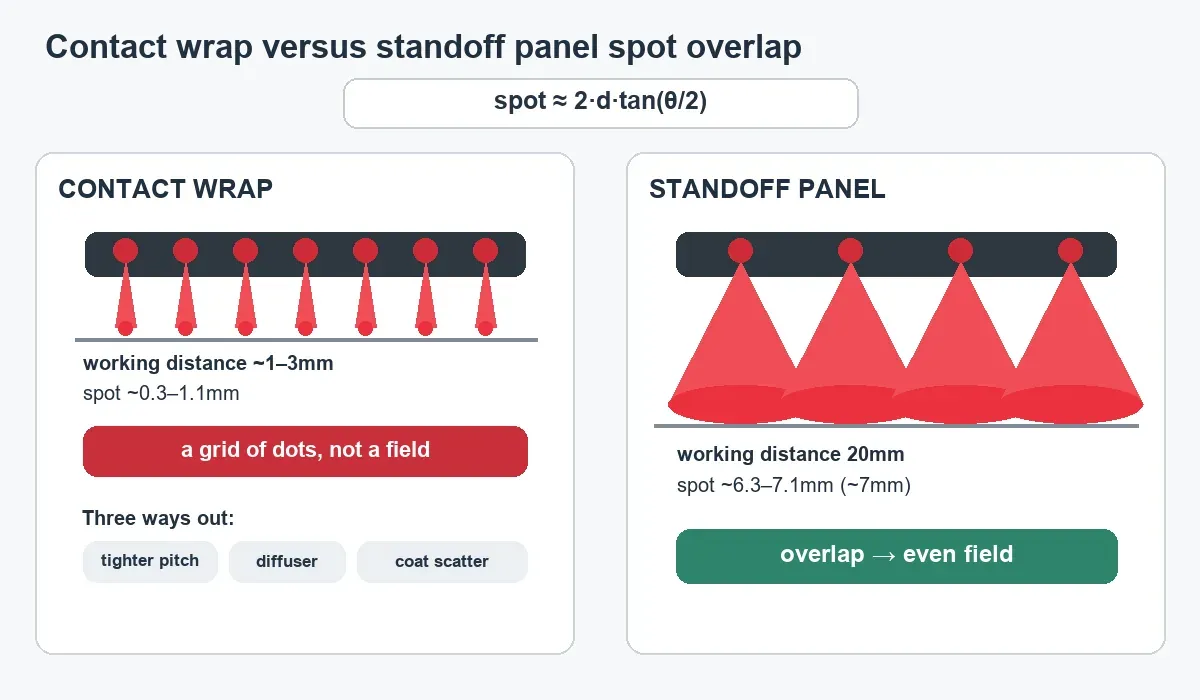
Beam geometry for these VCSELs is simple:
spot diameter ≈ 2 × working distance × tan(divergence ÷ 2)
At the 18°–20° typical divergence of the red SMD parts, working distance decides everything:
Working distance | Spot diameter (18°–20°) | Typical form factor |
|---|---|---|
1mm | ~0.3–0.4mm | wrap pressed to coat |
3mm | ~1.0–1.1mm | wrap over coat |
5mm | ~1.6–1.8mm | padded wrap |
10mm | ~3.2–3.5mm | standoff pad |
20mm | ~6.3–7.1mm | panel or hood |
A panel at 20mm standoff throws a 7mm spot, so a 7mm emitter pitch gives you overlap and something like an even field. Strap that same board to a leg and the standoff collapses to a millimeter or two. The spots shrink to under a millimeter and stop touching each other entirely. You have not built a field. You have built a grid of dots with dark ground in between, and the average irradiance on your report will not show it.
Three ways out, and you will probably use two. Tighten the pitch until the spots overlap at contact distance, which for a sub-millimeter spot means a lot of emitters. Add a diffuser and pay for it in output. Or use the coat and skin, which scatter the light for you. That last option is the honest one, and it is what makes measuring through a real coat non-negotiable rather than nice to have, because your optical design now depends on it. The underlying irradiance and dose arithmetic is the same as any red-light array; the working distance is what an equine wrap changes.
Scale changes the electrical problem
A face mask runs perhaps 120 emitters. A hindquarter rug or a full-leg wrap can run several hundred, and it runs them off a battery, on an animal that moves.
The arithmetic is unforgiving. At 2.3–2.6V and 10mA, a red VCSEL draws roughly 23–26mW of electrical power and converts 5–7mW of it into light; the remaining approximately 16–21mW becomes heat. Six hundred emitters therefore place roughly 9.6–12.6W of thermal load into a flexible board wrapped around a limb, with a coat over it holding the heat in. NIR emitters are more efficient and give some of that back, but the shape of the problem does not change: on an equine device, waste heat and battery constrain emitter count long before optical output does.
That is the argument for getting the dose calculation right rather than reaching for a bigger number. Photobiomodulation follows a biphasic dose response, so past an optimum the reported effect falls away, and more optical power is not a free upgrade even when the battery could carry it.
Fitting red and near-infrared on one wrap
Once the design accepts that it needs red for the surface and NIR for depth, the integration question arrives: two wavelengths, one flexible board, limited area, and a pitch requirement that just got tighter because of contact standoff.
Discrete emitters in two populations is the obvious answer and often the right one. The alternative is a multi-wavelength VCSEL SMD that carries red and near-infrared in a single package with independently driven channels. That keeps one pick-and-place population, one pitch, and one thermal footprint, and it lets firmware sequence the bands instead of the layout fixing the ratio. The trade is that you buy the ratio the package gives you, where discretes let you tune red-to-NIR count independently. Neither is automatically right. It depends on whether your protocol needs a tunable ratio or a fixed one.
Specifying the emitter
For the red channel, the choice is format. The 660nm VCSEL SMD series comes in 5mW and 7mW classes across 2016 to 5730 packages for teams placing finished parts on a flexible or rigid board. The 660nm bare die suits packaging houses and module makers building their own submount, which is worth considering for equine specifically, where a custom submount can buy the tight pitch that contact standoff demands.
Two specifications matter more here than in a human device. Wavelength binning first, because a batch that drifts across the absorption curve changes what the finished device delivers, and in this market a vet may be watching the outcome: 660nm typical, with tolerance specified per model and center wavelength, tolerance, and power bin all specifiable per project. Drive characteristics second, because your battery budget is set by them: threshold around 1.5–4.0mA, forward voltage 2.3–2.6V at 10mA.
The component boundary in a veterinary market
The emitter is a component. The finished-device manufacturer remains responsible for optical-dose validation, irradiance at the coat and at the skin, treatment distance, thermal design, laser-safety classification, applicable photobiological risk assessment, and every claim on the box. Standards such as EN 60825-1 may be relevant to laser product classification depending on the finished product and jurisdiction. A supplier provides the light source and its specifications, not therapeutic performance. Veterinary regulatory status varies by market and is the device maker’s to establish.
The honest summary for an equine red light therapy program: pick red for what red does, add near-infrared for depth, then go and measure what your wrap actually delivers through a real coat on a real horse before committing the layout. Evaluation kits of 10 pieces are one practical route to getting that measurement done early, which is the only place it is cheap. 1ONELASER develops red and near-infrared light-source solutions in bare die, SMD, and multi-wavelength packages, with custom package and array options where a catalog part cannot meet the pitch a wrap needs. That is the kind of project we typically support.
FAQ
What wavelength do equine red light therapy devices use?
Almost all of them run red and near-infrared together, typically 660nm plus 850nm or 940nm. Red at 660nm treats skin, wounds, and surface circulation. It does not penetrate to tendons or joints on a horse, especially through a coat, so near-infrared covers the deep targets.
Does red light therapy reach a horse’s tendon?
Not at 660nm. Visible red is absorbed and scattered strongly in superficial tissue, and how far it gets is not a fixed number, but on a horse whatever budget it has is spent on the coat and thicker skin first. Tendons, ligaments, and joints are near-infrared targets. A device claiming otherwise is describing marketing rather than optics.
How much light does a horse’s coat absorb?
There is no lookup value, which is the point. Loss depends on coat length, density, color, season, whether the horse is clipped, and how hard the wrap presses. It has to be measured with your emitter, your standoff, and a real coat, clipped and unclipped, before the array is designed.
Does coat and skin color change the design?
Yes. Melanin absorbs visible red much more strongly than near-infrared, so a dark-coated, dark-skinned horse receives less red at depth than a light one. Validate against the worst optical case, not the demo animal, and lean on near-infrared for depth because it is the least affected by pigment.
What emitter pitch works in a contact wrap?
Much tighter than a panel. Spot diameter ≈ 2 × working distance × tan(divergence ÷ 2), so at contact the spot falls under a millimeter and neighboring spots stop overlapping. Options are a very tight pitch, a diffuser, or relying on the coat and skin to scatter, which is another reason to measure through a real coat.
Do canine and small-animal devices have the same problem?
The physics is identical and the coat can be worse, since a double-coated dog is a dense optical barrier. What changes is scale and target depth: smaller anatomy brings some targets back within reach, but pigment, coat, and the contact-standoff pitch problem all still apply.
Does 1ONELASER support veterinary device designs?
Yes, at component level: 660nm red as SMD and bare die, near-infrared, and multi-wavelength SMD packages, with custom package and array options where a catalog part cannot meet the pitch a contact wrap needs, and evaluation kits for design-in testing. The device maker validates the finished product and owns all clinical, regulatory, and marketing claims.