
Sep 8, 2026Technical Insights
Single Mode vs Multimode VCSEL Which Should You Choose
Single-mode vs multimode VCSEL comparison for OEMs. See how beam quality, power, spectrum, polarization, and application needs affect selection.
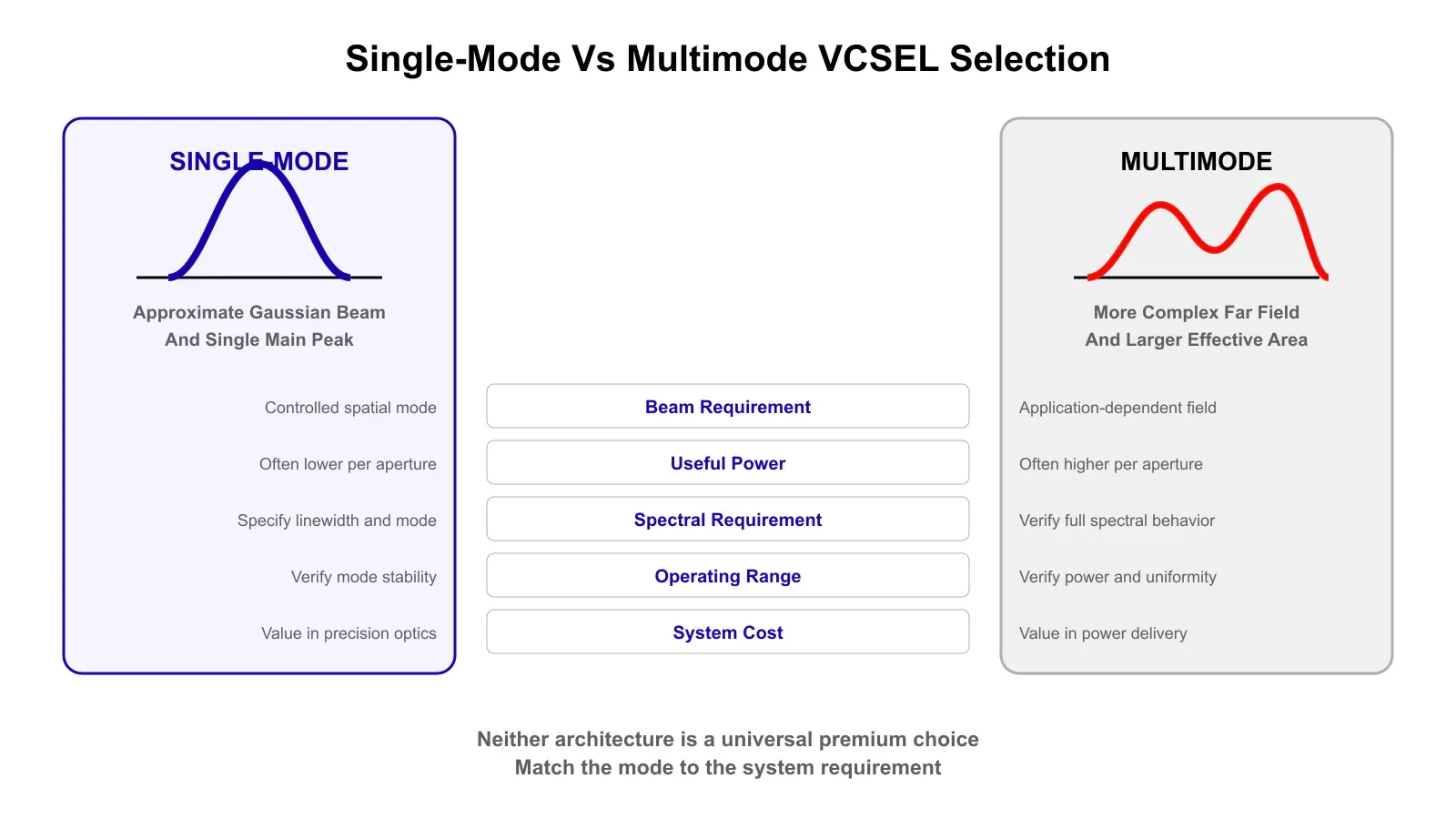
Choose a single-mode VCSEL when the application depends on a clean fundamental beam, or when a precision optical architecture also requires tightly specified spectral and polarization behavior. Those spectral and polarization requirements still need to be specified separately. Choose a multimode VCSEL when higher optical output, a larger emitting aperture, or robust illumination matters more than fundamental-mode beam quality.
The common mistake is treating single mode as the premium version of multimode. It is not. The two architectures optimize different things. Paying for single-mode performance does not improve a system that only needs illumination, and choosing a higher-power multimode source can make a precision optical system harder to stabilize or couple. For an OEM team, the decision should be made from the receiver, the target, or the optical interaction backward.
The table below summarizes how the two architectures compare on the requirements that usually drive the decision. The sections that follow explain each row and give the qualification questions to ask before requesting samples.
Requirement | Single Mode VCSEL | Multimode VCSEL |
|---|---|---|
Transverse mode | Fundamental mode dominant | Multiple transverse modes allowed |
Beam profile | Cleaner and easier to focus or couple | More structured and application dependent |
Higher power from one emitting aperture | More constrained if the fundamental mode must be maintained | Usually easier with a larger active aperture |
Tight optical coupling | Strong candidate | Depends on receiver acceptance |
Atomic clocks and vapor-cell OPM sensing | Usually required | Usually unsuitable |
Flood illumination | Often unnecessary | Common practical choice |
PPG and reflective sensing | System dependent | Often sufficient |
Cost decision | Compare total system cost | Compare total system cost |
First define what single mode means in the specification
In this article, single mode refers primarily to single transverse mode unless longitudinal mode is stated explicitly, because that is where two candidate parts most often differ. A VCSEL can be described in terms of transverse modes, longitudinal modes, and polarization, and these are related but not the same specification.
A single-transverse-mode VCSEL is designed so that the fundamental lateral mode dominates rather than several spatial modes oscillating at once, which gives the source a cleaner near field and usually a more Gaussian-like far field. A single-longitudinal-mode requirement instead concerns the optical frequencies supported along the cavity axis. Conventional short-cavity VCSELs commonly operate in a single longitudinal mode while still supporting multiple transverse modes, so a product still needs to be qualified for the spectral behavior the application requires. Polarization is a third, separate requirement: a device may need stable linear polarization even when its other mode specifications look acceptable, and in atomic and precision optics this is often quantified as an orthogonal polarization suppression ratio.
This distinction matters most in precision sensing. If a specification simply says single mode without defining whether it means transverse mode, longitudinal mode, polarization stability, linewidth, or side-mode suppression, two suppliers can ship parts that satisfy very different interpretations of the same word. If the team still needs the architecture background, start with what a VCSEL is before comparing mode behavior.
Why multimode VCSELs can deliver more useful power
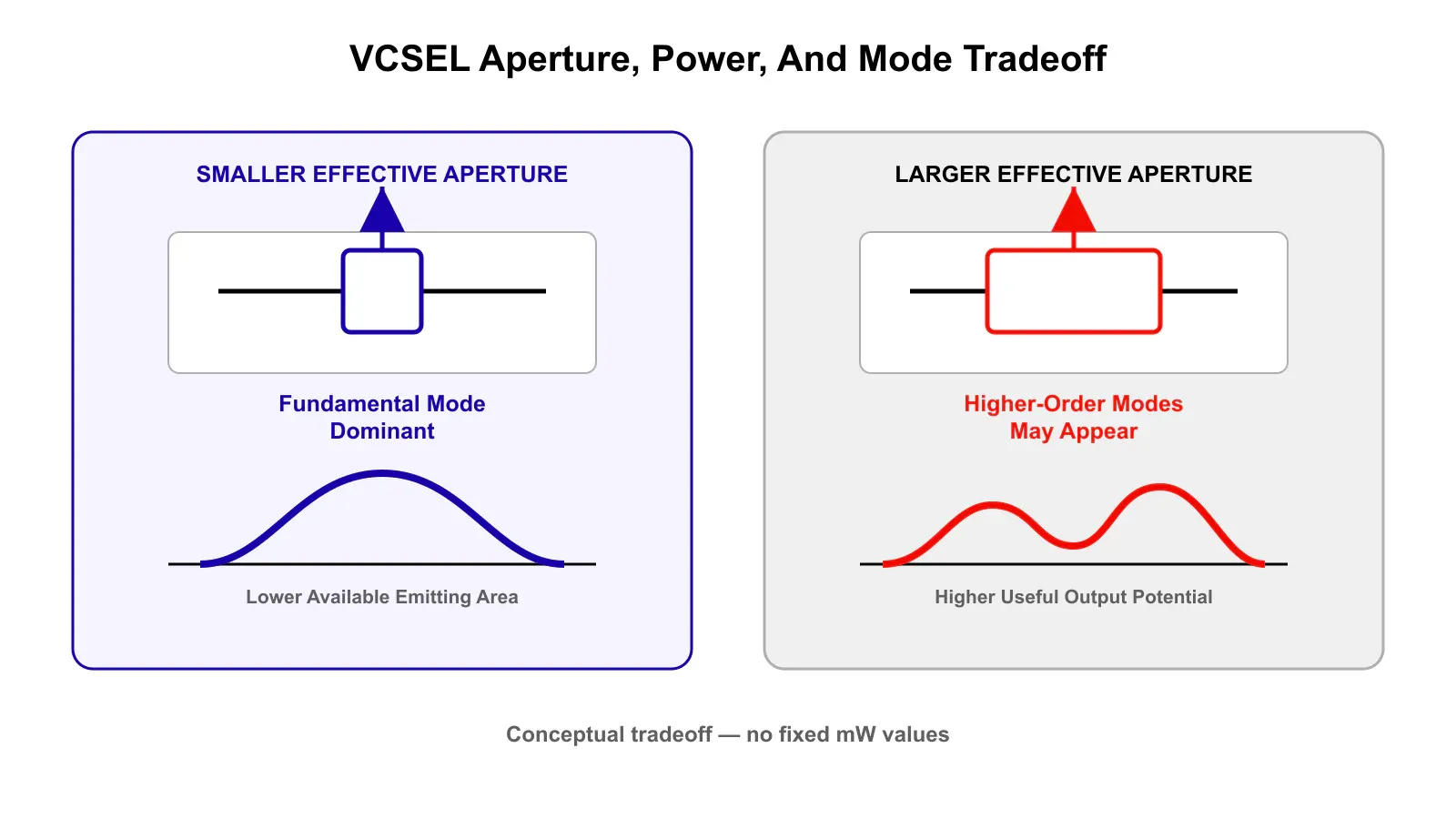
A conventional way to force a VCSEL toward fundamental transverse-mode operation is to restrict the effective optical and current aperture. That helps suppress higher-order modes, but it also reduces the active area available to generate optical power and can increase electrical and thermal resistance.
This creates a real engineering tradeoff rather than a simple quality hierarchy.
Research on transverse-mode control describes an output power and mode composition tradeoff. Enlarging the effective mode area can raise output, but it also makes it easier for higher-order transverse modes to oscillate. More advanced structures can push the single-mode power limit upward, but the underlying design problem remains.
A multimode VCSEL can therefore be the more practical source when the application needs substantial optical output from a compact emitter and does not require a fundamental Gaussian mode.
Commercial devices reflect that split. Multimode VCSELs for high-power illumination and sensing are offered for applications such as time-of-flight sensing, flood illumination, and in-cabin illumination. Those products are designed around useful power and field illumination rather than atomic spectroscopy.
Do not turn those examples into a universal wattage rule. The achievable output depends on wavelength, junction architecture, emitter area, array size, pulse width, duty cycle, temperature, and package.
Beam quality is where the modes become visible to the system
A single fundamental transverse mode usually produces the cleaner beam, which matters when the next optical element is a small aperture, a single-mode fiber, a tightly focused spot, an interferometric system, or another component that only accepts a limited spatial mode. Multimode VCSELs can show more complicated near-field and far-field patterns, and depending on the design and operating point, higher-order modes can produce annular, lobed, or otherwise structured intensity distributions. That is not automatically a defect, because a broad illumination system may only care about the integrated field after a diffuser or lens.
The useful question is not whether a beam looks cleaner on a camera but what fraction of optical power reaches the receiver or target after the complete optical path. For a coupling application, that means measuring coupling efficiency and stability; for a sensing aperture, received optical power and signal-to-noise ratio; for an illumination system, irradiance and uniformity mapped at the actual working distance; and for a focused system, the spot and beam propagation under the real operating current and temperature. A mode label is only useful when it predicts one of those system measurements.
Single mode is often necessary in atomic sensing
Atomic clocks and optically pumped magnetometers are good examples of applications where multimode output is usually the wrong starting point. The source has to interact with a narrow atomic transition, so mode structure, linewidth, wavelength tuning, polarization, and noise all affect the quality of that interaction. A broad or unstable spectrum is not simply extra light: it can place optical power where the atomic system does not use it and can convert laser frequency noise into amplitude noise on the detected signal. A review of VCSELs in atomic sensors describes single-mode, narrow-linewidth, polarization-controlled VCSELs as enabling sources for compact atomic clocks, magnetometers, and related sensors.
The published requirements are specific enough to plan around. The source generally has to sit on a chosen transition such as the rubidium or cesium D line, maintain a single transverse mode, and hold a controlled polarization state appropriate to the interrogation scheme. A 2022 review of commercial VCSELs for atomic magnetometers lists linewidth specifications of 50 MHz, 60 MHz, and 100 MHz, illustrating how the acceptable linewidth depends on the device and the sensing architecture rather than a single universal threshold. Recent research has demonstrated substantially narrower devices: a single-mode narrow-linewidth VCSEL for chip-scale atomic clocks on the cesium D1 line reached an intrinsic linewidth near 1 MHz with a side-mode suppression ratio above 35 dB and an orthogonal polarization suppression ratio above 25 dB. Those values belong to that reported device, which uses a monolithically integrated passive cavity, and its test conditions, so they should not be treated as generic single-mode VCSEL specifications.
Because the qualification set is this specific, a chip-scale atomic clock VCSEL should be specified from the atomic transition and modulation scheme rather than from optical power alone, and that companion article covers the vapor-cell and modulation details this section deliberately does not repeat. For Rb D1 and Cs D1 vapor-cell systems already at the sourcing stage, 795 nm and 894.6 nm single-mode VCSELs are direct starting points for atomic clock and OPM evaluation. When requesting samples, ask for more than the words single mode. A workable qualification set covers target wavelength and tuning range, linewidth at the intended operating point, side-mode suppression ratio, polarization state and orthogonal polarization suppression ratio, optical output across the current range, wavelength shift with current and temperature, modulation response where the system uses direct-current or RF modulation, relative intensity noise where it affects signal-to-noise ratio, and mode stability across the full temperature range. A device that is single mode at one current on a room-temperature datasheet may not stay in that modal state throughout the product operating envelope.
Precision sensing does not automatically mean single mode
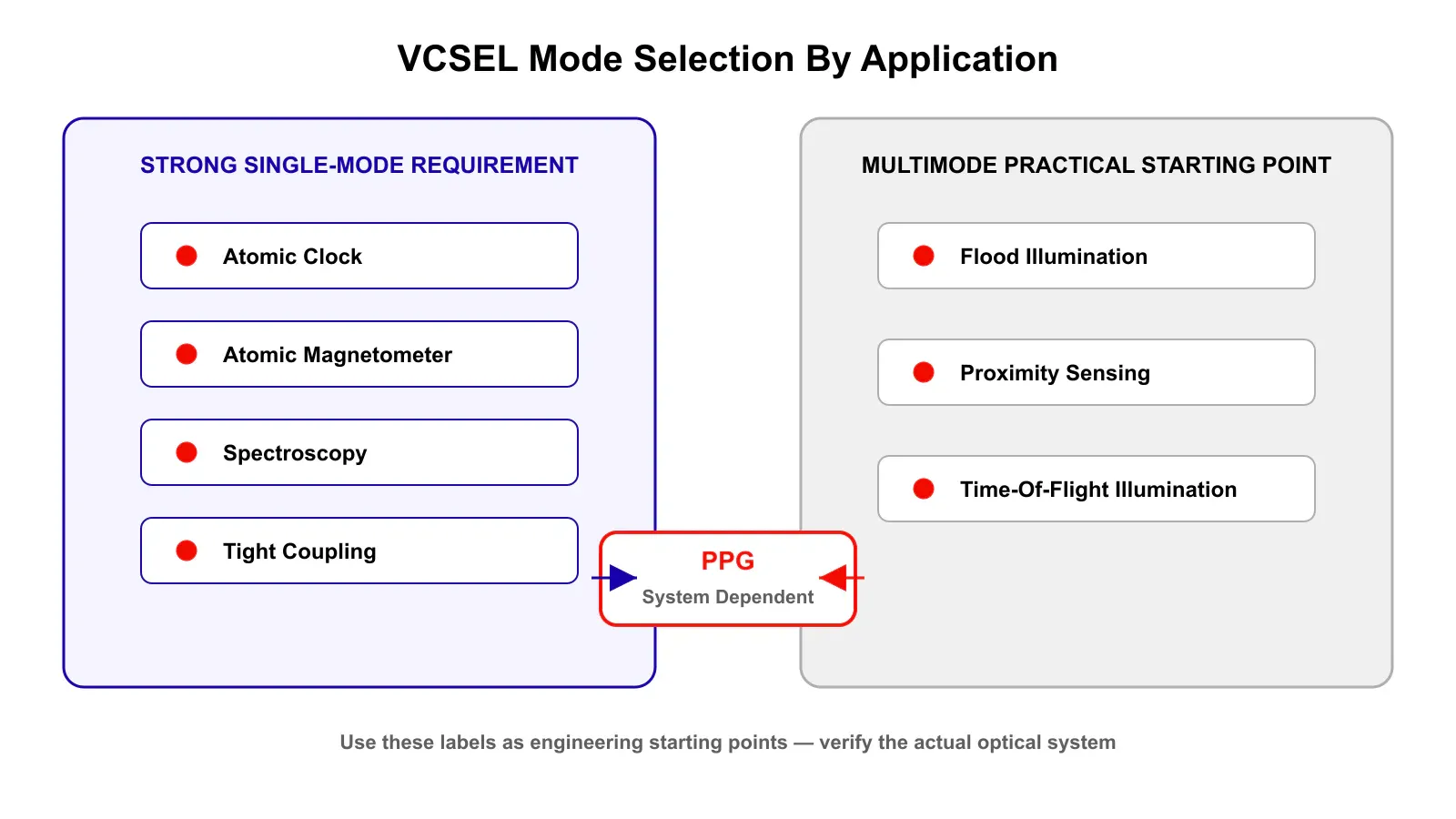
The word sensing covers too many architectures to make a category rule. Absorption spectroscopy, atomic sensing, interferometric detection, coherent metrology, and tight fiber coupling can create a real single-mode requirement, whereas proximity sensing, reflective detection, time-of-flight illumination, object detection, some encoder architectures, and many broad receiver systems may not. If the detector integrates light over a relatively large area and does not discriminate between transverse modes, extra beam purity may produce no measurable system benefit.
The specification should therefore start with the receiver acceptance condition. Define the detector area, numerical aperture where relevant, optical filter bandwidth, working distance, acceptable spot or field geometry, and required signal margin, then determine whether multimode behavior actually causes a loss.
Illumination and many health-sensing systems can often use multimode sources
For flood illumination, broad-area red or near-infrared delivery, and many reflective sensing systems, usable optical power and field uniformity can matter more than fundamental-mode purity.
A multimode VCSEL can therefore be entirely appropriate when the downstream optics mix or reshape the output and the receiver does not require a single spatial mode. The same logic applies to many health-sensing architectures. A photoplethysmography system, for example, ultimately cares about the optical signal returned to the photodetector after the complete tissue and mechanical path, so if a multimode emitter produces sufficient received signal, acceptable power consumption, stable wavelength behavior, and manageable thermal performance, single-mode output may not improve the device. That is not a rule that PPG should always use multimode, since some compact optical stacks or wavelength-sensitive systems benefit from a more controlled source. The proof is receiver performance in the finished module.
For flood-illumination and time-of-flight designs already at the sourcing stage, multimode VCSEL sources for sensing are the usual starting point. If the choice is still between source categories rather than VCSEL modes, make the VCSEL or LED comparison first.
Spectral width and transverse mode are related but not interchangeable
Another common mistake is treating single transverse mode as a guarantee of one exact spectral linewidth. Reducing the number of transverse modes can reduce spectral complexity, but linewidth, side-mode suppression, wavelength stability, and longitudinal-mode behavior still need their own specifications. A multimode device likewise has no universal spectral width, because aperture, current, temperature, cavity design, and the number of oscillating transverse modes all influence the measured spectrum.
When comparing candidates, use the same measurement definition. Comparing one supplier spectral FWHM against another supplier wavelength tolerance mixes two different quantities: one describes the width of emitted optical power around a spectral peak, the other defines where that peak is allowed to sit. A guide on how to read a VCSEL datasheet covers these distinctions in more detail.
System cost matters more than component price
A single-mode VCSEL can require a more restrictive device design and may deliver less power per emitting aperture than a multimode alternative. That can affect cost, but there is no defensible category rule that every single-mode part costs a fixed percentage more, so the system cost is the more useful comparison. For a precision optical path, a clean fundamental beam may reduce coupling losses, alignment margin, filtering requirements, or calibration work. For an illumination product, paying for that beam quality may buy nothing while forcing the design to use more emitters to reach the required power.
A practical cost model is:
system source cost = emitters + driver + optics + thermal design + assembly + calibration + test
Use the architecture with the lower cost at the required system performance, not the part with the lower or higher unit price.
Operating point can change the mode behavior
Mode selection is not a one-time label attached to a chip. As drive current rises, gain distribution, carrier density, refractive index, and junction temperature all change, so higher-order transverse modes that are suppressed near threshold may appear at another operating point. Thermal gradients can also modify lateral optical confinement, and a narrow-linewidth device can become more susceptible to mode hopping as temperature and current shift. A single line on a datasheet is therefore insufficient for a product that operates across a wide current or temperature range.
Ask for the range over which the specified modal behavior is maintained, then verify the part at the intended current, pulse condition, heat sinking, ambient temperature, and optical feedback condition of the finished device. This matters most when a product is driven harder in short pulses than in continuous operation.
Use this selection sequence before requesting samples
1. Define the optical interaction
Write down what receives the light. It may be an atomic vapor, a detector, a fiber, an aperture, a tissue target, a diffuser, a camera, or a free-space optical path.
2. Decide whether spatial mode purity changes a system metric
Identify the metric that would improve with single-mode operation. Examples include coupling efficiency, focused spot quality, interferometric contrast, atomic resonance signal, or receiver signal-to-noise ratio.
If there is no measurable metric, do not specify single mode by habit.
3. Set the required optical power at the target
Specify useful power after the actual optics rather than only emitter output.
4. Set spectral and polarization requirements separately
Define peak wavelength, tolerance, linewidth, side-mode suppression, tuning behavior, and polarization only where the application needs them.
5. Define the operating envelope
State CW or pulsed operation, drive current, duty cycle, ambient temperature, heat path, and any expected optical feedback.
6. Compare complete system cost
Include emitter count, driver, optics, alignment, cooling, calibration, and production test.
7. Evaluate both candidates in the actual optical stack
If both architectures remain plausible, measure them in the real system. Beam camera images are useful, but the final decision should follow target-plane power, receiver signal, temperature, stability, and production tolerance.
About 1ONEVCSEL
1ONEVCSEL is 1ONELASER's specialized product brand focused on VCSEL technology. It supplies selected single-mode and multimode VCSEL components across visible-red and near-infrared wavelength families for OEM and R&D evaluation, in available bare-die, packaged, and array configurations depending on the wavelength and project.
A useful evaluation request should state the target wavelength, required optical output, single-mode or multimode requirement, linewidth or SMSR requirement where relevant, beam requirement, polarization requirement, CW or pulsed operation, operating temperature, package preference, and prototype quantity.
If you are comparing single-mode and multimode sources for an OEM project, send us your wavelength, target optical power, beam requirement, operating mode, and package constraints and we identify suitable parts for evaluation before you freeze the optical architecture. Start with Request Evaluation Kits.
The finished-device manufacturer remains responsible for validating optical performance, thermal behavior, safety, regulatory requirements, and any application claims.
Frequently asked questions
Is a single-mode VCSEL always better than a multimode VCSEL
No. Single mode is better only when the application benefits from fundamental-mode beam quality, spectral behavior, polarization control, coupling, or another mode-dependent property. Multimode is often the better engineering choice when useful optical power and illumination matter more.
Does a multimode VCSEL always have more power
Not as a universal specification. Multimode architectures can support a larger active aperture and high optical output, which is why they are common in high-power illumination and sensing. Actual power still depends on wavelength, device architecture, drive condition, array size, and thermal limits.
Does single mode mean narrow linewidth
Not automatically. Transverse mode, longitudinal mode, linewidth, SMSR, and polarization are different parameters. A precision application should specify and measure each requirement it actually depends on.
Can a multimode VCSEL still be single longitudinal mode
Yes. In VCSEL terminology a device can operate in a single longitudinal mode while supporting several transverse modes, which is common in conventional short-cavity parts. This is why a datasheet that only says single mode should be checked for the exact modal definition before you rely on it.
Which VCSEL mode is better for atomic clocks
Single-mode operation is normally required because the source must interact cleanly with a narrow atomic transition. Atomic-clock qualification also depends on linewidth, polarization, wavelength tuning, modulation response, noise, and stability over temperature and current.
Which VCSEL mode is better for illumination
Multimode VCSELs are often a practical starting point for flood illumination, time-of-flight illumination, proximity sensing, and other systems where high optical output matters more than a fundamental Gaussian beam. The finished field still needs to be validated at the target plane.
Can I decide from the datasheet alone
No. A datasheet can shortlist a part, but mode stability, useful optical power, beam distribution, coupling, thermal behavior, and receiver performance should be tested under the operating conditions of the real device.